
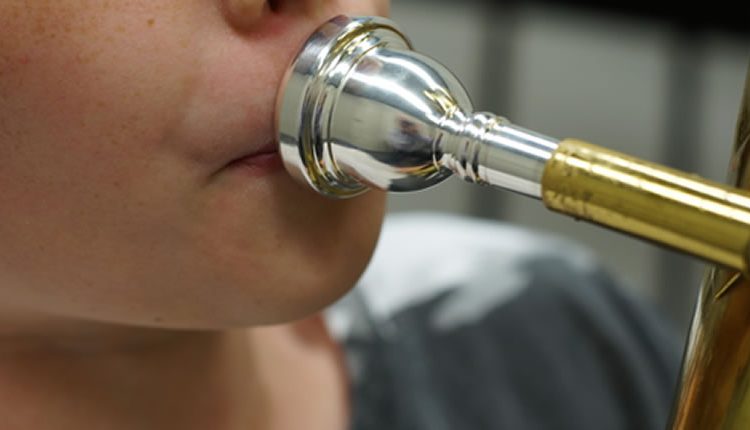
When equipment supports your technique, progress becomes simpler and more consistent. Trombone mouthpieces play an important role in how your instrument feels and responds. Although they do not create skill, they strongly influence tone quality, comfort, endurance, and efficiency. Because of this, many trombone players spend years searching for the “right” mouthpiece without understanding what it actually does.This guide explains how trombone mouthpieces work, how their design affects your playing, and how to choose one that supports your musical goals. Whether you are a beginner or an experienced player, understanding these fundamentals will help you make confident and informed choices. Read this article and study the information provided for you in choosing your next trombone mouthpiece.
Let’s get started!
Disclaimer
This article contains Amazon Affiliate Links. What this means, is that, at no cost to you, if you click a link and follow through with a purchase, this site may earn a small commission.
What a Trombone Mouthpiece Does
The trombone does not create sound on its own. The sound begins in the mouthpiece, where your lips buzz and set the air in motion. The trombone then takes that vibration and amplifies it helping it carry through the room. If the mouthpiece helps your buzz stay steady, the trombone can amplify a clear sound. If the mouthpiece is uncomfortable or poorly made, the instrument will simply amplify an unfocused sound.
Think of it this way:
The mouthpiece starts the sound, and the trombone helps that sound grow.
Use this guide as a foundation. Then explore the Trombone Mouthpiece Comparison Chart to learn how specific designs affect your playing. When equipment supports your technique, progress becomes simpler and more consistent.
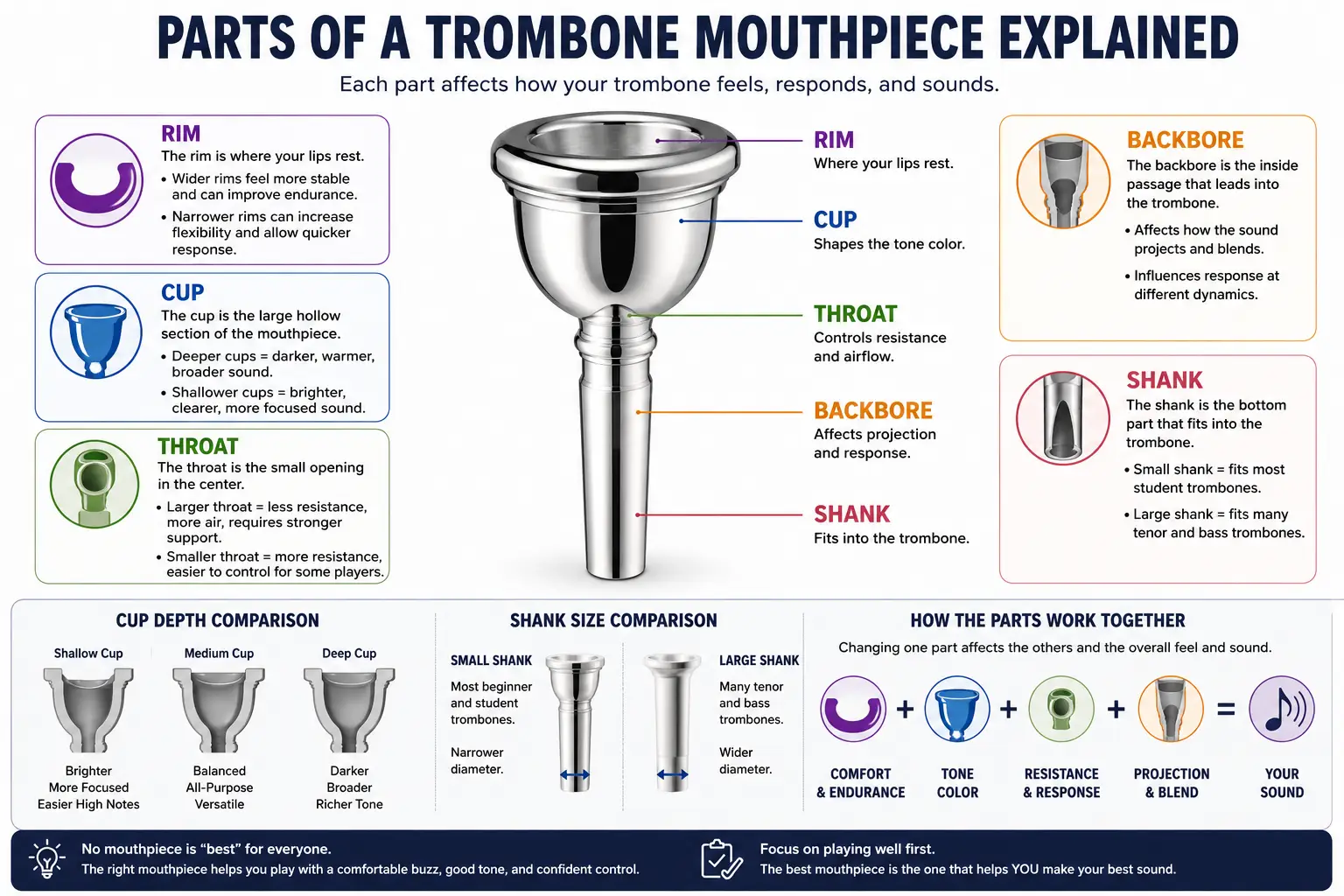
Parts of a Trombone Mouthpiece Explained
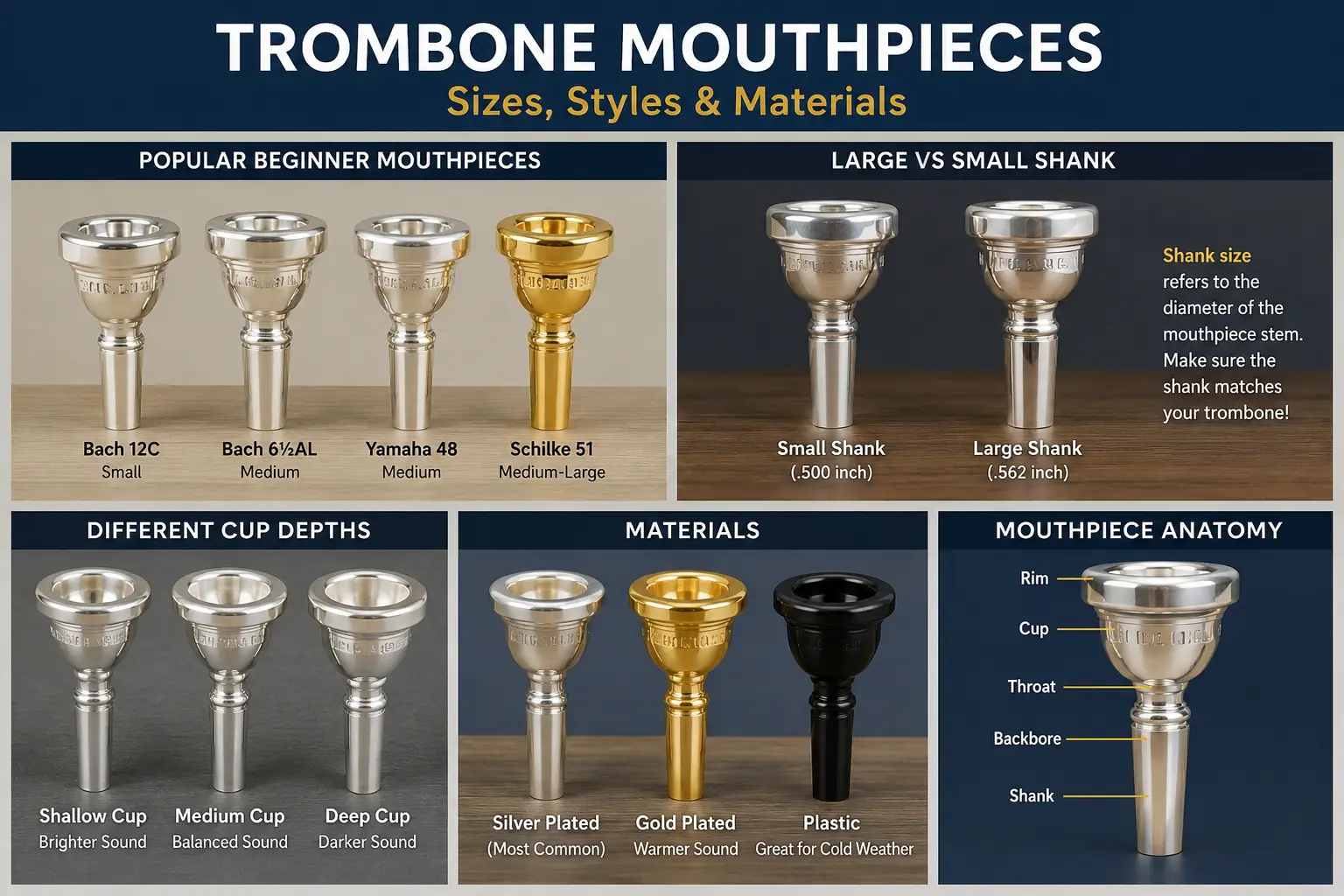
Understanding the basic parts of a trombone mouthpiece can make choosing the right one much less confusing. Even though mouthpieces may look simple, each part changes how the trombone feels and sounds. Small changes can make a big difference in comfort, tone, endurance, and range.
Rim
The rim is the part of the mouthpiece where your lips rest.
The shape and width of the rim affect comfort, flexibility, and endurance while playing.
- A wider rim often feels more comfortable and stable, especially during long rehearsals or concerts. Many students like wider rims because they can help reduce lip fatigue.
- A narrower rim may allow quicker flexibility and easier movement between notes, but some players find it less comfortable over long periods of time.
No rim size is perfect for everyone. What feels comfortable for one student may feel awkward to another. This is one reason why trying different mouthpieces can be helpful as you improve.
Cup
The cup is the large hollow section inside the mouthpiece.
Cup depth has a major effect on tone quality.
- A deeper cup usually creates a darker, warmer, and fuller sound. Many concert band and symphonic players prefer deeper cups because they produce a rich tone.
- A shallower cup tends to create a brighter, clearer, and more focused sound. Some jazz players prefer shallower cups because they can help with upper notes and projection.
Beginning students do not need to worry about finding the “perfect” cup depth right away. Most school band mouthpieces are designed to give students a balanced sound while they develop good playing habits.
Throat
The throat is the small opening in the center of the mouthpiece that air passes through.
The size of the throat affects resistance and airflow.
- A larger throat allows more air to move through the instrument. This can produce a bigger sound, but it also requires stronger breath support and control.
- A smaller throat creates more resistance. Some players feel this makes the instrument easier to control, especially in the upper register.
For younger players, too large of a throat can sometimes make the trombone feel harder to play because it requires more air support.
Backbore
The backbore is the inside section of the mouthpiece that leads into the trombone.
Even though students may not notice it immediately, the backbore affects how the instrument responds and projects sound.
- Some backbores create a more open, broad sound.
- Others create a more focused and centered sound.
The backbore also affects how easily the trombone responds at soft and loud dynamics. Professional players often pay close attention to backbore design when choosing advanced mouthpieces.
Shank
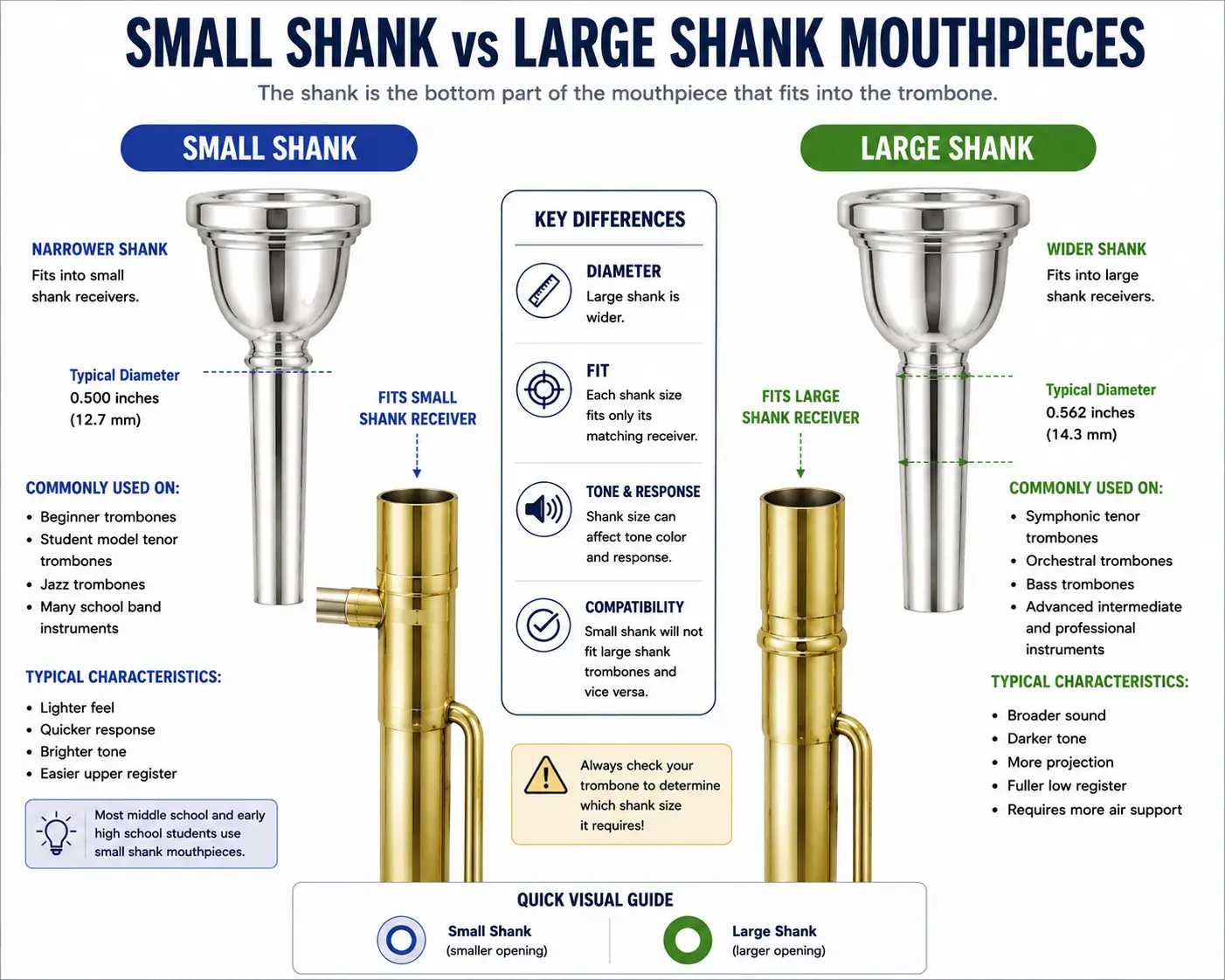
The shank is the bottom part of the mouthpiece that fits into the trombone.
Trombone mouthpieces come in different shank sizes, and using the wrong size can cause playing problems.
The two most common types are:
- Small shank
- Large shank
Most beginner trombones use small shank mouthpieces, while many larger tenor and bass trombones use large shank mouthpieces.
Before buying a new mouthpiece, students should always make sure it matches their instrument.
How the Parts Work Together
Each part of the mouthpiece works together with the others. Changing one feature affects the entire playing experience.
For example:
- A deeper cup combined with a large throat may create a huge sound, but it may also require more air and endurance.
- A shallow cup with a smaller throat may make high notes easier, but the tone could become brighter and thinner.
Because of this, mouthpiece selection is always about balance. The “best” mouthpiece is not necessarily the biggest, smallest, deepest, or most expensive. The best mouthpiece is the one that helps a player produce a comfortable, consistent, and healthy sound.
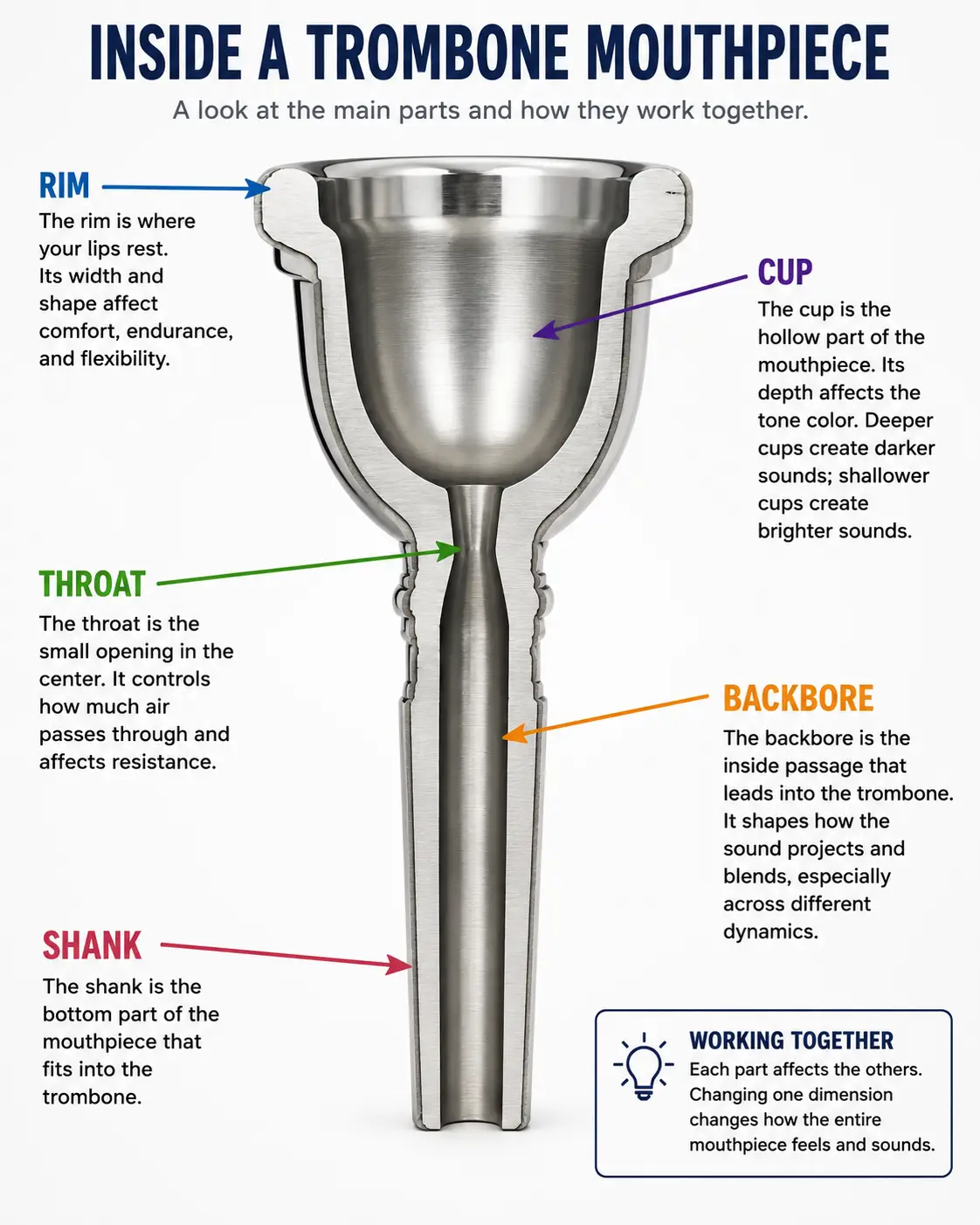
How Trombone Mouthpieces Affect Your Tone
A trombone mouthpiece plays a much bigger role in tone production than most players initially realize. While the instrument itself shapes overall character and projection, the mouthpiece is the first point of contact for your sound—and even small changes in its design can noticeably alter Trombone Tone response, and control.
Larger mouthpieces can support a broader sound when paired with efficient air and embouchure control. Without that support, they often feel unfocused and tiring. Smaller mouthpieces may feel easier to play, yet they can limit tonal depth if they restrict airflow.
Tone quality depends more on consistency than size. A centered sound comes from steady air and a clear sound concept. The mouthpiece simply supports that process.
For most players, the best mouthpiece size allows clarity, control, and endurance, not just volume or width of sound.
Refer to my Complete A-Z Music Glossary for more musical terms.
Small Bore vs Large Bore Trombones
Mouthpiece choice should always match the instrument.
A small bore trombone is typically a tenor trombone. The inner tubing diameter or bore size is measured between .480″ and .509″. The bell size is usually 6.5″ to 8″. A small bore trombone plays best with a slightly smaller mouthpiece. These combinations encourage quick response, clarity, and flexibility, especially in jazz and commercial settings.
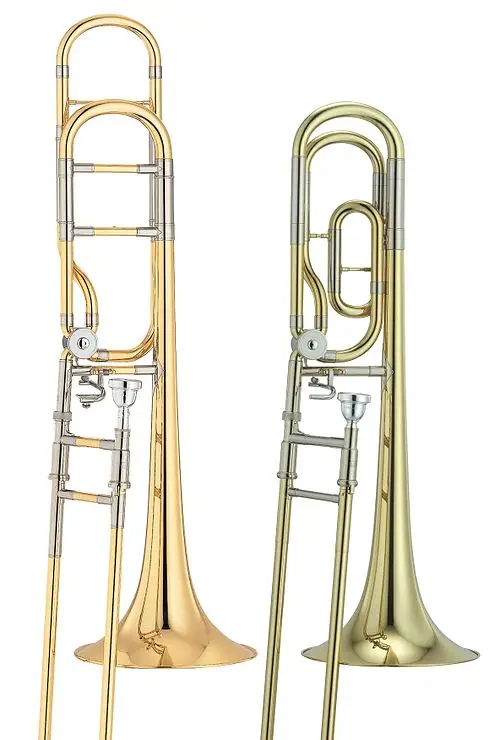
A large bore trombone is one that features an F Attachment (trigger) for extended low range, distinguishing it from smaller bores used in jazz. This type trombone has an inner slide diameter of around .547″. This give the instrument a darker and fuller sound for orchestra and concert band playing. Large bore trombones typically require larger mouthpieces to support increased airflow. This pairing helps produce a fuller sound and better blend in orchestral and wind ensemble playing.
When the mouthpiece does not match the instrument, response often suffers. In contrast, matched equipment feels balanced and predictable.
Small Shank vs Large Shank Mouthpieces
Small Shank Mouthpieces
A small shank mouthpiece has a narrower taper designed to fit smaller receivers typically found on many of the straight tenor trombones. This is the most common starting point for new players.
Which Trombones Use Small Shank Mouthpieces?
Small shank mouthpieces are usually used with:
- Student trombones
- Beginner tenor trombones
- Many professional and commercial tenor trombones
If you purchased a starter trombone, there’s a very good chance it uses a small shank.
Characteristics of Small Shank Mouthpieces
Small shank mouthpieces are known for being:
- Easy to play
- Responsive
- Efficient with less air
They tend to produce a brighter, more direct tone that works well in many playing situations, especially for beginners.
Large Shank Mouthpieces
A large shank mouthpiece has a wider taper designed to fit larger receivers found on more advanced trombones.
These are typically used by intermediate and advanced players.
Which Trombones Use Large Shank Mouthpieces?
Large shank mouthpieces are commonly used with:
- Intermediate tenor trombones
- Professional trombones
- F-attachment (trigger) trombones
- Bass trombones
If your trombone has an F-attachment, it almost always uses a large shank mouthpiece.
Characteristics of Large Shank Mouthpieces
Large shank mouthpieces are designed for:
- A darker, fuller sound
- Greater projection
- More tonal flexibility
They require more air support but reward the player with a richer, more powerful tone.
Popular Trombone Mouthpieces Compared
Below is a chart of the popular and quality made trombone mouthpieces on the market. These manufacturers are the best as they are the specialists in this field. Please note that there are many other companies that produce mouthpieces for trombone that are very poorly made. They are very low prices because of the quality of the metal and they do not meet the specifications outlined in this article. Don’t be fooled! Click on a mouthpiece link to check a price from Amazon.
Trombone Mouthpiece Chart
| Brand & Model | Rim / Cup / Throat / Backbore | Best For | Key Benefits |
|---|---|---|---|
| Bach 12C | Rim ≈ 24.50 mm · Medium cup · Medium-wide rim · Throat ≈ 5.85 mm · Backbore #402 | Students → professionals · All-around use | Balanced response · Comfortable rim · Extremely versatile and widely trusted |
| Bach 7C | Rim ≈ 24.75 mm · Shallow-medium cup · Medium-wide rim | Lead playing · Higher register | Bright, focused tone · Easier upper range · Flexible articulation |
| Bach 6½AL | Medium-wide rim · Medium-deep cup · Open “G” throat · Backbore #420 | Beginner -Intermediate – Concert band & orchestral | Warm, full tone · Strong low register · Broad dynamic range |
| Schilke 51D | Rim ≈ 25.55 mm · Medium-large cup · Throat ≈ 7.03 mm · Standard backbore | Advanced players · Euphonium doubling | Very full, dark tone · Strong projection · Stable rim for endurance |
| Schilke 52E2 | Narrower rim · Very deep E-cup · Open throat · Deep backbore | Symphony & solo repertoire | Enhanced low-register projection · Big orchestral sound |
| Denis Wick Classic (e.g., DW5880) | Classic Wick rim · Medium-deep cup · Consistent backbore | Intermediate → advanced · General playing | Clear articulation · Flexible response · Reliable craftsmanship |
| Denis Wick Heritage 6BL | Larger rim & cup · Tailored backbore | Strong players · Orchestral | Full, rich tone · Strong projection · Easy mid-range response |
| Yamaha SL48L (Large Shank) | Rim ≈ 25.25 mm · Standard cup · Throat ≈ 6.62 mm · Semi-narrow backbore | Large-shank trombones | Versatile response · Blend of flexibility and power |
What Do The Numbers Mean on a Mouthpiece?
One of the most confusing things for beginner trombone players is understanding mouthpiece numbers. At first glance, names like Bach 6½AL or Bach 12C can seem completely random. However, once you understand the system, mouthpiece sizes become much easier to compare.
Understanding the Bach Mouthpiece Sizing System
The Bach mouthpiece system is one of the most commonly used sizing systems in the trombone world. Many other brands also use similar numbering ideas.
Here is the most important thing beginners need to know:
Smaller Numbers = Larger Mouthpieces
This confuses many new players.
For example:
- A Bach 4G is larger than a Bach 6½AL
- A Bach 6½AL is larger than a Bach 12C
So even though the number gets smaller, the mouthpiece itself gets bigger.
In general:
- Larger mouthpieces produce a bigger, darker, fuller sound
- Smaller mouthpieces can make high notes easier and create a brighter sound
However, larger mouthpieces also require more air and strength to control comfortably.
What the Numbers Usually Indicate
The number mainly refers to the diameter of the rim and cup size.
Smaller Number
Usually means:
- wider rim diameter
- larger cup
- bigger overall mouthpiece
Larger Number
Usually means:
- smaller rim diameter
- shallower cup
- smaller overall mouthpiece.
For Example:
|
Mouthpiece |
General Size |
| Bach 4G | Large |
| Bach 5G | Medium-Large |
| Bach 6½AL | Medium |
| Bach 12C | Small |
Not sure which mouthpiece fits YOU?
Get personalized guidance with private lessons
ONLINE TROMBONE LESSONS – Learn Anywhere with a Private Trombone Teacher
What Do The Letters Mean?
The letters after the numbers describe certain design characteristics of the mouthpiece.
Here are some common Bach letters beginners may see:
|
Letter |
Meaning |
| C | Medium cup depth |
| G | Deep cup |
| AL | Larger throat and deeper design commonly used on trombone |
For example:
Bach 6½AL
This is one of the most popular beginner and student trombone mouthpieces because it offers:
- balanced tone
- comfortable size
- good flexibility
- easier low range development
Trombone Mouthpieces for Different Skill Levels
Skill level plays an important role in mouthpiece selection.
Beginners benefit from mouthpieces that encourage comfort, flexibility, and easy response. Extremely large or specialized mouthpieces often slow early progress. One of the best choices for a trombone beginner is the Bach 12C.
Intermediate players may begin refining their sound and adjusting equipment for ensemble needs. At this stage, thoughtful changes can help. However, frequent switching rarely produces long-term improvement.
Advanced players often choose mouthpieces for specific musical situations. Even then, consistency remains more valuable than constant experimentation.
A mouthpiece should support your current abilities, not your future expectations.
Frequently Asked Questions (FAQ): Trombone Mouthpieces
Choosing the right trombone mouthpiece can raise many questions, especially for beginners and parents. Here are answers to some of the most common questions players ask.
What size mouthpiece should a beginner use?
Most beginners do best with a medium-sized mouthpiece, such as a 12C or 6 1/2 AL. These provide a good balance of comfort, control, and ease of tone production while the embouchure is still developing.
Is a 6½AL bigger than a 12C?
Yes. A 6½AL has a wider and deeper cup than a 12C. This makes it more suitable for players who need a fuller sound, while a 12C is typically smaller and easier for beginners to control.
What mouthpiece do professionals use?
Professionals use a wide range of mouthpieces depending on their style and role. Common choices include the 5G, 6½AL, and custom variations. Larger mouthpieces are often used for orchestral playing, while smaller ones may be preferred for lead or commercial work.
Does a larger mouthpiece make low notes easier?
Generally, yes. Larger mouthpieces tend to support a fuller airflow and can make lower notes feel more open and resonant. However, they may require more strength and control in the upper register.
Can I use a euphonium mouthpiece on trombone?
No, a euphonium mouthpiece is not designed for trombone shank sizes or acoustics. Attempting to use one can damage fit, tuning, and tone production.
How often should I replace a mouthpiece?
Mouthpieces don’t need regular replacement unless they become damaged, dented, or worn. With proper care, a quality mouthpiece can last many years or even a lifetime.
Does a bigger mouthpiece make you sound better?
Not necessarily. A larger mouthpiece can produce a fuller, darker tone, but it also requires more air support and embouchure strength. Many players actually sound better on a mouthpiece that matches their current skill level rather than simply choosing a larger size.
Do professional trombone players use different mouthpieces than beginners?
Yes. Professional players often use mouthpieces tailored to their musical needs, such as orchestral, jazz, or solo performance. However, many professionals still use medium sizes similar to student models. Skill and practice matter far more than equipment alone.
Does mouthpiece material matter?
Most trombone mouthpieces are made of silver-plated brass, which works very well for nearly all players. Some players prefer gold plating for comfort or allergy reasons, but the difference in sound is usually subtle compared to factors like size and shape.
Can changing my mouthpiece improve my range?
A mouthpiece can influence range slightly, but it is not a shortcut to higher notes. Range improvement primarily comes from proper technique, airflow, and consistent practice. A comfortable mouthpiece simply makes development easier.
Is an Expensive Mouthpiece Worth It?
Not always. Many affordable mouthpieces perform extremely well. A more expensive mouthpiece does not automatically make a player sound better. Comfort, fit, and technique are far more important than price.
When a Mouthpiece Change Helps – and When It Doesn’t
Sometimes, changing a trombone mouthpiece makes sense.
A change may help when:
- You switch instruments
- Your primary musical setting changes
- Your current mouthpiece causes ongoing discomfort
However, a change rarely helps when:
- Range feels unreliable
- Tone lacks consistency
- Endurance problems appear suddenly
In these cases, technique and practice habits deserve attention first.
Most trombone players benefit from fewer mouthpiece changes, not more.
Trombone Mouthpieces and Breathing Through a Straw
Learning to play the trombone on a poorly made mouthpiece is like trying to breathe through a bent, bargain-bin straw.
Yes, technically, air still goes through it. If you work hard enough, you can make it function. But the resistance is inconsistent, the airflow feels unpredictable, and you spend more time adjusting how you breathe than actually learning to breathe well.
A well-made mouthpiece is like breathing through a smooth, properly shaped straw. Air moves consistently and naturally. You don’t have to force it, fight it, or compensate for random resistance. You just breathe—and focus on tone, phrasing, and musical control.
Here is Where Quality Matters.
Cheaper mouthpieces are often made with lower-grade materials, thinner plating, and looser manufacturing tolerances. That means the rim may not be perfectly shaped, the cup depth may vary slightly from piece to piece, and the throat and backbore may not be machined to precise specifications. In other words, the “straw” isn’t quite straight.
Top manufacturers adhere to consistent design specs, better materials, and tighter quality control. They’re not doing this to sound fancy—they’re doing it so the mouthpiece behaves the same way every time you play it.
The mouthpiece doesn’t give you better lungs. It doesn’t give you better tone. But it does remove unnecessary obstacles. And for a beginner, fewer obstacles means fewer bad habits, less frustration, and a much better chance of enjoying the learning process.
Or put another way:
You can learn to play through a crooked straw… but why would you, if you don’t have to?
Ready to Sound Better on Trombone Faster?
Choosing the right mouthpiece is an important step — but the biggest improvement always comes from proper guidance and consistent practice. In private lessons, you’ll learn how to match your equipment to your playing style, develop a stronger embouchure, and produce a richer, more confident tone.
Whether you’re a complete beginner or looking to improve your sound, personalized instruction can save you months (or even years) of frustration.
Interested in private trombone lessons?
I offer one-on-one lessons designed to help students:
- Play with a full, clear tone
- Improve range and endurance
- Develop correct breathing and embouchure habits
- Gain confidence quickly
ONLINE TROMBONE LESSONS are available and tailored to each student’s goals and experience level.
Final Thoughts on Trombone Mouthpieces Explained
Trombone mouthpieces influence how easily your sound develops, but they do not replace solid fundamentals. When chosen carefully, they support tone, endurance, and musical confidence. The information in this article goes “hand-in-hand” with the mechanics of How to Play a Trombone: Beginner Step-by-Step Guide.
About the Author
Rick Lawrence is a music educator, conductor, professional trombonist, and private instructor with more than 40 years of playing and teaching experience. He has performed with orchestras, jazz ensembles, brass bands, and pit orchestras. Rick studied with John Coffey of the Boston Symphony Orchestra, Donald Knaub of the University of Texas, and composer, arranger, trombonist – Edward J. Madden.
Through The Trombone Mentor, Rick provides online trombone lessons and educational resources for beginner, intermediate, and advanced trombonists.
Related Trombone Articles
Trombone Practice Mutes: A Complete Guide
The Best Warm-Up Routine for Trombone Players
Staccato vs Legato: Understanding Trombone Articulation
How to Practice Trombone Effectively