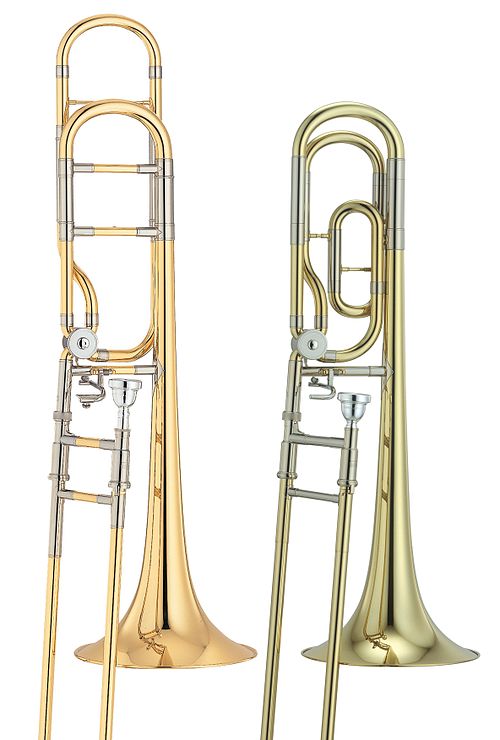
An F attachment trombone is one of the most important upgrades a player can make after learning the basics on a straight tenor trombone. It adds a valve (trigger) that lowers the instrument into F, giving you a wider range, easier alternate slide positions, and smoother access to low notes used in band and orchestral music. If you’re wondering whether you need an F attachment trombone, the answer depends on your playing level, musical goals, and the type of ensembles you perform in. In this complete guide, you’ll learn exactly how the F attachment works, when it becomes useful, and how to choose the best model for your needs in 2026.
Let’s get started!
Disclaimer
This article contains Amazon Affiliate Links. What this means, is that, at no cost to you, if you click a link and follow through with a purchase, this site may earn a small commission.
What Is an F Attachment Trombone?
An F attachment trombone is a tenor trombone that includes a valve system (activated by a thumb trigger) which reroutes air through extra tubing, lowering the instrument’s pitch from B♭ to F. This extension expands the low range of the trombone and provides alternate slide positions that make technical passages easier to play. Most F attachment trombones are used in concert band, orchestra, and advanced ensemble settings where lower notes and improved flexibility are required.
How an F Attachment Trombone Works
When the trigger is pressed, the valve redirects air through additional tubing, effectively lengthening the instrument. This lowers the pitch and changes available slide positions. Instead of relying only on extended slide reaches, players can use the F attachment to move more efficiently between notes, especially in the lower register. In simple terms, the slide controls pitch placement, while the F attachment provides alternate, more efficient routes to those notes.
A useful analogy:
- The slide determines where the notes are
- The F attachment determines how efficiently you get there
This makes difficult passages more manageable and reduces excessive slide movement.
Why Trombonists Use F Attachment Trombones
Players choose F attachment trombones for musical and practical reasons:
- Access to low C, B natural, and pedal register notes
- Alternate positions for tuning problem notes
- Less slide travel in fast technical music
- More flexibility in ensemble playing
Used wisely, the F attachment is a tool—not a crutch.
Musical Situations Where an F Attachment Trombone Excels
- Orchestral repertoire (many parts assume low notes)
- Wind ensemble & symphonic band
- Brass quintet and chamber music
- Advanced jazz or commercial writing
Straight trombones still have a place—but the F attachment often simplifies demanding music.
F Attachment Trombone vs Straight Tenor Trombone
One of the most common questions players ask is how an F attachment trombone compares to a straight tenor trombone. While both instruments are built on the same basic design, the addition of the F attachment changes how the instrument functions in lower ranges and technical passages.
A straight trombone is lighter, simpler, and easier for beginners to manage. It uses only slide positions to change pitch, which makes it ideal for learning fundamentals such as tone production, slide accuracy, and basic music reading. Many jazz players also prefer straight trombones because of their lighter feel and direct response.
An F attachment trombone, on the other hand, includes a valve system that extends the instrument into a lower key when the trigger is engaged. This gives players access to additional low notes and alternate slide positions, which reduces the amount of slide movement required in more advanced music. It is especially useful in concert band, wind ensemble, and orchestral settings where low-register playing is common.
In short, the straight trombone is designed for simplicity and early development, while the F attachment trombone is designed for expanded range, flexibility, and advanced performance demands.
| Feature | Straight Trombone | F Attachment Trombone |
|---|---|---|
| Weight | Lighter | Heavier |
| Learning Curve | Easier for beginners | Moderate |
| Low Range | Limited | Extended |
| Slide Travel | More movement required | Reduced movement with trigger |
| Best For | Beginners, jazz lead | Concert band, orchestra, advanced players |
| Cost | Lower | Higher |
Benefits of an F Attachment Trombone
An F attachment trombone offers several important advantages that become more noticeable as players move into intermediate and advanced music. While a straight tenor trombone is excellent for learning fundamentals, the addition of a trigger system expands both technical and musical possibilities.
1. Extended Low Range
One of the biggest benefits is access to lower notes such as low C, B natural, and pedal tones. These notes are common in concert band and orchestral music, and the F attachment allows players to reach them more comfortably without extreme slide positions.
2. Alternate Slide Positions
The F attachment provides additional slide options for many notes. This reduces the need for long slide movements, making fast passages easier to play and improving overall accuracy and intonation.
3. Improved Technical Efficiency
Because fewer large slide shifts are required, technical passages feel more manageable. This is especially helpful in advanced band literature where speed and clarity are required.
4. Better Intonation Options
Certain notes on the trombone naturally sit slightly sharp or flat in extended positions. The F attachment gives players alternate positions that often improve tuning consistency.
5. Greater Musical Flexibility
An F attachment trombone allows players to adapt more easily to different musical settings, including concert band, orchestra, brass ensembles, and advanced solo repertoire.
In summary, the F attachment is not about making the trombone easier—it’s about making advanced music more efficient, flexible, and controlled for developing and professional players.
Who Should Play an F Attachment Trombone?
An F attachment trombone is not necessary for every player right away, but it becomes increasingly valuable as musical demands grow. The right time to switch depends on a player’s experience level, technical control, and the type of music they are performing.
Beginners
Most beginners are better served starting on a straight tenor trombone. At this stage, the focus should be on developing core fundamentals such as tone production, slide accuracy, breath control, and reading music. Adding a trigger too early can create unnecessary complexity before these basics are secure.
Intermediate Players
This is often the ideal stage to consider an F attachment trombone. As students enter advanced middle school or high school ensembles, they begin encountering music with lower notes, faster passages, and more demanding technical requirements. At this level, the F attachment becomes a practical tool that improves efficiency and expands musical capability.
Advanced and Professional Players
For advanced players, an F attachment trombone is often essential. Concert band, wind ensemble, orchestra, and many college-level programs expect players to handle low-register passages and complex orchestral parts. In these situations, the trigger is not optional—it is part of standard performance practice.
In general, the F attachment should be seen as a progression tool. It does not replace strong fundamentals, but it supports players as their musical responsibilities increase.
Valve Types Explained
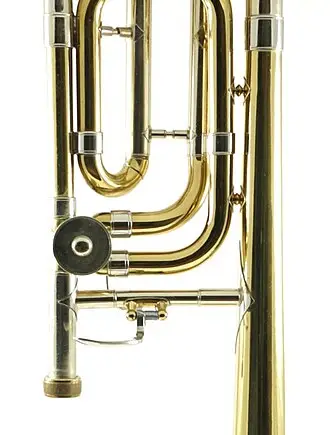
The valve system on an F attachment trombone plays a major role in how the instrument responds when the trigger is engaged. While all F attachments serve the same purpose—redirecting air through additional tubing—the type of valve affects airflow, resistance, and overall playing feel.
Rotary Valve (Traditional Design)
The rotary valve is the most common system found on student and many intermediate trombones. When the trigger is pressed, a rotor turns to redirect air through the F attachment tubing. This design is reliable and widely used, but it introduces a slight bend in airflow, which can create a bit more resistance compared to modern alternatives.
Axial Flow (Thayer-Style) Valve
The axial flow valve is designed for smoother airflow with fewer sharp directional changes. Instead of forcing air around tight turns, it allows a more direct path through the instrument. Many advanced and professional players prefer this design because it feels more open and responsive, especially in fast or technical passages.
Hagmann Valve
The Hagmann valve is a modern hybrid design that aims to balance smooth airflow with mechanical efficiency. It reduces airflow disruption while maintaining durability and consistent response. Many professional orchestral trombonists favor this system for its stability and even feel across all registers.
In general, valve choice affects feel more than pitch. The tubing still determines the fundamental key change, but the valve system influences how freely the instrument responds when the trigger is used.
When exploring F attachment trombones, it’s important to understand that not all F attachments are created equal. While the purpose is the same — adding extra tubing to lower the instrument’s pitch and expand playing options — the type of valve and the wrap of the tubing can have a noticeable effect on feel, response, and airflow.
Wrap Styles Explained
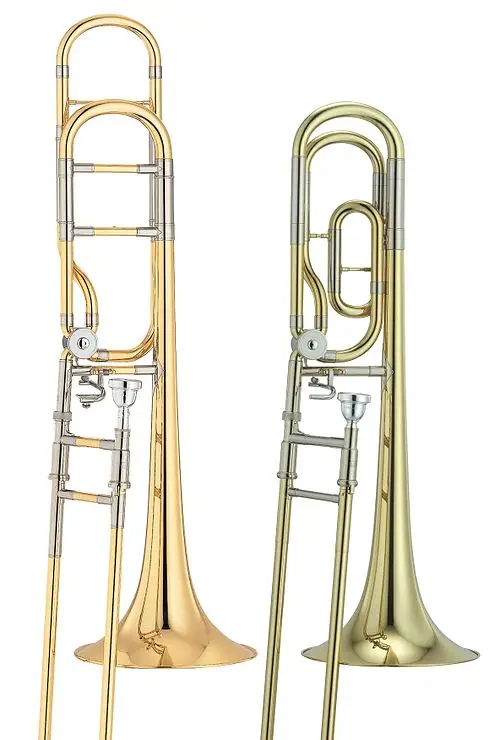
The wrap of an F attachment trombone refers to how the extra tubing is physically arranged around the instrument. While the wrap does not change the pitch of the trombone, it can influence airflow feel, instrument balance, and overall playing comfort.
Closed Wrap (Traditional Design)
In a closed wrap design, the F attachment tubing is tightly coiled around the main body of the trombone. This creates a compact and sturdy layout that many players find stable and familiar. However, because the air must travel through more compact bends, it can feel slightly more resistant when the trigger is engaged.
Open Wrap
An open wrap design uses wider, more gradual tubing curves with fewer tight bends. This allows air to flow more freely through the instrument, which many players describe as a more open and responsive feel. Open wrap trombones are especially popular in orchestral and advanced ensemble settings where fluidity and ease of response are important.
Hybrid / Modified Wrap
Hybrid or modified wrap designs combine elements of both closed and open systems. These instruments aim to balance airflow efficiency with compactness and playability. Many modern manufacturers use this approach to improve comfort while maintaining control and stability.
In Summary
While wrap style does not affect pitch, it does influence how the instrument feels in your hands and how freely air moves through the F attachment. Choosing the right wrap is often a matter of personal preference, playing style, and comfort.
Choosing the Right Mouthpiece For an F Attachment Trombone
An F-attachment trombone does not require a special mouthpiece, but the mouthpiece you choose can have a significant impact on tone, range, response, and endurance. Most intermediate and advanced F-attachment trombones use a large-shank mouthpiece, while many beginner and intermediate straight trombones use a small-shank mouthpiece. Before purchasing a new mouthpiece, be sure to confirm which shank size your instrument requires.
For middle and high school students, a Bach 6½AL or similar medium-sized mouthpiece is often a popular choice because it provides a balanced sound and works well in concert band, wind ensemble, and solo settings. Some younger players may begin on a 12C and later move to a larger mouthpiece as their embouchure develops and their musical demands increase. Read my article: Trombone Mouthpiece Comparison Chart
Best F Attachment Trombones (2026)
Choosing the best F attachment trombone depends on your playing level, budget, and musical goals. Some models are designed for developing students, while others are built for advanced orchestral or professional performance. Below are some of the most reliable and widely recommended options for 2026.
Best Starter F Attachment Trombone
Yamaha YSL- 446G
The Yamaha YSL-446G is a strong entry-level F attachment trombone designed for developing players transitioning from a straight tenor trombone. Its medium-large bore makes it easier to control while still offering the benefits of a trigger system. It is known for its consistent response, durability, and ease of play in school ensembles.
Best Intermediate Upgrade
Yamaha YSL-448G
The Yamaha YSL-448G is one of the most popular step-up trombones for advancing students. With a larger bore and fuller sound, it supports stronger air development and more demanding repertoire. This model is commonly used in high school and pre-college band and orchestra settings.
Best Professional Standard
Conn 88H
The Conn 88H is one of the most respected professional F attachment trombones in the orchestral world. It is known for its warm tone, strong projection, and dependable performance in large ensemble settings. Many professionals consider it a long-term standard instrument.
Best Traditional Orchestral Option
Bach 42B / 42BO
The Bach 42 series is a long-standing benchmark in the trombone world. It delivers a rich, centered tone with excellent projection. The open wrap version (42BO) offers a more free-blowing feel, making it a favorite among orchestral players.
Best Value Upgrade
Getzen 547 Capri
The Getzen 547 Capri provides a strong balance between quality and affordability. It offers professional-style features at a more accessible price point, making it a solid option for advancing students who want long-term durability.
Best Modular / Modern Design
S.E. Shires Q Series
The Shires Q Series is designed with flexibility and customization in mind. These instruments offer excellent response and balance, making them popular among advanced students and professionals who want a more modern playing experience.
Choosing the Right Model
When selecting an F attachment trombone, consider:
- Your current skill level
- Bore size and air requirements
- Valve and wrap preference
- Musical setting (band, orchestra, jazz)
- Budget and long-term goals
The best instrument is not always the most expensive one—it’s the one that matches your playing needs and helps you progress efficiently.
Best F-Attachment Trombones (Quick Comparison)
| Model | Level | Bore | Best For |
|---|---|---|---|
| Yamaha YSL-446G | Intermediate | .525″ | Middle / High School |
| Yamaha YSL-448G | Intermediate | .547″ | Middle / High School |
| Bach 42B | Professional | .547″ | Orchestral players |
| Conn 88H | Professional | .547″ | High School – Pro |
| Getzen 547 Capri | Intermediate | .547″ | Middle / High School |
| S.E. Shires Q Series | Advanced | .547″ | Symphony-level playing |
| Yamaha YSL-882O | Professional | .547″ | Symphony-level playing |
Does an F Attachment Trombone Affect Tone?
Modern F attachment trombones are designed to minimize tonal compromise. Differences in response are usually subtle and easily managed with proper air support and setup.
Most sound issues attributed to the F attachment are actually technique-related.
What to Consider Before Buying
- Weight and balance
- Valve type and feel
- Bore size and air requirements
- Musical setting (band, orchestra, jazz)
- Budget and long-term goals
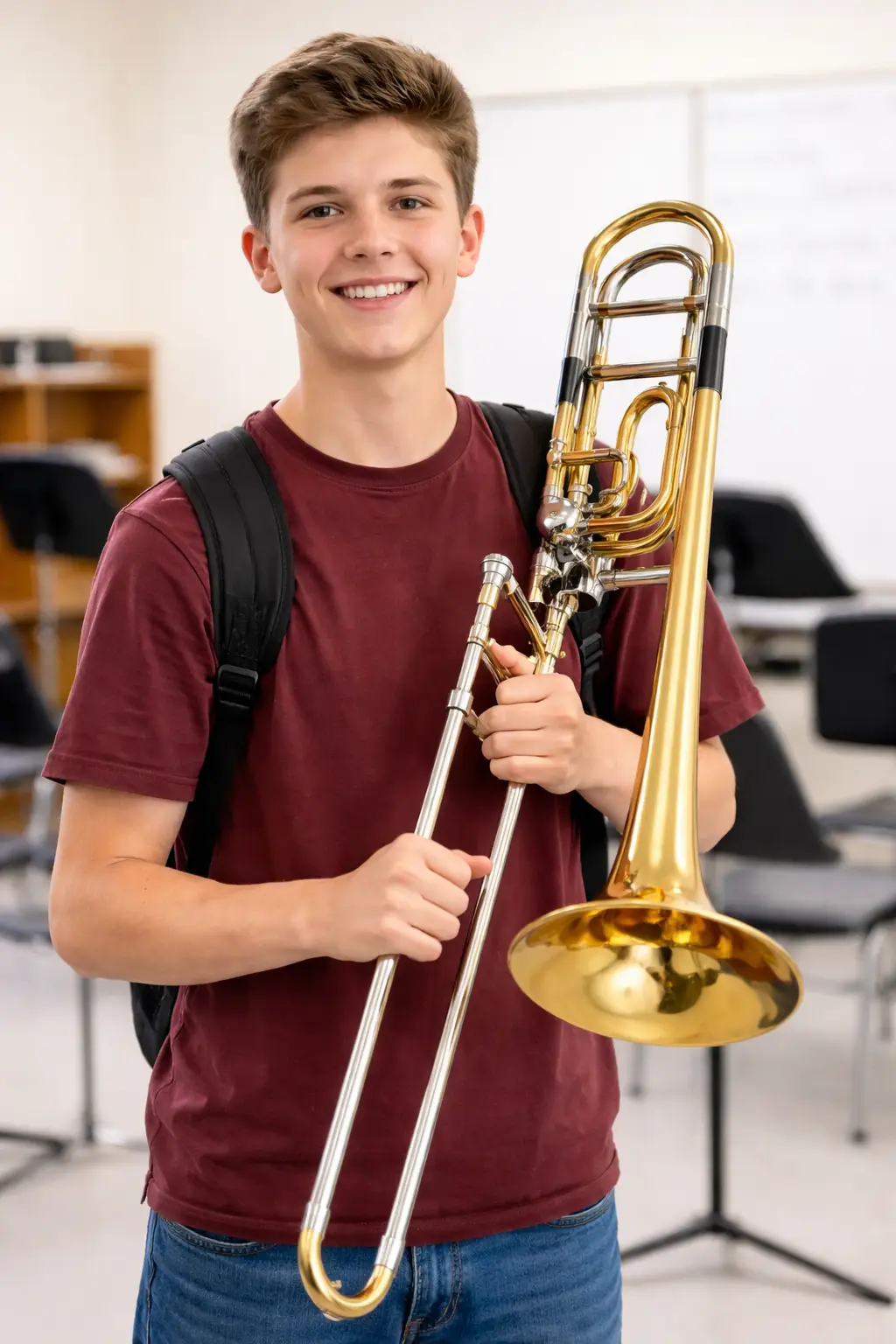
F Attachment Trombone for Middle and High School Students
Once you’ve mastered the basics of slide technique on a standard tenor trombone, adding the F-attachment can be a big step forward in your playing journey. For middle and high school students, in particular, the F-attachment opens up new possibilities—both in range and technical flexibility.
Start Slowly with Basic Positions
First, as an intermediate player, begin by practicing the alternate slide positions that the F-attachment offers. For example, when you engage the trigger, notes that used to be in 6th or 7th position can now be played closer to your body in 2nd or 3rd position. At the same time, focus on slow, deliberate practice, ensuring each alternate note is in tune and that your slide coordination remains smooth.
Build Confidence with Simple Exercises
Next, practice simple scales and songs that naturally incorporate the F-attachment. To begin with, start with familiar pieces you already know and see how the alternate positions make certain low notes easier. Over time, you’ll build muscle memory and become confident shifting between the two sets of positions.
Use the F-Attachment for Better Intonation
In addition, one of the biggest benefits for intermediate players is improved intonation. The F-attachment gives you alternate slide positions that allow for more precise tuning. As you practice, pay attention to how each alternate position sounds in your ear. As a result, you’ll soon rely on them for more accurate pitch in band or ensemble settings.
Stay Patient and Consistent
Finally, mastering the F-attachment takes time. Therefore, as a middle or high school student, be patient with yourself. Small, regular practice sessions will gradually make the trigger feel natural. Before long, the F-attachment will be a seamless part of your playing toolkit.
Frequently Asked Questions (FAQ)
Do beginners need an F attachment trombone?
Most beginners do not need an F attachment trombone. A straight tenor trombone is usually the better choice because it allows new players to focus on core fundamentals such as tone production, slide accuracy, and reading music before adding the complexity of a trigger system.
Is an F attachment trombone harder to play?
An F attachment trombone is not necessarily harder to play, but it does require adjustment. The instrument is slightly heavier and introduces additional valve mechanics. However, once learned, it actually makes many technical passages easier due to alternate slide positions.
When should a student switch to an F attachment trombone?
Most students consider switching in middle school or high school once they are comfortable with basic slide positions and are performing more advanced band or orchestra music. The right time depends on individual progress and musical demands rather than age alone.
Is an F attachment required for orchestra?
In many advanced orchestral settings, an F attachment trombone is strongly expected. Some repertoire assumes access to lower notes that are much easier to play with a trigger system. While not always strictly required, it is often considered standard equipment.
Can you play jazz on an F attachment trombone?
Yes, many players use F attachment trombones in jazz settings. However, straight tenor trombones are more common in lead and commercial jazz due to their lighter weight and quicker response. The choice depends on style and personal preference.
What does the F attachment actually do?
The F attachment lowers the trombone’s pitch from B♭ to F by redirecting air through additional tubing when the trigger is pressed. This extends the instrument’s range and provides alternate slide positions for improved efficiency and flexibility.
Ready to Take Your Trombone Playing to the Next Level?
Final Thoughts
An F attachment trombone is not about shortcuts—it’s about musical efficiency. This type of trombone expands your range, improves accuracy, and supports advanced repertoire without changing the core identity of your sound.
The best choice is the one that helps you serve the music.
Related Trombone Articles
To continue building your trombone skills and understanding your equipment, here are some helpful related guides on The Trombone Mentor:
Trombone Practice Mute: A Complete Guide for Quiet, Effective Practice
Small Shank vs Large Shank Trombone Mouthpieces
Trombone Practice Tools: 10 Tools That Actually Improve Your Playing
Trombone Scales With Slide Positions: Bb, F, and Eb Major
These articles will help you improve technique, choose the right equipment, and develop a stronger overall foundation as a trombone player.