If you want to dramatically improve your sound, flexibility, and endurance, trombone lip slurs must become a daily part of your routine.
Whether you are a beginner just learning first position or an advanced player working on upper register control, lip slurs train the most important part of brass playing: airflow and embouchure coordination.
In this complete guide, you’ll learn:
-
What trombone lip slurs are
-
Why they are essential for every player
-
Step-by-step instructions for practicing them
-
Beginner and intermediate exercises
-
Common mistakes to avoid
-
How to build lip slurs into your daily warm-up
If practiced correctly and consistently, lip slurs will transform your playing.
Let’s get started!
Disclaimer
This article contains Amazon Affiliate Links. What this means, is that, at no cost to you, if you click a link and follow through with a purchase, this site may earn a small commission.
Trombone Slurs vs. Trombone Lip Slurs: What’s the Difference?
Many beginners hear the word slur and assume it means the same thing every time. On trombone, however, there are two different types of slurs, and they require different techniques:
-
Regular slurs (connected notes)
-
Lip slurs (embouchure-driven note changes)
Understanding the difference is essential for developing smooth playing and strong fundamentals.
| Regular Slur | Lip Slur |
|---|---|
| Slide moves | Slide stays still |
| Notes connect smoothly | Notes connect smoothly |
| Pitch changes from slide position | Pitch changes from harmonic series |
| Focus: smooth slide technique | Focus: embouchure and air control |
Both are slurs. But the physical technique is different.
Another way to remember the difference between the two is:
“If the slide moves, it’s a regular slur.
If the slide doesn’t move, it’s a lip slur.”

Why Trombone Lip Slurs Are So Important
1. They Improve Tone Quality
Lip slurs force you to use proper airflow instead of pressure. When done correctly, they:
-
Center your pitch
-
Reduce thin or pinched tone
-
Create a fuller, warmer sound
If your tone sounds forced or spread, lip slurs help balance air and embouchure.
2. They Build Flexibility
Flexibility means being able to move smoothly between notes without bumps or cracks.
Lip slurs train:
-
Smooth interval changes
-
Partial accuracy
-
Quick response
This carries directly into band music, solos, and jazz playing.
3. They Increase Range
Many players try to “muscle” high notes. Lip slurs teach proper technique instead.
Higher notes require:
-
Faster air
-
Smaller aperture
-
Controlled support
Practicing lip slurs daily strengthens the coordination needed for upper register playing without strain.
4. They Develop Endurance
Consistent lip slur practice builds embouchure strength gradually and safely.
Instead of blasting high notes, you develop:
-
Balanced muscle use
-
Efficient airflow
-
Sustainable endurance
Beginner Trombone Lip Slur Exercises
Exercise 1: Notes – Bb–F–Bb
In this exercise, we will use just three notes. The second line Bb, the fourth line F, and the Bb above the staff. All in first position.
These are two measure slurs, a measure rest and the three measure slurs. Make sure that you observe the rests. This is important even though it is a short period of time. Always take a full breath before playing.
Exercise 2: Notes – A-E-A
This exercise is just like the first exercise but in 2nd position.
Make sure that you keep the slide steady while playing.
Give each note it’s full value.
Keep the same relaxed air flow.
Exercise 3:
In this exercise we will use the notes in the previous exercises and concentrate on a little flexibility.
Using the quarter note you will practice the lip slurs a bit faster up and down.
This is a simple exercise, but played every day for a while will strengthen your embouchure. This helps you to improve your range and endurance.
Exercise 4:
This exercise will feature both upward and downward direction trombone lip slurs. Each two measure phrase should be played in one breath. If possible, use a metronome and set the tempo at mm-88. The dynamic level should be soft – piano.
In the first two measures, the lip slurs move in an upaward direction. Use the syllable “ta – ee” when playing the F to Bb. Tighten the lips slightly and use a faster air stream.
In measures 3-and 4, the notes are written in a downward direction. Use the syllable “tee- a”. This first part is all done in first position. Repeat this pattern in second and third positions. Rest a bit before going on to exercise #5.
Exercise 5:
In this exercise, notice that the rhythm is identical to #4, but the notes have changed. This is concentrating on your lower lip slurs starting with the second line Bb. Each two measure sequence or pattern is repeated using a lower set of notes. These notes outline the harmonic series of that slide position.
Again, try to use your metronome and list to the beats for an accurate tempo. Use lots of breath support. Rest a bit before going on to exercise #6.
Exercise 6:
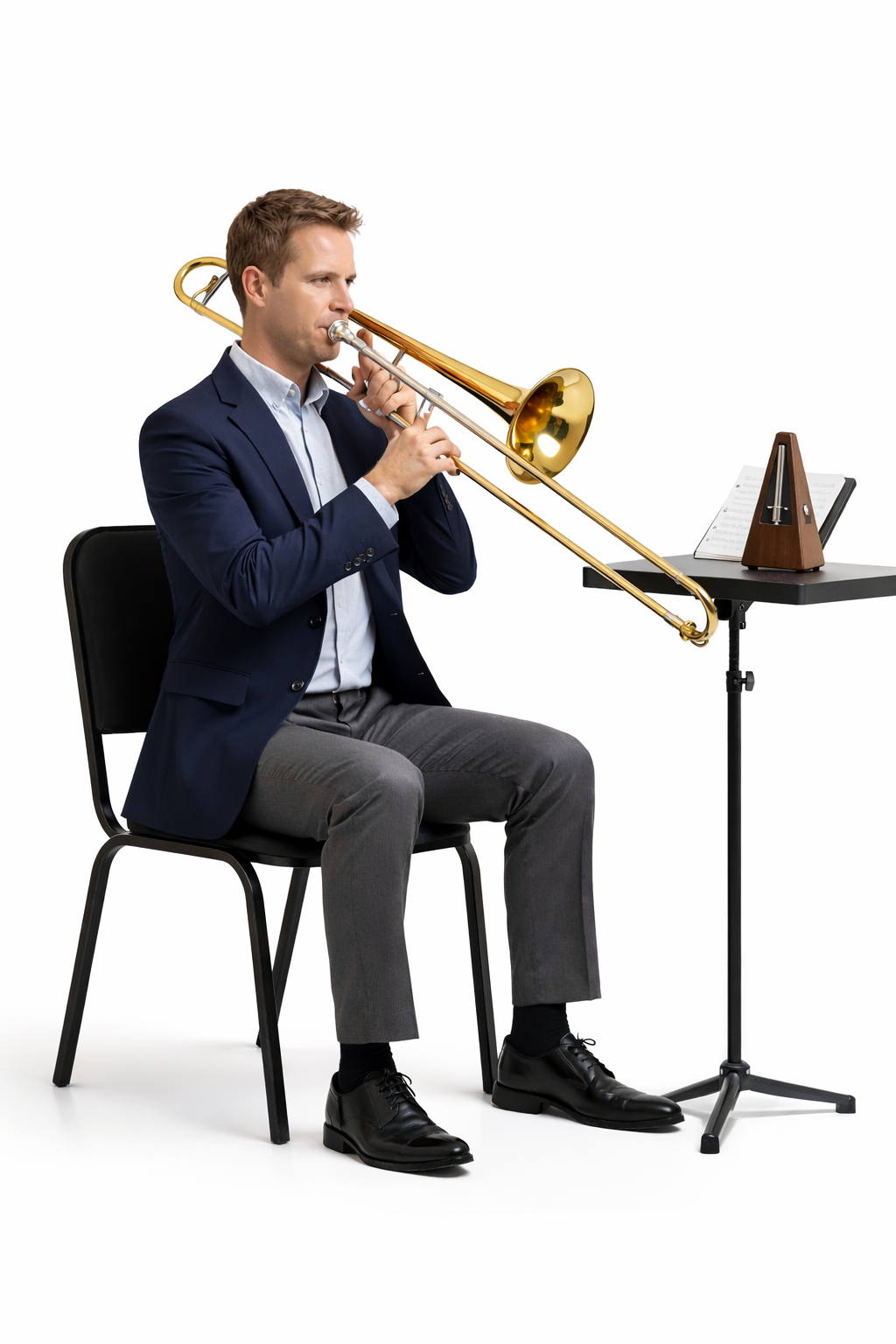
With each of these repetitive exercises, we are not using many notes or pitches, but rather patterns shared with different slide positions. Play this exercise using the instructions from the two previous ones. Correct posture is important. Sit straight with your feet flat on the floor.
Practice Guidelines for Beginners
-
5–7 minutes daily
-
Stop if tone deteriorates
-
Rest as much as you play
Consistency matters more than intensity.
Intermediate Trombone Lip Slurs
Below are three different exercises featuring trombone lips slurs for the intermediate player. These exercises are great for your warm up period before you actually start your practice session. The emphasis on this set of lip slurs is the use of alternate positions for certain notes. Play the exercises slowly. Don’t rush through them and concentrate on listening to each note making sure that you are producing “lips slurs”. Lastly, make sure to rest between exercises.
Exercise #1
This exercise is a short spaced lip slur called an “interval”. An interval is the space between two notes. We start in 6th position with your fourth line F to A. The interval is a Major third. For more vocabulary assistance refer to my Complete A-Z Music Glossary
When playing a lip slur going in an upaward direction, use the syllable “ta – ee”. Tighten the lips slightly and use a faster air stream
Exercise #2
In this exercise, we are featuring a lip slur that is an “arpeggio-based” style. Arpeggios are broken chords usually associated with the piano. But for the purpose of this exercise, it works extremely well for trombone lip slurs.
When we play lip slurs in a downward direction, it is important to use the syllable “tee- a”. Drop your jaw slightly. This doesn’t mean to loosen your embouchure. Keep the corners of your lips firm and support the tone.
Observe all of the notes that you can play in the different slide positions. This type of exercise improves musical phrasing and technical accuracy.
Exercise #3 Faster playing of lip slurs
Apply what we learned in the first two exercises when playing this exercise. By playing these lip slurs faster, you are strengthening the muscles in your embouchure, improving you tone, and building up you range.
Intermediate Practice Time
-
8–10 minutes daily
-
Focus on tone over speed
-
Gradually increase tempo
Common Mistakes When Practicing Trombone Lip Slurs
Avoid these errors:
- Moving the Slide – Lip slurs require staying in the same position
- Using Too Much Pressure – Pressure kills flexibility and tone.
- Playing Too Fast – Speed hides problems. Slow practice builds control.
- Ignoring Tone Quality – If the tone becomes thin or harsh, reset and refocus.
- Practicing When Tired – Lip slurs require control. Stop before fatigue causes bad habits.
FAQ About Trombone Lip Slurs
How Often Should You Practice Lip Slurs?
There is no hard and fast rule for how often you should practice lip slurs. It is important though to have as regular regiment in your warm up and or method book studies.
For most players:
-
Beginners: 5–7 minutes daily
-
Intermediate: 8–10 minutes daily
-
Advanced: 10–15 minutes daily
Small, consistent sessions produce better results than occasional long workouts.
There are several trombone method books available, but my favorite is the Arban Method for Trombone. This method is known as the “Trombone Bible”.
Do Trombone Lip Slurs Increase Range?
Yes — but indirectly.
Lip slurs:
-
Strengthen coordination
-
Improve airflow efficiency
-
Develop accurate partial control
They create the technical foundation that makes higher notes possible.
Your trombone range will developed gradually with consistent, relaxed practice. The important word here is “consistent”.
Should Beginners Practice Lip Slurs?
Absolutely. This is where we start!
In fact, beginners benefit the most because lip slurs:
-
Teach correct air usage early
-
Prevent pressure habits
-
Build flexibility from the start
Simple two-note slurs are enough in the beginning.
Why Do My Lip Slurs Crack?
Cracked notes usually happen because of:
-
Hesitant air
-
Tension in the throat
-
Moving the jaw excessively
-
Insufficient support
Fix it by:
-
Slowing down
-
Focusing on steady air
-
Practicing smaller intervals
How to Build Lip Slurs Into Your Warm-Up
Here is a simple structure:
-
Long tones (3–5 minutes)
-
Simple lip slurs (5–10 minutes)
-
Scales
-
Repertoire
Lip slurs connect long tones to technical playing.
They are the bridge between sound production and music performance.
Tools That Help With Your Practice
You don’t need much, but these tools absolutely help:
Recording yourself reveals bumps or uneven tone you might not notice while playing.
The Long-Term Benefits of Trombone Lip Slurs
Players who practice lip slurs daily develop:
-
Cleaner attacks
-
Smoother phrasing
-
Stronger endurance
-
Greater range control
-
More consistent tone
These benefits show up in:
-
Band rehearsals
-
Jazz improvisation
-
Solo performances
-
Auditions
Lip slurs are not flashy — but they are powerful.
Final Thoughts: Mastering Trombone Lip Slurs
Trombone lip slurs are one of the most important exercises you can practice.
They build:
-
Flexibility
-
Tone
-
Range
-
Endurance
-
Control
The key is simple:
- Practice daily
- Go slowly
- Focus on air
- Stay relaxed
- Always listen to your playing.
Small improvements compound over time.
If you stay consistent, you’ll notice smoother playing, stronger high notes, and a more centered sound.
And remember — flexibility is not built overnight. It is built one careful, controlled lip slur at a time.
Ready to Take Your Trombone Playing to the Next Level?
Whether you’re a complete beginner or looking to refine your skills, personalized guidance can make all the difference. Private lessons with The Trombone Mentor give you step-by-step instruction, customized practice plans, and expert feedback designed to help you improve faster and play with confidence.
Start making real progress today — schedule your private lesson and discover how enjoyable learning trombone can be with the right support. CONTACT me for more details.
Related Trombone Articles
Trombone Practice Mute: A Complete Guide for Quiet, Effective Practice
Trombone Practice Tools: 10 Tools That Actually Improve Your Playing