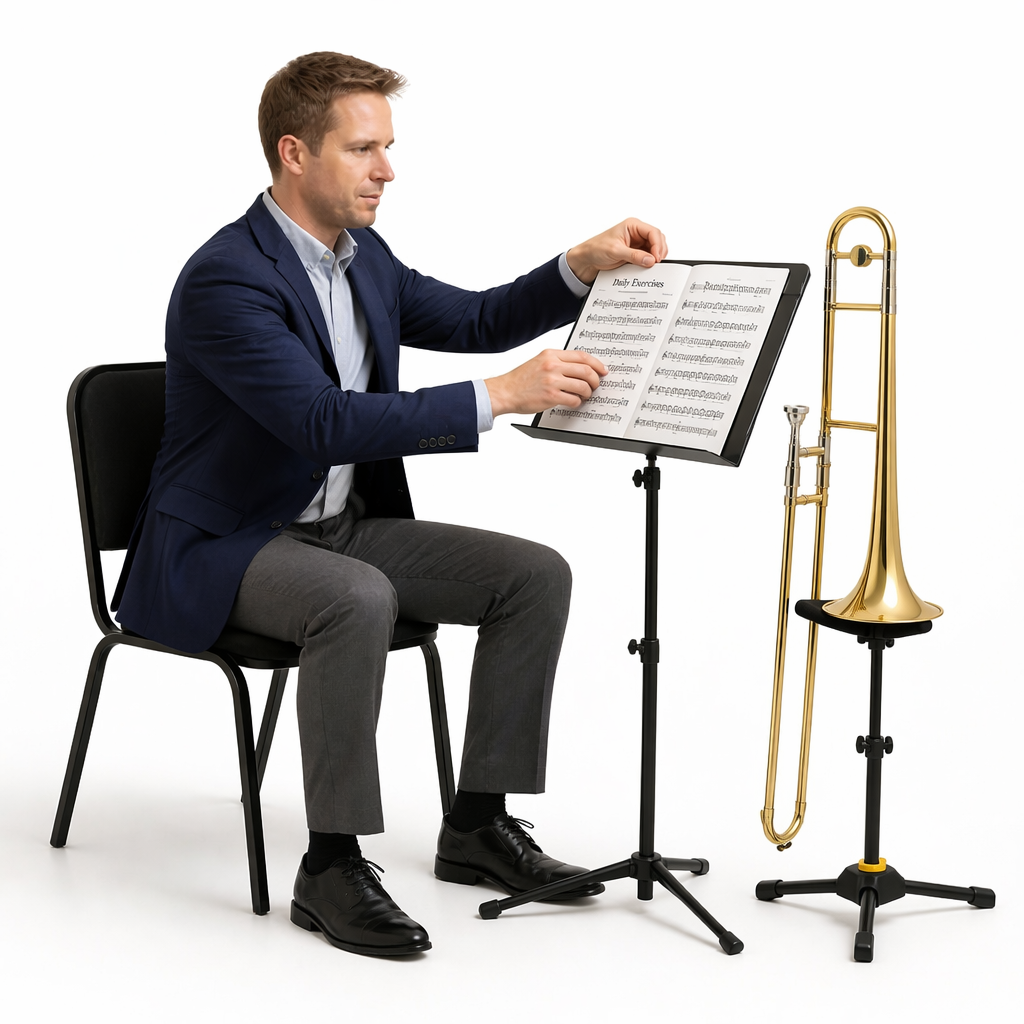
Learning how to read trombone music is one of the most important skills you can develop as a player. While producing a good tone and mastering slide positions are essential, your ability to read music fluently is what allows you to play songs, participate in ensembles, and grow as a musician.
The trombone presents a unique challenge compared to other instruments. Instead of pressing valves or keys, you must match what you see on the page with precise slide movements and accurate pitch. That coordination takes time—but with the right approach, it becomes second nature.
This guide walks you step-by-step through everything you need to know, from understanding the staff to reading rhythms and applying it all on the trombone.
So, let’s get started!
Disclaimer
The Trombone Mentor participates in the Amazon Services LLC Associates Program. As an Amazon Associate, we earn from qualifying purchases at no extra cost to you.
New to the Trombone?
I highly recommend that you check out the article:
How to Start Playing Trombone: A Beginner’s Guide
This article goes hand-in-hand with what you are about to read.
Understanding the Basics of Music Notation
The Musical Staff

At the foundation of reading trombone music is the musical staff, which consists of five horizontal lines and four spaces. Notes are placed on these lines and spaces to represent pitch.
-
- Notes higher on the staff sound higher
- Notes lower on the staff sound lower
- Extra notes extend beyond the staff using ledger lines
Bass Clef

Most trombone music—especially for beginners and intermediate players—is written in bass clef. This clef centers around the note F (on the fourth line of the staff).
Key points:
-
- Bass clef is your “home base”
- Nearly all band music for the trombone uses bass clef
- First-year players should focus exclusively on mastering this clef
Measures and Barlines

Music is divided into measures, separated by vertical lines called barlines.
- Each measure contains a fixed number of beats
- This structure helps organize rhythm and timing
- You may also see:
- Double barlines (end of a section)
- Repeat signs (play a section again)
Understanding measures is essential for staying in time with other musicians.
Reading Notes on the Staff
As we continue to learn how to read trombone music, the notes on the staff will be fun and very important.
In bass clef, notes are divided into lines and spaces:
Lines (bottom to top):
- G, B, D, F, A
Spaces (bottom to top):
- A, C, E, G
Helpful strategies:
- Use the following saying to help – Lines: Good Boys Deserve Fudge Always and Spaces: All Cows Eat Grass
- Practice identifying notes daily
- Focus on recognition speed, not just accuracy
Connecting Notes to Slide Positions
Reading trombone music is not just about naming notes—it’s about connecting them to physical movement.
Examples:
- Bb = 1st position
- C = 6th position
- D = 4th position
Over time, this connection becomes automatic. However, early on, it requires deliberate practice.
Important: Always use your ear to confirm pitch. The trombone does not “lock in” notes like valve instruments.
The Seven Trombone Positions
Rhythm Fundamentals for Trombone Players
Rhythm in music is “Organized Sounds and Silences” Sounds = Notes Rests = Silences
Note Values

Rhythm tells you how long to play each note.
Common note values:
- Whole note = 4 beats
- Half note = 2 beats
- Quarter note = 1 beat
- Eighth notes = ½ beat each
Understanding these durations is essential for playing accurately in time.
Rests

Rests are a very important part of all music.
Common rests:
- Whole rest
- Half rest
- Quarter rest
- Eighth rest
- Sixteenth rest
- Thirtysecond rest
Time Signatures
A time signature is a musical symbol that appears at the beginning of a piece of music. It consists of two numbers written like a fraction, and it tells you how the music is organized rhythmically.
Examples:
- 4/4 = 4 beats per measure (most common)
- 3/4 = 3 beats per measure
- 2/4 = 2 beats per measure
The top number tells you how many beats are in each measure.
The bottom number tells you which type of note receives one beat.
Counting Exercises
- Exercise #1 shows you whole, half, and quarter notes and how to count them in a measue with the time signature of 4/4. In the next 7 measures you will notice the whole, half, and quarter rests and how to count them. Remember our definition of music? Music is – Organized Souds and Silences. Sounds = Notes Silences = Rests
- In exercise #2, we want to practice counting out loud and clapping the notes.
- Exercise #3 is a continuation of #2 with more emphasis on the quarter rest.
- In exercise #4, we introduce the eighth note and eighth rest using the “and” system (+). Remember the only difference between the notes and rests is that notes are sounds and rests are silent beats.
- Exercise #5 shows you how these notes and rests can work together to give you a great variety of rhythms. If you own a metronome, please use it because it will help you count much easier.
- After you have practiced counting and clapping these exercises, you are now ready to play them on your trombone.
Counting Exercises for Trombone
Key Signatures and Accidentals
:Key signatures and accidentals function as a form of musical shorthand, indicating which notes are consistently raised or lowered so composers don’t have to mark every change individually. This allows musicians to read more efficiently while clearly establishing the tonal framework of the music.
A key signature appears at the beginning of the staff and tells you which notes are consistently sharp or flat.
What Is a Key Signature?
A key signature is a set of “accidentals” (sharps or flats) at the beginning of a piece of music that indicates which notes are consistently raised or lowered throughout the piece.
Common Beginner Keys
- Bb Major (2 flats)
- F Major (1 flat)
- Eb Major (3 flats)
These keys are commonly used in band music and align well with brass instruments.
Accidentals Explained
Accidentals temporarily change a note:
- Sharp (#) raises the pitch
- Flat (b) lowers the pitch
- Natural cancels previous alterations
Important rule:
- Accidentals apply only within the measure unless repeated
Articulations
As you learn how to read trombone music, you will start to see symbols called articulations. These symbols tell you how to play each note, not just which note to play.
A simple way to think about articulations is this: they show you how to pronounce the notes on your instrument.
Common types:
Staccato = •
(short and separated)
Legato = ⌢ (slur line)
(smooth and connected)
Accent = >
(emphasized)
On trombone, articulation is controlled by the tongue and air.
Dynamic Markings
Dynamics indicate volume and expression
Dynamic Markings Chart
| Name | Letters | Level |
|---|---|---|
| fortississimo | fff | very, very loud |
| fortissimo | ff | very loud |
| forte | f | loud |
| mezzo forte | mf | moderately loud |
| mezzo piano | mp | moderately quiet |
| piano | p | quiet |
| pianissimo | pp | very quiet |
| pianississimo | ppp | very very quiet |
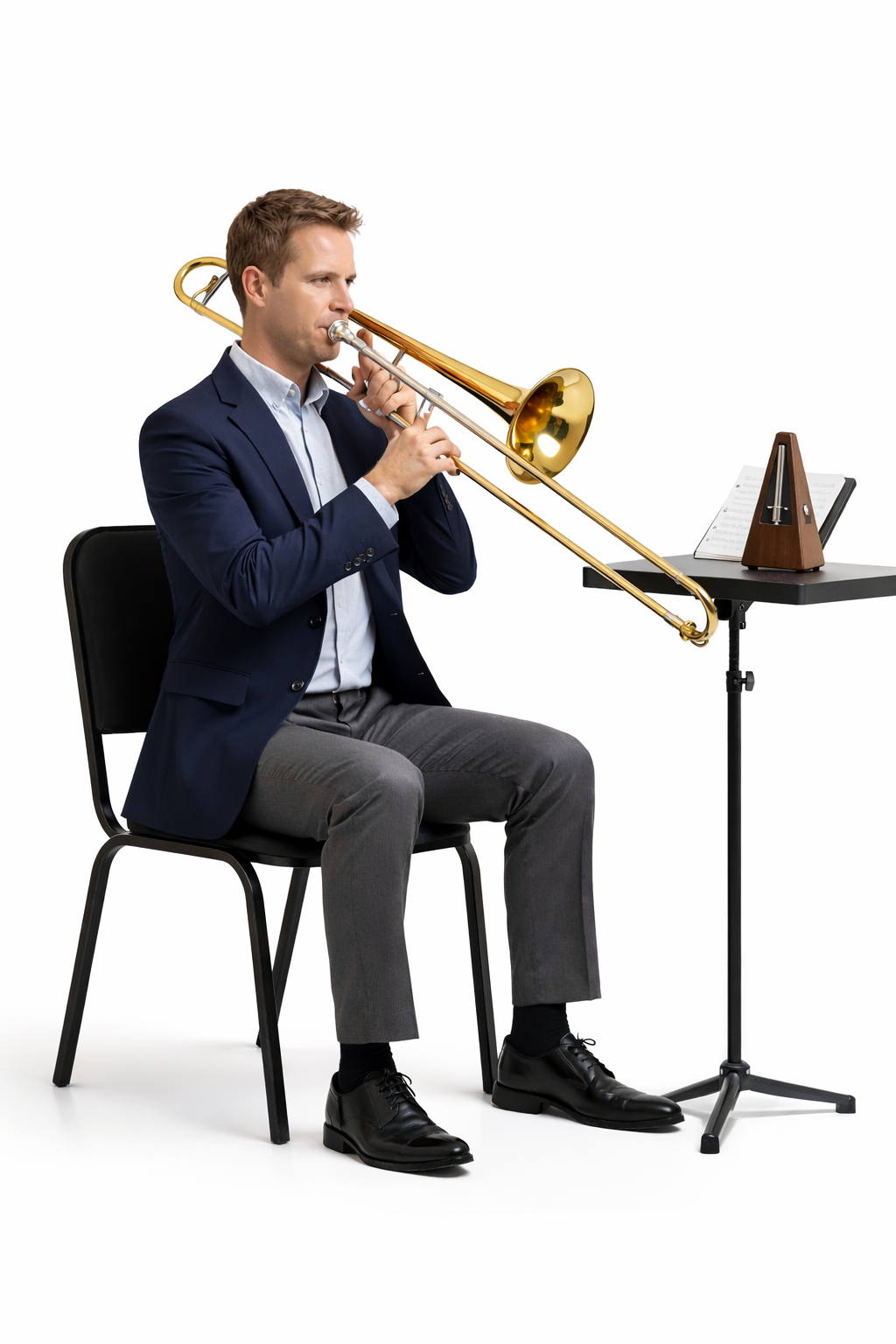
How to Read and Play at the Same Time
Eye Tracking Techniques
Strong readers don’t look at just one note at a time. Instead, they:
- Look slightly ahead in the music
- Anticipate upcoming notes
- Maintain steady movement
This prevents hesitation and improves flow.
Slow Practice Strategy
Always start slower than you think you need to.
Steps:
- Break music into small sections
- Practice slowly and accurately
- Gradually increase speed
Accuracy builds speed—not the other way around.
Combining Slide Movement with Reading
One of the biggest beginner challenges is coordinating:
- Visual reading
- Slide movement
- Air support
Common mistakes:
- Moving the slide too late
- Guessing positions
- Rushing transitions
Solution:
- Practice slowly
- Isolate difficult passages
- Repeat consistently
Common Challenges (and How to Fix Them)
1. Confusing Notes in Bass Clef
Solution: Daily note-reading drills and flashcards
2. Inconsistent Slide Positions
Solution: Practice with a tuner and focus on muscle memory
3. Rhythm Errors
Solution: Clap rhythms before playing
4. Losing Your Place
Solution: Use your finger or pencil to track the music
5. Poor Tone While Reading
Solution: Slow down and prioritize sound quality over speed
Practice Exercises for Reading Trombone Music
Beginner Note Exercise
- Practice stepwise patterns:
- Bb → C → D → Eb → F
- Focus on smooth transitions
Rhythm Clapping Exercise
- Clap rhythms before playing
- Count out loud while clapping
Daily Sight-Reading Routine (5 Minutes)
- Choose simple, unfamiliar music
- Scan key signature and time signature
- Play slowly without stopping
- Do not correct mistakes—keep going
Consistency matters more than difficulty.
Recommended Resources
Method Books
Tools
Articles and Worksheets
Trombone Practice Mute: A Complete Guide for Quiet, Effective Practice
Trombone Breathing Exercises: 7 DIY Tools
These resources reinforce daily learning and accelerate progress.
Ready to Take Your Trombone Playing to the Next Level?
.Whether you are just starting trombone or looking to strengthen your tone, technique, and musical confidence, private lessons can help you progress faster with clear guidance and personal support.
With The Trombone Mentor, you receive:
• Step-by-step instruction
• Customized practice plans
• Expert feedback and encouragement
• Online lessons you can take from anywhere
Stop guessing and start making steady progress with lessons designed around your goals.
Final Thoughts
Learning how to read trombone music is a skill that develops through consistent, focused practice. At first, it may feel like you are juggling multiple tasks—reading notes, counting rhythms, and moving the slide—but over time, these elements come together naturally.
The key is to build a strong foundation:
- Learn bass clef thoroughly
- Practice rhythms daily
- Connect notes to slide positions
- Prioritize accuracy over speed
With patience and repetition, reading trombone music becomes less of a challenge and more of a powerful tool that allows you to enjoy playing, perform with others, and continue growing as a musician.