
Learning how to write a major scale is one of the most important skills for young musicians. Major scales are the foundation of almost all music. They help you understand how notes work together, make it easier to read music, and give you the tools to play songs correctly on your instrument. Whether you play in band, on the piano, or on a trombone, knowing major scales will make learning new music faster and more fun.
We need to learn how to write a major scale because it teaches us the rules of music. Writing scales helps us understand which notes belong together and how to create songs that sound correct. It also helps us play our instruments more accurately and read music more easily. Once you know how to write a scale, you can figure out any song or key and even create your own music.
By the end of this lesson, you will be able to write a major scale starting on any note. This skill will help you read music, play better, and feel more confident as a musician.
Music Theory Vocabulary for This Lesson
Before we start learning How to Write a Major Scale, let’s review some important music vocabulary you will see throughout this lesson. Some of these terms you will be familiar with. Others will be new and add to your total music vocabulary for the future.
- Scale – A scale is a group of musical notes played in order, going up or down, that follow a specific pattern.
- Major Scale – A major scale is a type of scale that follows a pattern of whole steps and half steps
- Note – A note is a musical sound with a specific pitch, represented by a letter name such as A, B, or C.
- Pitch – Pitch is how high or low a note sounds.
- Tonic – The tonic is the first note of a scale. It is the note the scale is named after and the note that sounds like “home.”
- Octave – An octave is the distance between one note and the next note with the same name that sounds higher or lower.
- Whole Step – A whole step is the distance between two notes that are two half steps apart. On a piano, this means skipping one key.
- Half Step – A half step is the smallest distance between two notes in music. On a piano, it is moving to the very next key.
- Sharp (♯) – A sharp raises a note by one half step.
- Flat (♭) – A flat lowers a note by one half step.
- Accidental – An accidental is a symbol, such as a sharp or flat, that changes the pitch of a note.
- Musical Alphabet – The seven musical note names: A, B, C, D, E, F, and G.
- Major Scale Formula – The major scale formula is the pattern of whole steps and half steps used to build a major scale:
Whole–Whole–Half–Whole–Whole–Whole–Half.
The Major Scale Formula
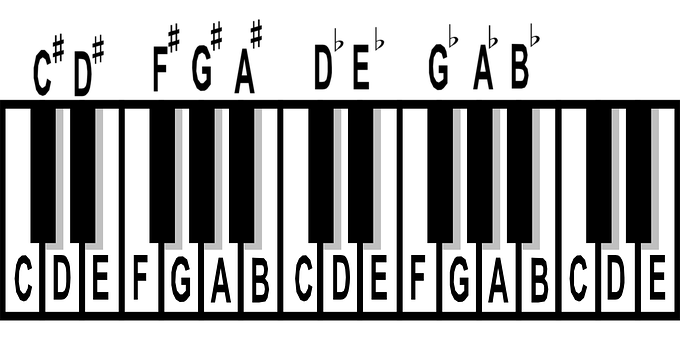
Everything that I am presenting in How to Write a Major Scale will be based off the C Major Scale and the piano keyboard. This will help you understand the construction of a major scale better. The white keys represent the “natural” notes” using the notes of the musical alphabet – ABCDEFG. The black keys will represent altered notes.
The Major Scale Formula (Using C Major)
Every major scale is built using the same pattern of whole steps (W) and half steps (H).
This pattern is called the Major Scale Formula:
Whole – Whole – Half – Whole – Whole – Whole – Half (or W W H W W W H)
What Are Whole Steps and Half Steps?
-
A half step is the smallest distance between two notes on a keyboard or staff
(for example: E to F, B to C) -
A whole step is made up of two half steps
(for example: C to D, F to G)
On a piano:
-
Notes that have a black key between them are a whole step apart. C to D has a black key between them – Whole Step
-
Notes with no black key between them are a half step apart. The notes E to F and B to C have no black keys between them – Half Steps
Writing the C Major Scale Step-by-Step
Let’s apply the Major Scale Formula starting on C. This scale is our model scale, because the formula is already built in to it. To begin, you will need a piece of music paper (staves with five lines and four spaces) and a pencil w/ eraser.
First Step
At the top left of your music paper, draw either a treble clef or a bass clef, depending on what instrument you play. For my trombone students, I will be using the bass clef. 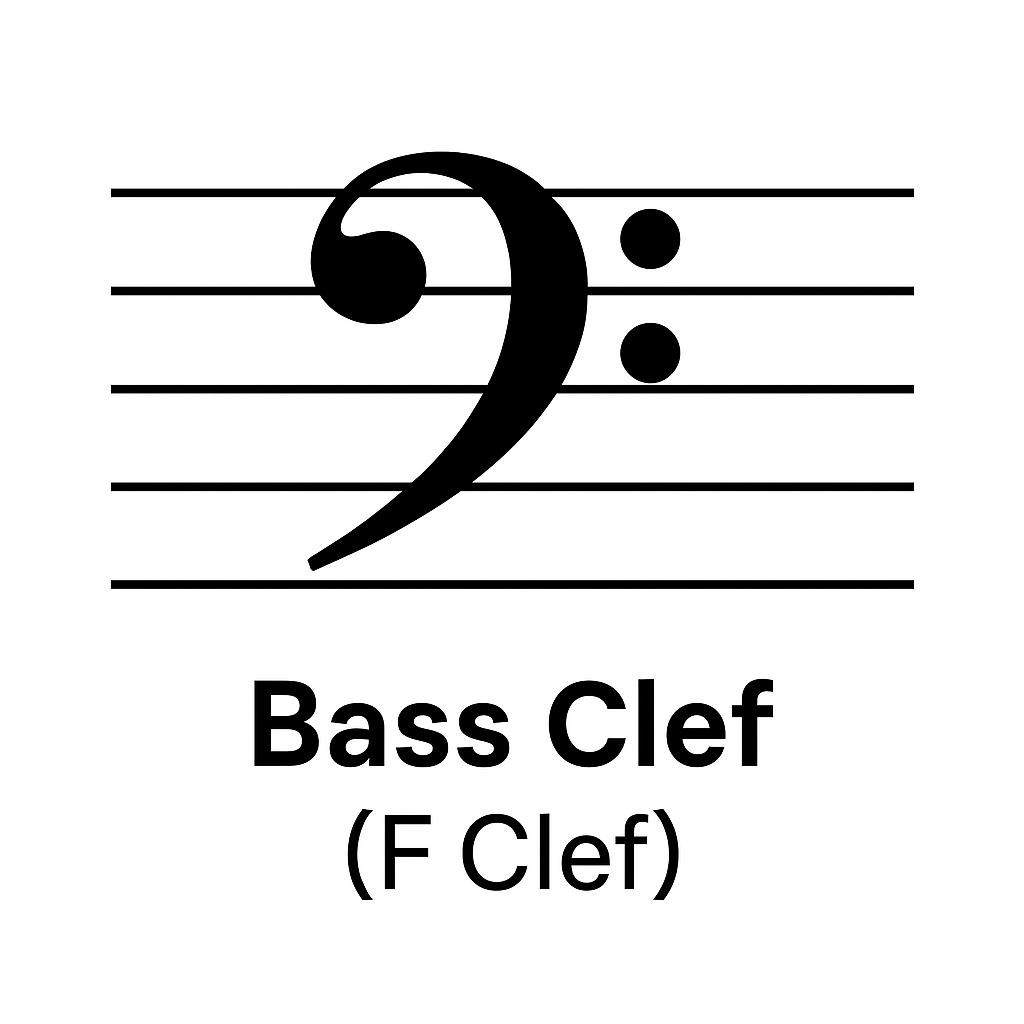 If you are not familiar with writing this symbol, take a few minutes and write ten bass clefs on the first row evenly spaced. Don’t forget to put the two dots on either side of the fourth line. This line is called “F”.
Second Step
Next, put a whole note on the second space for the note C. Follow this by writing the rest of the notes (ascending) D, E, F, G, A, B, C. Try to evenly space these notes apart. After that, label each note above with its proper name. Your paper should look like this –
Third Step
In capital letters, write the formula at the top of your page. Write it large enough so that it stands out. You need to memorize this: Whole Step – Whole Step – Half Step – Whole Step – Whole Step – Whole Step – Half Step
Under the scale we will now put the Major Scale Formula. Remember that the C Major Scale is already set. The Major Scale Formula calls for a whole step between the 1st and 2nd notes. Whole step between the 2nd and 3rd notes. A half step between the 3rd and 4th notes. Whole step between the 4th and 5th notes. A whole step between the 5th and 6th notes. Whole step between the 6th and 7th notes. Finally, a half step between notes 7 and 8.
C – D – E – F – G – A – B – C
W W H W W W H
Look at the piano keyboard above and observe how the whole steps and half steps line up with the notes of the scale. Now let’s write our next Major Scale.
Writing the G Major Scale Step-by-Step
Now that you understand the C Major Scale construction, we will build the G Major Scale using our major scale formula.
Step One
On your music paper, draw a bass clef.
Step Two
Put a whole note on the bottom line. This is the note “G”. Remember, we are writing this using the bass clef for trombone players.
Step Three
Evenly space out the next seven notes grom the G. Space – line:
The letter names of the notes should say G – A – B – C – D – E – F – G
Step Four
Under the letter names, put the major scale formula in between the letter names.
G – A – B – C – D – E – F – G
W W H W W W H
Step Five
This step is the most crucial because we will be inserting a symbol (#/b) on a note to comply with the formula.
Let’s find out why. First, remember in the C Major Scale that between the notes E – F and B to C are always half steps? Well, that applies to building our G Major Scale.
If we look at the notes in the scale below, everything is ok until we get to the notes E – F. Our formula says that we must have a Whole Step between notes 6-7 and that is E-F. What do we do? Well, if the notes E-F are always a Half Step and we need a Whole Step, we need to raise the pitch by making the F an F#. We now have a Whole Step. And because of this, F# to G become a Half Step and that is what our formula calls for. Now we have a G Major Scale.
G – A – B – C – D – E – F – G G – A – B – C – D – E – F# – G
W W H W W W H W W H W W W H
Step Six
Let’s practice!
Below, is a worksheet that you can practice on to write ten different major scales. Follow the instructions and you will be a master in no time.
Conclusion
Learning how to write a major scale gives you a powerful tool for understanding music. By mastering the whole-step and half-step formula, using correct letter names, and practicing regularly on your instrument, you build a strong musical foundation that will support everything you play.
Related Material
Online Trombone Lessons: Learn Anywhere With a Private Trombone Teacher