Playing slurs on the trombone is an essential skill for developing a smooth and expressive sound. Unlike many other brass instruments, the trombone does not use valves to connect notes. Instead, trombonists rely on a combination of air control, embouchure adjustments, and slide movement to produce smooth musical lines.
When slurs are played correctly, the music flows naturally and the notes sound connected rather than separated. Learning how to control different types of slurs will help trombone players improve their tone, flexibility, and overall musicianship.
In this guide, we will explore the three main techniques used when playing slurs on the trombone:
-
Lip slurs
-
Natural slurs
-
Legato slurs
Each technique plays an important role in developing smooth and musical phrasing.
Disclaimer
The Trombone Mentor participates in the Amazon Services LLC Associates Program. As an Amazon Associate, we earn from qualifying purchases at no extra cost to you.
Lip Slurs
A lip slur occurs when a trombone player moves between notes of the harmonic series without moving the slide. The pitch changes because of adjustments in air speed and embouchure.
For example, when the slide stays in 1st position, a player can slur between the following notes:
Bb → F → Bb → D → F
These notes all belong to the same harmonic series.
Lip slurs are one of the most important exercises for trombone players because they help develop:
-
Embouchure strength
-
Flexibility between partials
-
Consistent tone production
-
Better air control
Trombone Harmonic Series
The trombone harmonic series refers to the sequence of natural pitches that can be produced on the instrument without moving the slide, simply by adjusting the embouchure and air speed. These pitches occur because of a natural acoustic principle called the Harmonic Series. This principle exists on all brass instruments.
Understanding the harmonic series is essential for trombone players because it explains how multiple notes can be played in one slide position.
What the Trombone Harmonic Series Is
When a trombone player buzzes into the mouthpiece, the air column inside the instrument vibrates. Instead of producing only one pitch, the instrument naturally resonates at several frequencies that form the harmonic series.
These notes are called partials.
For example, when the slide is in 1st position, the trombone produces the B♭ harmonic series.
Exercise
If you are a beginning trombonist, make sure that you add the following exercise to your daily warmup routine. Play them slowly, deliberately paying attention to filling the lungs with air.
Practice Tip
Focus on keeping the air moving steadily while allowing the embouchure to guide the pitch change. Avoid using the tongue when practicing lip slurs.
Exercise
In exercises 4, 5, 6, we feature a higher level of difficulty. These lip slurs are a great addition to your warm up routine. They cover slide positions 1-4. Try to use the exercise 1-3 to build your embouchure strenghth before moving on to 4-6.
Natural Slurs
A natural slur connects two notes that lie on the same harmonic partial but in different slide positions. Instead of changing the embouchure significantly, the player simply moves the slide while maintaining the same airflow.
Example:
F (1st position) → Eb (3rd position)
Because the notes share the same harmonic level, the connection can be extremely smooth without any articulation.
Natural slurs are commonly used in legato trombone playing because they allow the phrase to remain fluid and connected.
Practice Tip
Move the slide smoothly and quickly, making sure it arrives exactly on pitch.
Many of my students were amazed when I introduced them to a trombone stand. This item solves alot of problems.
Exercise
Legato Slurs
Sometimes a musical phrase requires both a slide movement and a change in harmonic partial. In these situations, a natural slur is not possible.
To keep the phrase smooth, trombonists use legato tonguing, which is a very light articulation that connects the notes without creating a noticeable separation.
Instead of using a strong articulation like “tah”, use the syllable “du”.
The difference between a legato slur and a tenuto marking lies in what part of the music they control. One affects the connection between notes, while the other affects how a single note is sustained and emphasized.
Legato Slur
A legato slur is a curved line that connects two or more notes. It tells the performer to play the notes smoothly and connected without separation. It controls the relationship between notes and the smoothness of the musical line.
For trombone players, this means:
- Maintain continuous airflow
- Avoid noticeable gaps between notes
- Use natural slurs (lip slurs) when possible
- Use legato tonguing when slide movement requires articulation
The goal is to make multiple notes sound like one continuous musical phrase.
Tenuto Marking
A tenuto marking is a short horizontal line placed above or below a note. It instructs the performer to hold the note for its full value and give it slight emphasis. It controls the length of a single note as well as the weight or emphasis on that note.
For trombone players, this usually means:
- Sustain the note fully
- Use steady air support
- Give the note a gentle weight, not a sharp accent
Key Difference
| Feature | Legato Slur | Tenuto |
| Symbol | Curved line connecting notes | Short horizontal line above/below note |
| Controls | Connection between notes | Length and emphasis of one note |
| Sound | Smooth and connected | Full value with slight weight |
| Focus | Phrase or group of notes | Individual note |
Simple Way to Think About It
Legato slur: Connect the notes smoothly.
Tenuto: Hold this note fully and give it weight.
Practice Tip
This technique allows the trombone player to maintain a smooth, flowing musical line even when both the slide position and harmonic partial must change.
The airflow should remain continuous throughout the slur. Rather than stopping the air with the tongue, the tongue should simply lightly touch the air stream to guide the transition between notes.
A helpful way to think about this is to imagine water running from a faucet. If you briefly place your index finger into the stream, the water continues to flow, but the stream is momentarily shaped or redirected.
Legato tonguing works the same way—the tongue briefly touches the air stream without stopping it, allowing the musical line to remain smooth and connected.
You may want to check out the Arban Method for Trombone. Trombonists world-wide call this the “Trombone Bible”.
Exercise
The Importance of Continuous Airflow
One of the most important factors when playing slurs on the trombone is maintaining steady airflow. Remember that air is the fuel for your playing.
The air should feel like a continuous stream connecting each note in the phrase. If the air stops between notes, the slur will sound broken or choppy.
To develop better airflow:
-
Practice long tones
-
Focus on smooth breathing
-
Keep the air moving even during slide changes
Using Alternate Positions for Smoother Slurs
Experienced trombonists often use alternate slide positions to make slurs smoother and more efficient.
For example:
Instead of:
Bb (1st position) → F (6th position)
A player might choose:
Bb (5th position) → F (6th position)
This reduces the distance the slide must travel and helps maintain a smoother musical line.
Learning alternate positions is an important step toward advanced legato playing.
Ready to Take Your Trombone Playing to the Next Level?
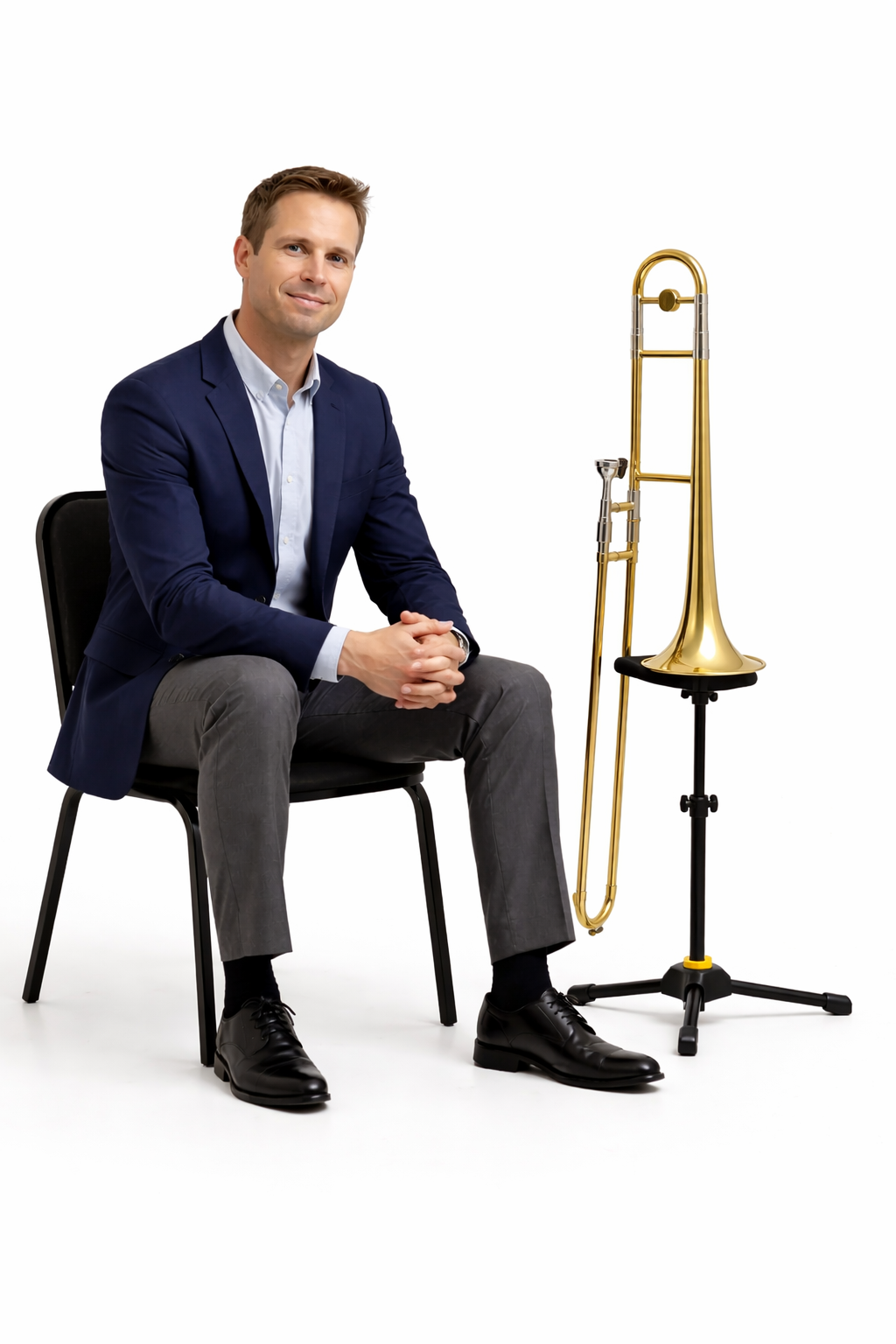
Whether you’re a complete beginner or looking to refine your skills, personalized guidance can make all the difference. Private lessons with The Trombone Mentor give you step-by-step instruction, customized practice plans, and expert feedback designed to help you improve faster and play with confidence.
👉 Start making real progress today — schedule your private lesson and discover how enjoyable learning trombone can be with the right support. CONTACT me for more details.
Final Thoughts
Learning how to master playing slurs on the trombone is an important part of becoming a skilled musician. Smooth slurring allows the instrument to produce a warm, flowing sound that resembles the natural phrasing of the human voice.
By developing control over:
-
Lip slurs
-
Natural slurs
-
Legato tonguing
-
Smooth slide movement
-
Continuous airflow
Trombone players can greatly improve both their tone and musical expression.
Consistent practice with these techniques will lead to stronger flexibility, better slide accuracy, and a more connected sound throughout the instrument.
Related Trombone Articles
How to Practice Trombone Effectively
The Best Warm-Up Routine for Trombone Players