
A great trombone tone is one of the most important skills any player can develop. In fact, audiences usually notice your sound before they notice your technique, range, or speed. A player with a warm, rich tone will often sound more musical than someone who can play fast notes but struggles with sound quality.
The good news is that tone is not something you are simply born with. Instead, it is a skill that can be improved through proper breathing, consistent practice, strong fundamentals, and smart listening habits.
If your trombone sound feels thin, airy, bright, harsh, or inconsistent, this guide will help you understand exactly how to improve it. These strategies work for beginner, intermediate, and advanced trombone players alike.
Because this article supports our complete guide on Trombone Long Tones, you will also discover why long tones remain one of the most effective tone-building exercises ever created.
Let’s get started!
Disclaimer
This article contains Amazon Affiliate Links. What this means, is that, at no cost to you, if you click a link and follow through with a purchase, this site may earn a small commission.
What Creates a Great Trombone Tone?
Before learning how to improve your sound, it helps to understand what actually creates a good trombone tone in the first place.
Several factors work together every time you play a note.
Airflow
The trombone is powered entirely by air. Without steady, supported airflow, the sound becomes weak and unstable.
Strong airflow creates:
- Better resonance
- Fuller sound
- Improved projection
- More consistent tone quality
Many tone problems actually begin with inefficient breathing rather than the lips themselves.
Embouchure
Your embouchure refers to how your lips, facial muscles, and mouthpiece work together.
A healthy embouchure should feel:
- Firm at the corners
- Relaxed in the center
- Flexible rather than stiff
Too much tension can create a pinched sound. However, too little firmness can create an airy tone.
Open Oral Cavity
Professional trombone players often describe playing with an “open throat.”
Think about the feeling of saying:
- “OH”
- “AH”
This open shape helps the instrument resonate more freely.
A tight throat usually produces a small, restricted sound.
Posture
Good posture improves breathing efficiency.
When sitting or standing:
- Keep your chest comfortably lifted
- Relax your shoulders
- Avoid slouching
- Keep your head balanced naturally
Poor posture limits airflow and reduces resonance.
Equipment
Although the player matters more than the equipment, your setup still affects your tone.
Important factors include:
- Mouthpiece size
- Trombone quality
- Slide condition
- Instrument cleanliness
A dirty trombone can dramatically reduce resonance and response.
Why Many Trombone Players Struggle With Trombone Tone
Almost every trombone player experiences tone problems at some point.
Common issues include:
- Thin sound
- Airy tone
- Harsh brightness
- Lack of projection
- Inconsistent sound between registers
- Cracked attacks
Usually, these problems come from a few common causes.
Weak Air Support
Many beginners simply do not move enough air through the instrument.
Instead of filling the horn with steady airflow, they blow cautiously and create an unsupported sound. Learn more about Trombone Breathing Exercises: 7 DIY Tools
Excess Mouthpiece Pressure
Pressing the mouthpiece too hard against the lips restricts vibration.
This often creates:
- Thin tone
- Endurance problems
- Poor flexibility
Tension
Tension is one of the biggest enemies of good tone.
Players often tighten:
- The shoulders
- The jaw
- The throat
- The embouchure
Relaxation allows the instrument to resonate naturally.
Inconsistent Practice
Tone develops slowly over time.
Skipping fundamentals and only practicing songs or band music usually slows tone development considerably.
Follow this guide: How to Practice Trombone: A Beginner Routine That Actually Works
The Fastest Way to Improve Trombone Tone
If you want faster improvement, focus on daily fundamentals rather than complicated exercises.
The most effective tone-building habits include:
- Long tones
- Breathing exercises
- Lip slurs
- Soft playing
- Listening to professionals
- Recording yourself
Consistency matters far more than marathon practice sessions.
Practicing 20 focused minutes every day is usually more effective than practicing two hours once a week.
Master Your Airflow
Air is the foundation of great trombone tone.
Many players try to “muscle” the sound using lip tension. However, great trombone playing actually relies on relaxed airflow.
Breathe Deeply
Take full relaxed breaths from the lower torso.
Avoid:
- Raising your shoulders
- Shallow chest breathing
- Tight inhalation
Instead, allow the stomach and rib cage to expand naturally.
Use Warm Air
Imagine fogging up a mirror with warm air.
This helps encourage:
- Open throat playing
- Fuller resonance
- Richer tone
Cold, tight air often creates a thin sound.
Air Speed Matters
Different registers require different airflow approaches.
Low Register
Use:
- Warm air
- Large air volume
- Relaxed airflow
High Register
Use:
- Faster air
- Focused airflow
- Efficient support
Many players mistakenly force high notes with pressure instead of faster air.
Simple Breathing Exercises
Try this daily:
- Inhale for 4 counts
- Hold for 4 counts
- Exhale steadily for 8 counts
- Repeat 5 times
This helps build breath control and consistency.
Long Tones: The #1 Exercise for Better Trombone Tone
Long tones remain one of the best exercises for developing a beautiful trombone sound.
They improve:
- Air support
- Embouchure stability
- Resonance
- Dynamic control
- Intonation
- Endurance
Many professional trombonists still practice long tones every day.
Why Long Tones Work
When you sustain a note for several seconds, you expose weaknesses that short notes can hide.
Long tones reveal:
- Shaky airflow
- Tension
- Poor intonation
- Unstable attacks
Over time, they train the body to produce a more consistent sound.
How to Practice Long Tones
Start in the middle register where the instrument responds easily.
Hold each note:
- 8–12 seconds
- At a comfortable dynamic
- With steady airflow
Focus on:
- Smooth attacks
- Centered pitch
- Stable sound
- Relaxed breathing
Use a tuner and metronome whenever possible.
Dynamic Long Tones
Once basic long tones feel comfortable, try adding crescendos and decrescendos.
This improves:
- Control
- Air consistency
- Tone flexibility
For example:
- Start soft
- Gradually grow louder
- Return softly
- Keep tone quality consistent
Lip Slur Connection
Long tones and lip slurs work extremely well together.
Long tones develop stability while lip slurs improve flexibility and efficiency.
Together, they create a more resonant sound.
For a complete breakdown of long tone exercises and routines, be sure to read our pillar article:
“Trombone Long Tones Explained.”
Improve Your Embouchure for Better Tone
Your embouchure directly affects tone quality.
However, many players overcomplicate embouchure development.
A good embouchure is usually:
- Stable
- Relaxed
- Efficient
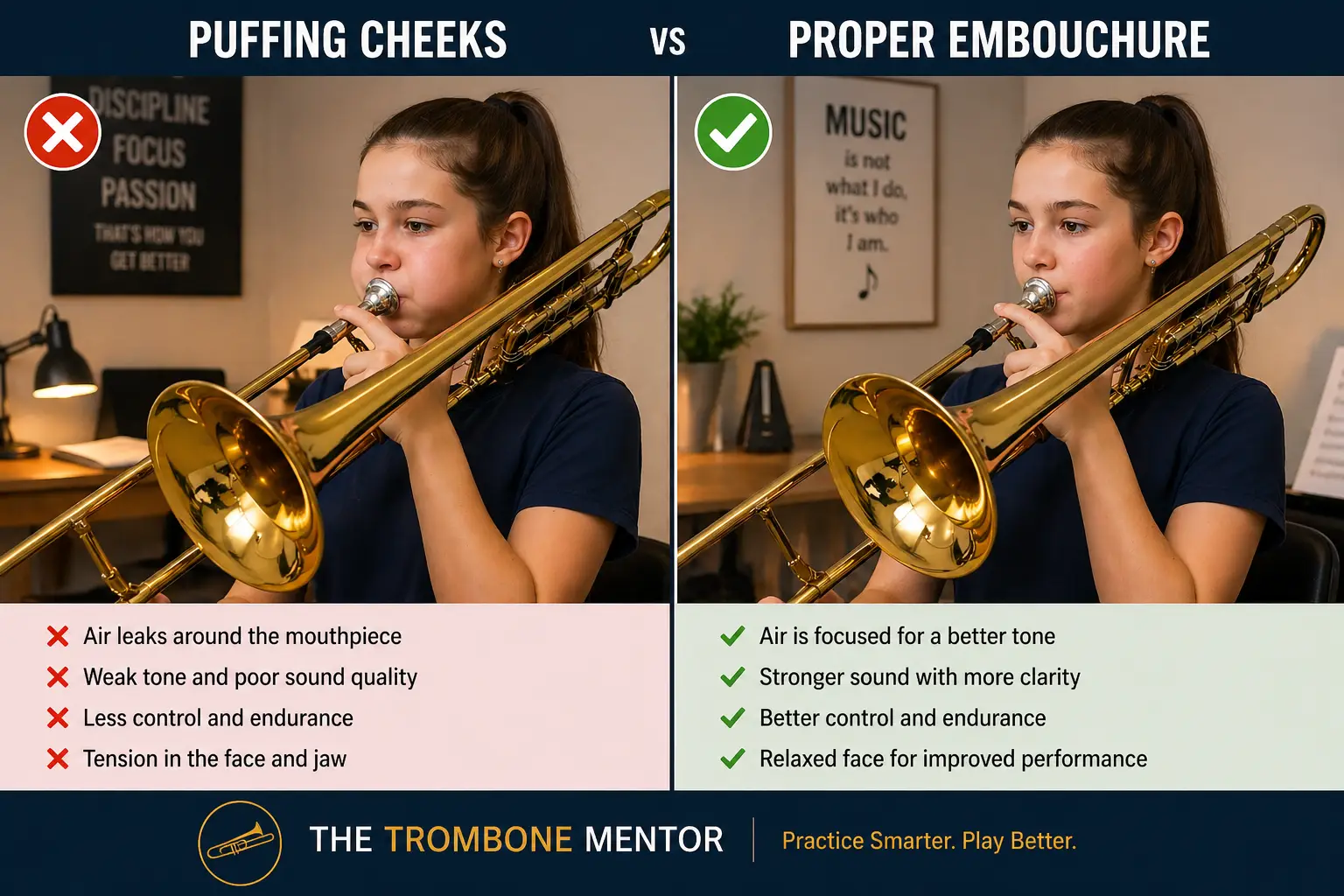
Common Embouchure Mistakes
Smiling Embouchure
Pulling the lips outward creates tension and thins the sound.
Puffing Cheeks
This reduces control and weakens support.
Excess Pressure
Pressing too hard restricts vibration.
Tight Corners
Over-tightening creates a pinched tone.
Mouthpiece Placement
Most trombone players use a mouthpiece placement close to:
- 50/50 upper-to-lower lip
or - Slightly more upper lip
However, individual differences exist.
Comfort, response, and resonance matter more than exact percentages.
Mouthpiece Buzzing
Buzzing can help improve:
- Pitch awareness
- Airflow
- Tone focus
Keep buzzing relaxed and musical rather than forced.
Simple melodies work best.
Lip Slurs and Flexibility Exercises
Lip slurs improve tone because they teach the embouchure to move efficiently between notes.
Efficient movement creates:
- Better resonance
- Smoother sound
- Improved consistency
Beginner Lip Slur Exercise
Try:
- Bb–F–Bb
- F–Bb–D
Focus on:
- Smooth transitions
- Steady airflow
- Minimal tension
Avoid Forcing High Notes
Many players damage tone by forcing upper register playing.
Instead:
- Use faster air
- Stay relaxed
- Allow range to develop gradually
Good tone should always come before extreme range.
Listening is Essential for Great Tone
You cannot consistently produce a beautiful sound if you do not know what a beautiful sound should sound like. Great players develop tone partly through imitation.
Listen to Professional Trombonists
Study the sound of great trombone players such as:
- Joseph Alessi
- Christian Lindberg
- Bill Watrous
- Urbie Green
- J.J. Johnson
- Wycliffe Gordon
Pay attention to:
- Warmth
- Clarity
- Projection
- Smoothness
- Articulation
I learned early enough to seek out recordings of some of the great trombonists. I got hooked real fast! Listen to the recording below of one of the best trombone players: Bill Watrous. In this recording, Bill starts out with a beautiful melodic section showing his smooth and great tone. The band gets going for a bit, followed by an incredible cadenza that shows off the Watrous range, improvisational technique. Enjoy!
Record Yourself
Recording yourself regularly is one of the fastest ways to improve.
Many players are surprised by how different they sound from what they hear while playing.
Use recordings to evaluate:
- Tone consistency
- Intonation
- Attacks
- Dynamics
Weekly recordings can reveal major progress over time.
Improve Articulation for Cleaner Tone
Tone quality begins at the start of every note.
Poor articulation often creates:
- Harsh attacks
- Explosive beginnings
- Unclear sound
Use Smooth Tonguing
Think:
- “Tah”
rather than - “Too”
This encourages a more open sound.
Keep Air Moving
The tongue should interrupt the airflow briefly, not stop it completely.
Continuous airflow creates smoother attacks and better resonance.
Practice Legato Playing
Legato exercises improve:
- Air consistency
- Connection between notes
- Overall smoothness
Smooth playing almost always improves tone quality.
Equipment Tips for Better Trombone Tone
Equipment will not magically fix poor fundamentals. However, the right setup can make good playing easier.
Mouthpiece Choice
Different mouthpieces affect:
- Tone color
- Response
- Flexibility
Generally:
- Larger mouthpieces create darker sounds
- Smaller mouthpieces create brighter sounds
Comfort and control matter most.
Keep Your Trombone Clean
A dirty instrument reduces resonance and airflow efficiency.
Regularly:
- Clean the slide
- Empty water keys
- Wash the mouthpiece
- Maintain lubrication
A well-maintained trombone responds more freely.
Slide Condition Matters
A smooth slide improves:
- Accuracy
- Relaxation
- Fluid playing
Jerky slide movement often creates tension throughout the body.
Daily Practice Routine for Better Tone
Here is a simple 20-minute tone-building routine.
1. Breathing Exercises (3 Minutes)
Focus on:
- Full relaxed breaths
- Steady exhalation
2. Long Tones (5 Minutes)
Use:
- Middle register notes
- Stable dynamics
- Relaxed sound
3. Lip Slurs (5 Minutes)
Focus on:
- Smooth movement
- Air consistency
4. Simple Melodies (5 Minutes)
Play lyrical music musically and smoothly.
5. Cool Down (2 Minutes)
End with relaxed low notes and soft playing.
How Your Mouthpiece Can Affect Your Tone
Your mouthpiece plays a major role in shaping the sound of your trombone. While the instrument itself provides the foundation, the mouthpiece influences tone quality, response, flexibility, endurance, and range.
Generally speaking, a smaller mouthpiece can produce a brighter, more focused sound and may make high notes easier to access. A larger mouthpiece often creates a broader, warmer tone that blends well in concert bands, wind ensembles, and orchestras. However, larger mouthpieces usually require more air support and embouchure strength.
For many students transitioning to an F-attachment trombone, the mouthpiece that came with their beginner instrument may not be the best long-term choice. As players develop, they often move to a mouthpiece that provides a fuller sound and greater flexibility throughout the instrument’s range.
It is important to remember that no mouthpiece can replace good fundamentals. Proper breathing, embouchure formation, and consistent practice have a far greater impact on tone than equipment alone. The right mouthpiece should enhance your playing, not compensate for weak technique.
If you’d like to learn more about mouthpiece sizes, shank types, and how to choose the best mouthpiece for your trombone, be sure to read my article, Trombone Mouthpieces Explained.
Common Mistakes That Hurt Trombone Tone
Avoid these common problems.
Playing Too Loud
Constant loud playing spreads the tone and creates tension.
Ignoring Soft Playing
Soft practice exposes weaknesses and improves control.
Skipping Warm-Ups
Cold playing often leads to poor response and tightness.
Practicing Without Listening
Always evaluate your sound consciously.
Focusing Only on Range
A beautiful middle register tone should come before extreme high notes.
How Long Does It Take to Improve Trombone Tone?
Tone development is gradual.
Most players notice:
- Small improvements within weeks
- Significant improvement within months
- Major transformation over years
Even professional trombonists continue working on tone throughout their entire careers.
The key is consistency.
Ready to Take Your Trombone Playing to the Next Level?
Whether you’re a complete beginner or looking to refine your skills, personalized guidance can make all the difference. Private lessons with the Trombone Mentor give you step-by-step instruction, customized practice plans, and expert feedback designed to help you improve faster and play with confidence.
Start making real progress today — schedule your private lesson and discover how enjoyable learning trombone can be with the right support. ONLINE TROMBONE LESSONS – Learn Anywhere with a Private Trombone Teacher
Final Thoughts
Improving trombone tone is not about finding a magic exercise or expensive equipment upgrade. Instead, great tone comes from mastering the fundamentals repeatedly over time.
Focus on:
- Strong airflow
- Relaxed playing
- Long tones
- Lip slurs
- Listening
- Daily consistency
Most importantly, stay patient.
Every great trombone player developed their sound gradually through focused practice and careful listening.
Related Trombone Articles
How to Practice Trombone: A Beginner Routine That Actually Works
Beginner Trombone Mistakes: 10 Common Problems (Fix Fast)
10 Easy Trombone Songs for Beginners (+ Free Practice Sheet)
Trombone Practice Tools: 10 Tools That Actually Improve Your Playing
About the Author
Rick Lawrence is a music educator, conductor, professional trombonist, and private instructor with more than 40 years of playing and teaching experience. He has performed with orchestras, jazz ensembles, brass bands, and pit orchestras, and studied with John Coffey of the Boston Symphony Orchestra, Donald Knaub of the University of Texas, and Edward J. Madden – trombonist, composer and arranger. Through The Trombone Mentor, Rick provides online trombone lessons and educational resources for beginner, intermediate, and advanced trombonists.