Disclaimer
The Trombone Mentor participates in the Amazon Services LLC Associates Program. As an Amazon Associate, we earn from qualifying purchases at no extra cost to you.
Meet Your Trombone Mentor
Before we dive into the details of how to play the trombone, I want to take a moment to introduce myself and explain why I created this guide.
My name is Rick Lawrence, and I am a professional trombonist and teacher. Over the past forty years, I’ve performed in orchestras, jazz ensembles, brass groups, and pit orchestras, and I’ve spent much of my career teaching students of all ages—from elementary school beginners to adult learners picking up the instrument later in life.
One of the most important lessons I’ve learned is this: every great trombonist starts in exactly the same place. No sound, awkward posture, uncertain slide positions, and a lot of questions. The difference between those who succeed and those who struggle is not talent—it’s guidance, patience, and consistent practice.
That’s exactly why I created Trombone Mentor.
This guide is not just a collection of information. It is the same step-by-step approach I’ve used with real students in lessons for decades. My goal is to help you avoid confusion, build strong fundamentals early, and enjoy the process of learning music instead of feeling overwhelmed by it.
If you follow this guide and take it one step at a time, you will be able to produce a clear sound, understand the basics of music reading, and begin playing simple songs sooner than you might expect.
Sign up for a free consultation lesson with Rick Lawrence
ONLINE TROMBONE LESSONS – Learn Anywhere with a Private Trombone Teacher
Let’s continue your journey.
Why Learn the Trombone?
The trombone is much more than a brass instrument—it is a musical instrument that can take you on a lifetime of exciting experiences. Whether you dream of performing on stage, playing in your school band, joining a jazz ensemble, or simply making music for your own enjoyment, the trombone offers opportunities that few instruments can match.
Versatility
One of the greatest strengths of the trombone is its versatility. This instrument is an essential part of the instrumentation in:
- concert bands
- symphony orchestras
- jazz bands
- marching bands
- brass bands
As your skills grow, you’ll discover that the trombone has an incredible library of literature for performance.
For most students, learning the trombone begins in elementary school and continues to middle school and high school bands and orchestras. It’s a wonderful way to make new friends, develop teamwork, and become part of something bigger than yourself. Playing in an ensemble teaches responsibility, listening skills, and cooperation—qualities that extend far beyond music.
The trombone is also an instrument that rewards dedication. Every practice session helps you improve your tone, accuracy, endurance, and confidence. While progress takes time, each new note, song, and performance is another milestone in your musical journey.
Learning the trombone also develops valuable life skills. Regular practice teaches patience, discipline, goal setting, and perseverance. You’ll learn that consistent effort produces steady improvement—a lesson that applies not only to music but to school, work, and many other areas of life.
Many students are surprised to discover how many opportunities become available as they continue playing. You may perform in school concerts, marching band competitions, jazz festivals, honor bands, community ensembles, church groups, or local theater productions. Some students even earn college scholarships or pursue careers in music education or professional performance.
Perhaps the greatest reward, however, is the joy of making music. There is something deeply satisfying about producing a beautiful sound, mastering a challenging piece, and sharing music with others. Whether you continue playing for a few years or for the rest of your life, the trombone can provide friendships, unforgettable experiences, and a lifelong appreciation for music.
As someone who has spent more than four decades performing and teaching, I can honestly say that learning the trombone has enriched my life in countless ways. My hope is that it will do the same for you.
My Trombone Journey
When I was in the 4th grade, I remember listening to the high school band director demonstrating the trombone for the students. I was immediately impressed with how this instrument sounded and in particular the tone produced by this teacher. The smooth silky sound and the “jazzy” tricks that he played for us. I signed up and never looked back. It was because of this teacher, the trombone, and his incredible sound that convinced me to play the trombone.
Choosing Your First Trombone
One of the first questions every beginning trombone player—or their parents—asks is, “What trombone should I get?” It’s an important question because the right instrument can make learning easier, more enjoyable, and much more successful.
The good news is that choosing your first trombone doesn’t have to be difficult.
Many beginners think they need an expensive instrument to play well. Fortunately, that’s simply not true. A quality beginner trombone that is well-made and in good playing condition will help you develop good habits and enjoy learning from the very first lesson.
The goal isn’t to buy the most expensive trombone. It is to choose a trombone that helps you succeed.
In this next section, I’ll explain the differences between renting and buying, what features really matter for a beginner, how much you should expect to spend, and the common mistakes to avoid. By the end, you’ll have the information you need to make a confident decision for yourself or your child.
Should You Buy or Rent?
For many families, choosing a first trombone can feel overwhelming—especially if no one in the family has a musical background. It’s perfectly normal to have questions. In fact, one of the most common things parents tell me is, “We don’t know anything about musical instruments.”
The good news is that you don’t have to become a trombone expert overnight. With a little guidance, you can make a confident decision that fits both your child’s needs and your family’s budget.
Many school districts work closely with local music stores that offer convenient rental or rent-to-own programs. These programs can be an excellent option for families who prefer smaller monthly payments or want to get started quickly. They also provide access to maintenance and repairs, which can be a valuable benefit for beginners.
However, renting isn’t the only choice.
If your family is in a position to purchase a beginner trombone outright, you will have a choice between different brands, models, and prices before making a decision. That allows you to choose an instrument that best fits your budget and your child’s long-term musical goals.
The purpose of this guide is not to tell you which option you must choose. Instead, it’s to give you the knowledge and confidence to understand your choices. Whether you decide to rent or buy, an informed decision is almost always the best decision.
In the following sections, I’ll explain what to look for in a quality beginner trombone, which features are most important, and how to avoid some of the common mistakes that can make learning more difficult. My goal is to help you feel comfortable with your decision and give your child the best possible start on the trombone.
What Should You Look for in a Beginner Trombone?
Whether you decide to rent or buy, the most important thing is choosing a trombone that is well-made and in good playing condition. A quality beginner instrument will make learning easier, sound better, and encourage good playing habits from the very beginning.
Many parents assume that all beginner trombones are the same. Unfortunately, that’s not the case. While many student models look similar on the outside, the quality of their construction can vary significantly.
Here are the features I recommend looking for when choosing a beginner trombone.
A Smooth-Operating Slide
The slide is the heart of the trombone. It should move freely and smoothly through all seven positions without sticking or feeling rough. A slide that binds or hesitates can quickly frustrate a beginner and make learning much more difficult.
If you’re purchasing a used trombone, always check the slide carefully. Even an excellent brand can become difficult to play if the slide has been damaged.
Good Overall Condition
Small scratches and signs of normal use are usually nothing to worry about, especially on a used instrument. However, avoid trombones with large dents, bent slides, broken braces, or obvious damage that could affect the way the instrument plays.
A well-maintained used trombone from a respected manufacturer is often a much better choice than a brand-new, inexpensive instrument of questionable quality.
A Reliable Manufacturer
Choosing a trombone from a well-established manufacturer gives beginners an excellent chance for success. Companies such as Yamaha, Conn, Bach, and King have earned strong reputations for producing dependable student instruments that are used in schools throughout the country.
These instruments are built to withstand everyday use while providing the sound quality and reliability that beginning students need.
A Standard Straight Tenor Trombone
For most beginners, I recommend starting with a standard straight tenor trombone rather than one with an F-attachment. A straight trombone is lighter, easier to hold, less expensive, and allows students to focus on developing strong fundamentals before moving to a more advanced instrument.
As students gain experience, there will be plenty of time to explore larger instruments and additional features.
Comfortable to Hold
A beginning student should feel comfortable holding the instrument. If the trombone feels unusually heavy or awkward, it may become tiring during practice or rehearsals. A properly balanced student model allows beginners to focus on making music rather than struggling to support the instrument.
Think Long-Term
Your first trombone doesn’t have to last forever, but it should provide a solid foundation for learning. A dependable beginner instrument can serve a student well for several years before it becomes necessary to consider upgrading.
Remember, the goal isn’t to own the most expensive trombone. The goal is to own one that allows you to learn, improve, and enjoy making music every time you pick it up.
Getting to Know Your Trombone
Congratulations!
You now have your trombone, and you’re probably eager to make your first sound. Before we do that, let’s take a few minutes to become familiar with the instrument itself.
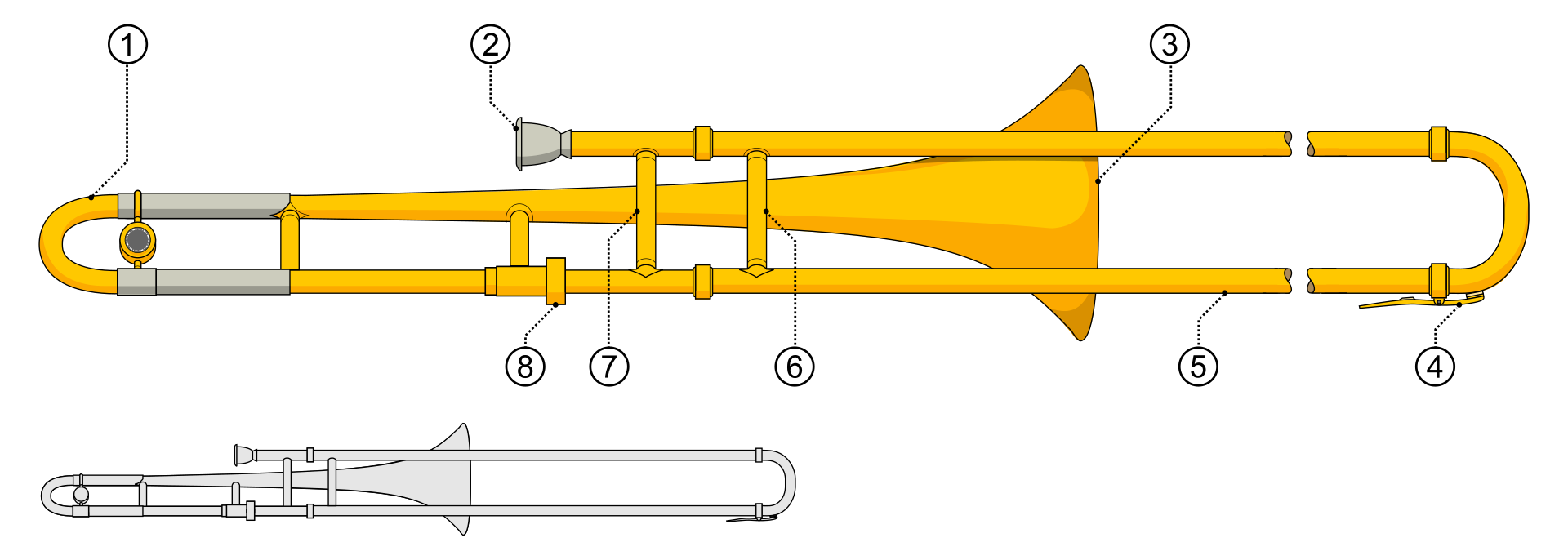
Every part of the trombone has an important job. As you learn the names and purpose of each part, you’ll feel more comfortable handling your instrument and better understand the instructions you’ll receive from your band director or private teacher.
Don’t worry about memorizing everything at once. Like learning anything new, you’ll become more familiar with these parts each time you pick up your trombone. Before long, their names and functions will become second nature.
Let’s begin by looking at the major parts of a standard beginner trombone.
The Bell
The bell is the large, flared end of the trombone where the sound projects outward. Although the bell helps amplify your sound, remember that a beautiful tone begins with good breathing and a relaxed embouchure—not simply by blowing harder.
The Slide
The slide is the trombone’s most recognizable feature. Unlike most brass instruments, which use valves, the trombone changes pitch by moving the slide to different positions. Learning to move the slide smoothly and accurately is one of the most enjoyable parts of playing the instrument.
The Mouthpiece
The mouthpiece is where your musical sound begins. Your lips vibrate inside the mouthpiece to create the buzzing that becomes the trombone’s rich, full tone. A properly fitted mouthpiece is essential for developing good playing habits.
The Tuning Slide
The tuning slide allows small adjustments to the overall pitch of the trombone. As a beginner, your teacher or band director will usually help you set the tuning slide correctly. Once it’s adjusted, it normally stays in the same position unless your instrument needs to be retuned.
The Water Key
As you play, moisture naturally collects inside the instrument. The water key allows you to release that moisture quickly and easily. Every trombone player uses the water key, so don’t be surprised when you hear someone say, “Empty your water key.”
The Braces
The braces connect different parts of the trombone and provide strength and support. They also give you safe places to hold the instrument while assembling, carrying, and playing it.
As you become familiar with these parts, you’ll begin to feel more comfortable handling your trombone with confidence. In the next section, I’ll show you how to assemble your instrument safely and correctly so you’re ready to make your very first sound.
Parts of the Trombone (Beginner Basics)
- Tuning Slide
- Mouthpiece
- Bell
- Water Key
- Slide
- Slide Handle
- Brace
- Connection
Understanding the parts of the instrument is essential for every beginner trombone player.
How to Assemble Your Trombone From the Floor Up
Take it from a student back in the 4th grade that thought he was smarter than the teacher and almost damaged his trombone on the first day. Yep! That was me. I didn’t follow directions and almost had a disaster. Since that day, I made a commitment to teach all of my beginning trombonists the correct way to assemble the trombone. Follow the step-by-step procedure for assembling your trombone. After today, you shouldn’t have any problems with this process.
PART ONE
- First, your trombone is in its case and on the floor. Correct? Good! Leave it there. Don’t put it on a chair or table. Leave it right on the floor.
- Second, open up the case so that the two parts of the trombone are flat on the floor.
- Third, with your right hand, pick up the slide part. Notice that there is a threaded part on one side and a place for the mouthpiece.
- Fourth, with your left hand, pick up the bell part of the trombone. Notice that there is a screw-on connector part.
- Fifth, carefully take the bell part and place it on the slide with the threaded part. Tighten the connector until it is snug.
- Sixth, reach down and pick up the mouthpiece and put it in its place. Please remember to NEVER pop the mouthpiece with your hand. The mouthpiece will get stuck.
PART TWO
Good job!. Now that you know the procedure for assembling your trombone, let’s reverse the process and disassemble your trombone.
- First, hold the instrument with your right hand and remove the mouthpiece from the trombone. Place it where it goes in the case.
- Second, with your left hand, loosen the connector, lift the bell section off of the slide and place it in the case.
- Third, with your right hand, take the slide and put it back in the case.
- Fourth, close up the case, making sure that the latches are secure. FANTASTIC!
PART THREE
This part is very simple and please don’t pass it by. Repeat part one and part two one more time. This process locks it into your brain removing 99% chance of a disaster in the future. CONGRATULATIONS!
How to Hold Your Trombone
Before you play your first note, it’s important to learn how to hold the trombone correctly. A good playing position helps you feel comfortable, protects the instrument, and makes it easier to develop good playing habits from the very beginning.
Holding the Trombone with Your Left Hand
Your left hand supports the weight of the instrument. Place your hand around the brace near the mouthpiece, using a comfortable grip that allows you to balance the trombone without squeezing it tightly.
A relaxed grip is important. Holding the instrument too tightly can create unnecessary tension that affects both your comfort and your playing.
Holding the Slide with Your Right Hand
Your right hand controls the slide.
Hold the slide gently using your thumb and your first two fingers. Your ring finger and little finger can remain relaxed and are not used to grip the slide.
The goal is to move the slide smoothly and naturally. Think of guiding the slide rather than forcing it. Now that you are holding the trombone properly, let’s move on to making our first sounds. Before we do that, let’s lay the trombone down in a safe place, except for the mouthpiece.
Making Your First Sounds
Making your first sounds is in two steps. Follow these steps and you will be off and running to producing a great sound on your trombone.
Step One: Learning to Buzz the Mouthpiece
Before we use the entire trombone, I’d like to introduce you to one of the most valuable exercises you’ll ever learn as a brass player. It’s called buzzing the mouthpiece. Let’s remember that the trombone doesn’t create the sound. You do.
Your lips create the vibration, the mouthpiece captures that vibration, and the trombone amplifies it into the beautiful sound we all recognize.
Learning to buzz the mouthpiece serves to accomplish several things:
- Helps you understand where your sound begins.
- It develops your embouchure
- Strengthens the muscles around your lips
- Teaches you to listen to the sounds coming out
- Improves your airflow
- Teaches you to produce a clear, steady tone before adding the rest of the instrument.
Follow these three steps:
- Start with a Relaxed Breath – take a slow, comfortable breath as though you’re about to sigh. Keep your shoulders relaxed and avoid taking a tense, forced breath.
- Bring the Mouthpiece to Your Lips – place the mouthpiece gently in the center of your lips. 50% on the upper lip and 50% on lower lip. Avoid pressing it hard against your mouth. Your lips should be firm enough to vibrate but relaxed enough to respond to the air you’re blowing through them.
- Create the Buzz – using the syllable “too” start a steady stream of air through your lips until they begin to vibrate. Listen to the sound coming from the mouthpiece. Let’s try this again!
Congratulations!
You’ve just created your first important sound without the trombone. It may sound more like a buzzing bee than beautiful music right now—and that’s what we want. As your control improves, so will your sound. It is best that you understand that this process makes it much easier to making your first trombone sound.
Step Two: Your First Trombone Sound
In this next step, let’s pick up the trombone. Remember how we learned to hold it properly. Insert the mouthpiece and bring the instrument up to your lips. Take a slow, comfortable breath. Use the syllable “too” and play your first trombone sound.
How did you do? Great! Now, we want to repeat this step three times. Each time play this note (that we will call B flat) for four long beats. The most important part of these two steps is to take your time. Rushing through them will defeat the purpose and result in negative results.
Need Help Mastering This Technique? Book a lesson with Rick.
ONLINE TROMBONE LESSONS – Learn Anywhere with a Private Trombone Teacher
Your Playing Posture
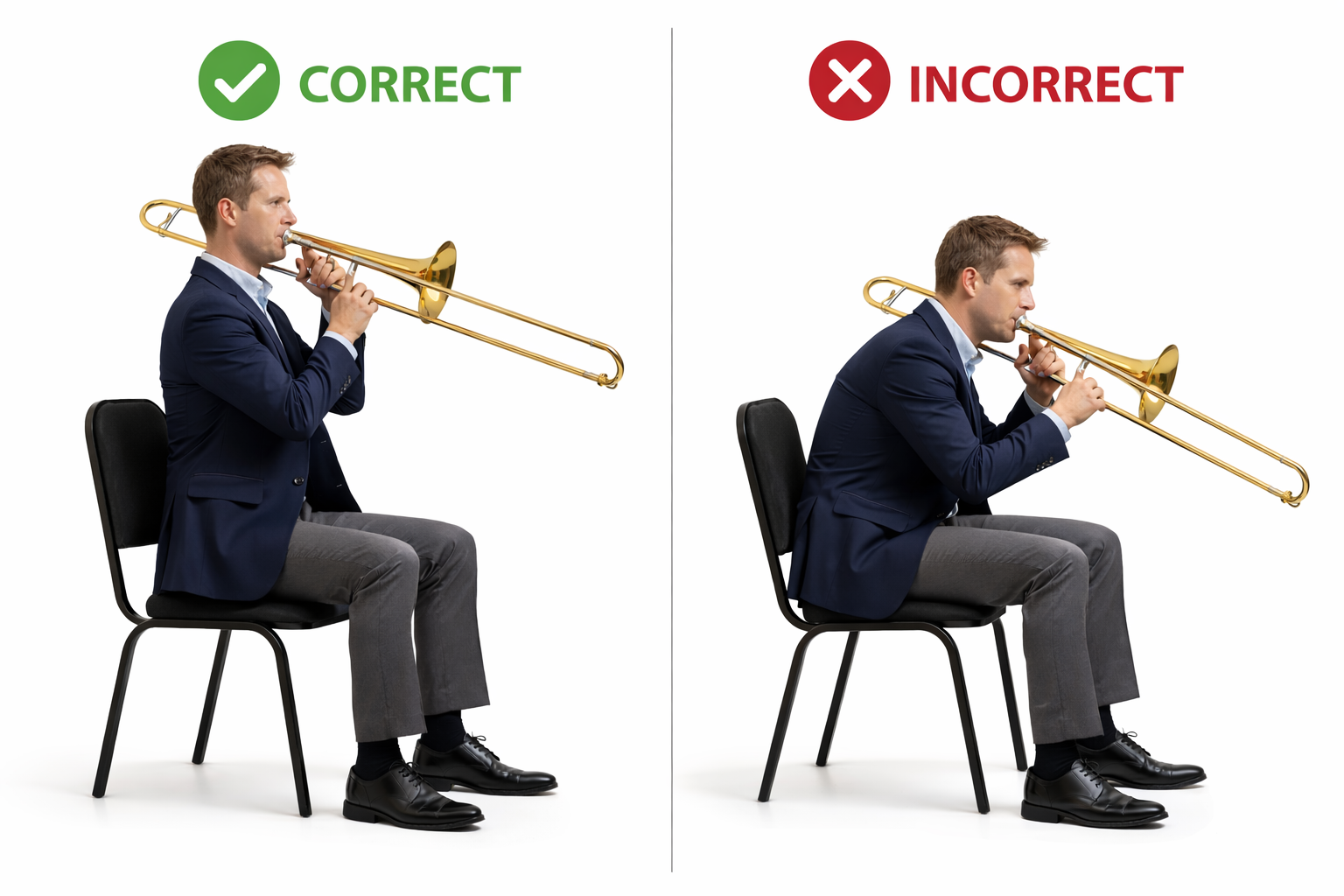
With everyone of my students, I always start with the correct posture and grip. These are critical for long-term success in beginner trombone playing. Whether sitting or standing, your posture should feel natural and balanced.
- Keep your back straight (not stiff)
- Avoid slouching or leaning forward
- If seated, sit toward the front of the chair
- Keep both feet flat on the floor
Think of your spine as “tall and relaxed,” not rigid.
LEARN MORE: Trombone Posture Guide for Beginners (Play Comfortably)
First Notes for Beginner Trombone
A good article to read is:Your first notes will typically come from first position:
- Low Bb
- F
- Higher Bb
Follow the instructions below that will explain how to play the exercises.
- The Bass Clef is what the trombone music will be in.
- The Time Signature will tell you how many beats in a measure and what note will get one beat.
- A Whole Rest represents slilence in music. In this exercise, the whole rest gets four counts.
- A Whole Note represents sound in music. In this exercise, the whole note will get four counts.
- The definition of music is “Organized Sounds and Silences”. Sounds = Notes Silences = Rests.
- The note values that you will learn in these exercises are: Whole Note – 4 counts, Half Notes – 2 counts each, and Quarter Notes – 1 count each.
- The notes that you will learn are Low Bb, F, Higher Bb.
- Take a deep breath for each set of notes.
- Use the syllable “tah” to play each note.
- Make sure that you push the air through the trombone, not just into it.
First Notes for Beginner Trombone
How did you do? For the first three days, focus on practicing these exercises consistently before moving on to more difficult material. Once you feel comfortable and your notes sound full and steady, you can proceed to the next part of this guide. Remember, this is not a race—quality matters more than speed. Aim to play each exercise at least ten times to help strengthen your embouchure muscles and build consistency.
Beginner Trombone Slide Positions Explained
Slide positions are a defining feature of beginner trombone playing.
What Are Slide Positions?
The trombone uses 7 basic slide positions to produce different pitches. Each position slightly changes the length of the tubing. Please watch the video below to get a good understanding of the seven slide positions and where they are on the slide.
How to Practice Trombone Notes and Slide Positions
To learn trombone notes and slide positions, practice the four exercises below every day. Just like your First Notes exercises, consistent repetition is essential for building accuracy and confidence.
Trombone Notes and Positions
Click the link above and follow these step-by-step instructions to get the best results from your practice:
Step 1: Start With Proper Setup
Before you begin, make sure your setup is correct.
- Sit or stand with good posture
- Keep your embouchure relaxed but firm
- Take full, steady breaths
A strong setup leads to a better sound and easier playing.
Step 2: Exercise #1 – Build Sound and Slide Awareness
First, begin with Exercise #1. This pattern uses the familiar Bb–F–Bb in first position.
- Notice the note names at the top
- Pay attention to the slide positions at the bottom
- Follow the exercise as it moves from first position to sixth position
As you play, focus on producing a full, steady tone.
Most importantly, use plenty of air. Think about pushing the air through the trombone, not just into it.
Step 3: Exercise #2 – Improve Slide Movement
Next, move on to Exercise #2. This exercise helps you practice moving between positions:
- First to second, back to first
- First to third, back to first
- Continue this pattern
Be sure to move your slide quickly and cleanly between positions. This will help you avoid a “smear” between notes.
In this exercise, note names and slide positions are not labeled. Therefore, rely on your memory and listening skills.
Step 4: Exercise #3 – Strengthen Tone and Breathing
Now, focus on Exercise #3. This exercise uses whole notes to develop tone.
- Take a deep breath before each note
- Play with a strong, steady sound
- Count in your head: 1–2–3–4
Each note includes its name and slide position, so use them as a guide.
Step 5: Exercise #4 – Play Your First Song
Finally, play Exercise #4—your first song on the trombone.
- The notes and slide positions are labeled
- Play slowly and carefully
- Focus on clean transitions between notes
Practice this exercise several times until you can play it smoothly from beginning to end.
Then, take the next step—perform it for your family and enjoy your first concert.
Practice Tip for Beginner Trombone Players
To make real progress, repeat each exercise multiple times during every practice session. Consistent practice builds muscle memory, improves accuracy, and strengthens your embouchure.
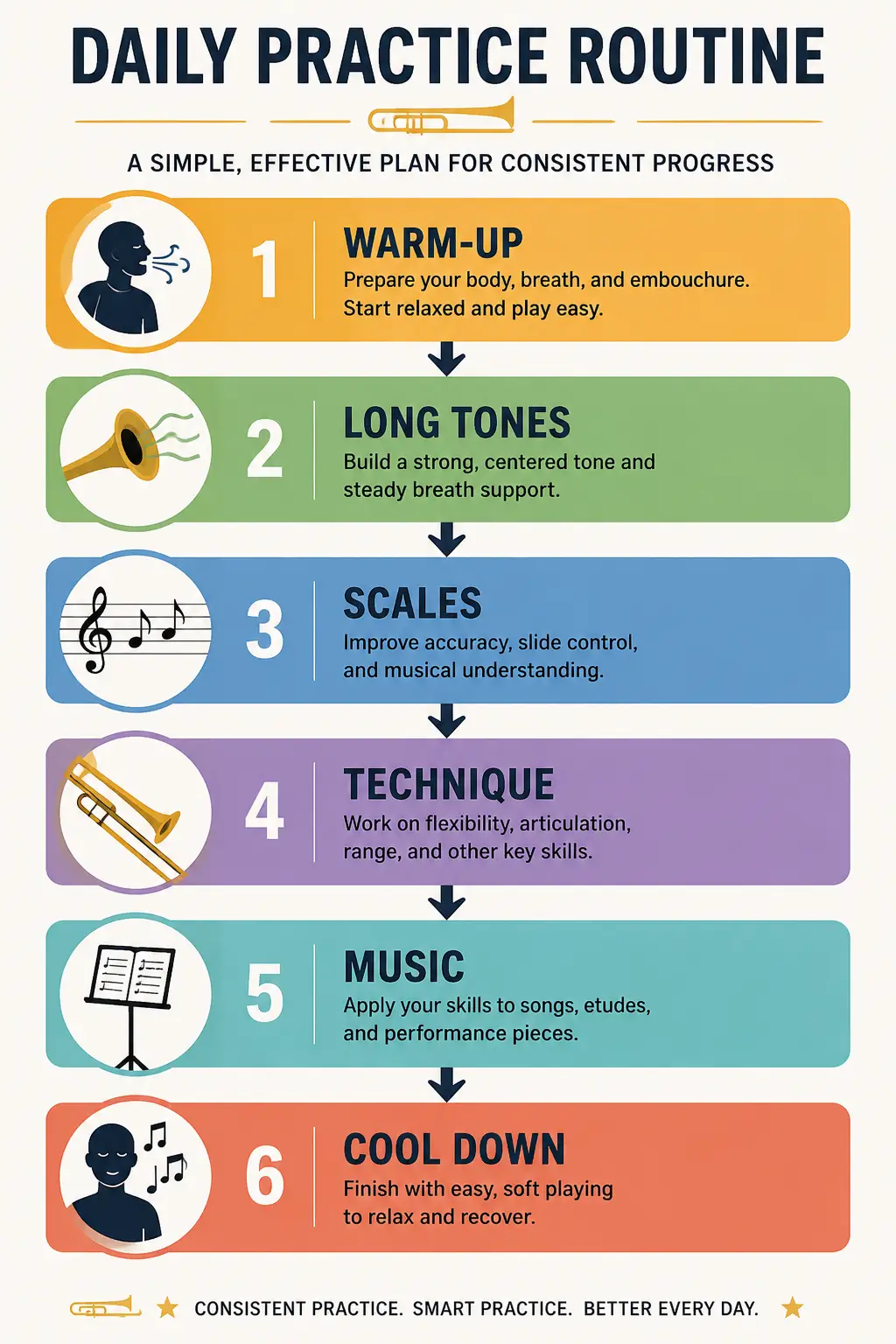
Beginner Trombone Practice Routine (Step-by-Step)
Your mindset as a beginner trombone player is very important. The first 3-4 weeks will determine how serious you are about being a dedicated trombone player. If you really want to become a good player, you need to have a daily practice routine. The emphasis is on the word “daily”. Try and make sure that nothing comes between you and your daily practice session. Consistency matters more than duration for beginner trombone players.
5–10 Minute Daily Routine
Start simple:
- Breathing (1 minute)
Focus on full, relaxed breaths - Long Tones (2–3 minutes)
Sustain notes for steady tone - Simple Slide Exercises (2–3 minutes)
Move between positions slowly - Basic Notes or Scale (2–3 minutes)
Practice Bb or simple patterns
Weekly Progression Plan
- Week 1–2: Focus on sound production: First 5 Notes for Trombone Beginners and Trombone Slide Positions Chart
- Week 3–4: Add slide accuracy (Warm Up Exercises, Three Major Scales
- Week 5+: Introduce simple songs (Warm Up Exercises, Three Major Scales, Easy Songs for Practice)
How Often Should You Practice?
For beginner trombone players:
- Your goal should be daily practice
- Short sessions (5–15 minutes) are effective
- Consistency beats long, irregular sessions
- As you improve will allow you to expand your practice time (15-30 minutes)
Three Major Scales for Beginner Trombone
Why Scales Matter
Scales help beginner trombone players:
- Learn slide positions
- Develop tone consistency
- Improve pitch accuracy
They are essential—not optional.
These scales appear frequently in beginner music.
Bb Major Scale (Your First and Most Important Scale)
The Bb major scale is usually the first scale trombone players learn because the trombone is a Bb instrument.
Typical notes used:
Bb – C – D – Eb – F – G – A – Bb
Practice Tips:
- Play slowly and focus on accurate slide positions
- Use steady air for a clear tone
- Practice with a metronome for consistent rhythm
Most beginner music is written in Bb major, so learning this scale will make your songs much easier to play.
Bb Major Scale Exercises
C Major Scale (Adding a New Sound)
The C major scale introduces a slightly different pattern of slide movements and helps beginners expand their familiarity with the instrument.
Typical notes
C – D – E – F – G – A – B – C
Practice Tips:
- Keep the air flowing smoothly through the scale
- Listen carefully for pitch accuracy, especially on A and E
C Major Scale Exercises
Common Beginner Trombone Mistakes (And How to Fix Them)
As a beginning trombonist, you will make mistakes along the way. Below are a few common mistakes that may come up. I have outlined the problem and how to fix it. Poor Embouchure Setup
Problem: Thin or unstable sound.
Fix: Your lips are too tight. Relax lips and use steady air
Weak Air Support
Problem: Inconsistent tone.
Fix: Use deeper, fuller breaths. Push the air through the trombone, not just into it.
Incorrect Slide Positions
Problem: Notes sound out of tune
Fix: Practice slowly and listen carefully
Inconsistent Practice
Problem: Slow progress
Fix: Establish a daily routine.
Avoiding these mistakes will dramatically improve your beginner trombone experience.
Ready to Take Your Trombone Playing to the Next Level?
Whether you are just starting trombone or looking to strengthen your tone, technique, and musical confidence, private lessons can help you progress faster with clear guidance and personal support.
With The Trombone Mentor, you receive:
• Step-by-step instruction
• Customized practice plans
• Expert feedback and encouragement
• Online lessons you can take from anywhere
Stop guessing and start making steady progress with lessons designed around your goals.
ONLINE TROMBONE LESSONS – Learn Anywhere with a Private Trombone Teacher
Beginner Trombone FAQs
Is trombone hard to learn?
The trombone is challenging at first due to slide positions, but it becomes much easier with consistent practice.
How do I improve my tone?
Focus on steady airflow, relaxed embouchure, and long tones.
Do I need lessons to start?
While you can begin on your own, guided instruction accelerates progress significantly. What age can a child start trombone?
What age can a child start trombone?
Most children are ready to begin learning the trombone between 9 and 12 years old. Public school music programs introduce the instrument in 4th through 6th grade. However, every child develops differently, so readiness is more important than age alone.
How long does it take to learn trombone?
Most beginners will be able to play simple songs within two to four months with dedicated practice. Learning the trombone is a physical activity, training muscles along with breathing techniques that take time.
Your Next Steps as a Beginner Trombone Player
Now that you understand the fundamentals of beginner trombone, your next steps are clear:
- Practice daily using a simple routine
- Focus on tone and accuracy first
- Learn a few easy songs
- Continue building your skills step by step
Most importantly, stay consistent. Progress on the trombone comes from small improvements repeated over time.
Final Thoughts
Learning beginner trombone is an exciting and rewarding journey.
By focusing on:
- Proper setup
- Strong air support
- Accurate slide positions
- Consistent practice
—you will build a solid foundation that supports everything you learn moving forward.
Take your time, stay patient, and enjoy the process.
About the Author
Rick Lawrence is a music educator, conductor, professional trombonist, and private instructor with more than 40 years of playing and teaching experience. He has performed with orchestras, jazz ensembles, brass bands, and pit orchestras, and studied with John Coffey of the Boston Symphony Orchestra, Donald Knaub of the University of Texas, and composer, arranger, trombonist Edward J. Madden.
Through The Trombone Mentor, Rick provides online trombone lessons and educational resources for beginner, intermediate, and advanced trombonists.