
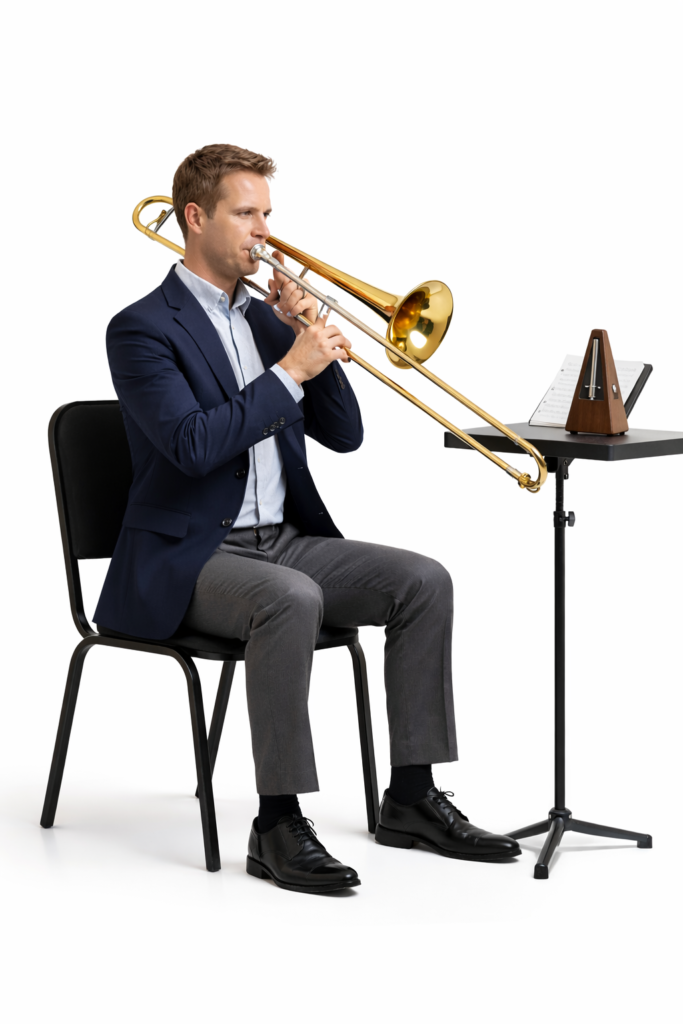
How to practice trombone is something many players struggle with. Most trombone players don’t improve as quickly as they’d like—not because they aren’t practicing, but because they don’t have a clear plan. It’s easy to spend time playing through songs or exercises without making real progress. Without structure, trombone practice can feel frustrating, unfocused, and inconsistent.
Want to improve faster on trombone? The best way is a simple daily routine focused on tone, slide accuracy, range, and music. Here’s the key idea: practicing is not the same as playing. When you practice the trombone, you are training your breathing, embouchure, ears, and muscle memory. Every note you play builds a habit—either correct or incorrect.
In this guide, you’ll learn a step-by-step trombone practice routine for beginners, along with the principles that make practice actually work.
👉 If you’re completely new, start here:
-
Beginner Trombone Guide: How to Start Playing the Right Way
-
First 5 Notes for Trombone Beginners: Easy Step-by-Step Guide
Disclaimer
The Trombone Mentor participates in the Amazon Services LLC Associates Program. As an Amazon Associate, we earn from qualifying purchases at no extra cost to you.
What Does it Mean to Practice Effectively?
Effective trombone practice is not measured by how long you play—it is measured by how focused and intentional your practice is. Many students assume that spending hours with the instrument automatically leads to improvement. In reality, organized and purposeful practice produces far better results than simply playing for a long period of time.
When you practice, your goal is not just to play notes. You are training your breathing, embouchure, slide technique, ears, and musical understanding. Every repetition creates a habit. The challenge is that your body does not know the difference between a correct habit and an incorrect one—it simply remembers what you repeat most often.
This is why effective practice requires concentration and attention to detail. Rather than rushing through exercises or songs, slow down difficult passages, correct mistakes immediately, and repeat them accurately. Listen carefully to your sound, watch your slide positions, and evaluate your progress as you play.
Key Principles of Effective Trombone Practice
A successful trombone practice routine should:
- Have a clear goal for each session
- Be organized into short, focused sections
- Emphasize slow, accurate repetition
- Prioritize quality over quantity
- Include active listening and self-evaluation
- Reinforce good habits through consistency
Remember, consistency beats intensity. Twenty focused minutes of quality practice each day will usually produce better results than two hours of unfocused playing once a week.
The secret to improving on the trombone is not practicing more—it is practicing smarter.
Why Beginners Struggle
Learning the trombone can be challenging, especially during the first few months. Many beginners become frustrated because they expect rapid improvement and do not realize that building musical skills takes time.
One common struggle is trying to learn too many things at once. New players are simultaneously developing their embouchure, breathing, slide technique, reading skills, and musical understanding. This can feel overwhelming at first.
Another challenge is inconsistent practice. Playing only occasionally makes it difficult to build muscle memory and establish good habits. Progress happens most quickly when students practice regularly, even for short periods.
Many beginners also focus too much on playing notes and not enough on producing a beautiful sound. Developing a strong tone should always be a priority because it forms the foundation for everything else you will learn.
The good news is that every successful trombonist has faced these same challenges. With patience and consistent effort, these early obstacles become stepping stones to greater musical growth.
Trombone playing is physical. Your embouchure, breathing, and slide control are all developing at the same time.
If mistakes go unchecked, they become permanent habits.
How to Practice Trombone for Beginners: Step-by-Step
The following seven-step plan provides a systematic approach to learning the trombone. Follow these steps in order and focus on mastering each one before moving to the next.
Step 1: Set Up Your Practice Area
A dedicated practice space helps you stay focused and build a consistent routine.
Your practice area should include:
- A sturdy chair without arms
- A music stand positioned at eye level
- A trombone stand
- Adequate room to move the slide freely
- Good lighting
- A metronome and tuner
- A trombone practice mute for quieter practice sessions
Choose a location where you can practice regularly with minimal distractions.
Step 2: Assemble and Hold the Trombone Correctly
Good posture and proper instrument setup make playing easier and help prevent bad habits.
- Carefully connect the slide and bell sections
- Unlock the slide only when ready to play
- Sit or stand tall with relaxed shoulders
- Keep both feet flat on the floor when seated
- Support the instrument with the left hand
- Move the slide lightly with the right hand
Step 3: Begin with Breathing Exercises
Air is the fuel that powers your sound.
Practice:
- Taking deep breaths from the diaphragm
- Expanding the abdomen while inhaling
- Exhaling steadily and smoothly
- Breathing in for four counts and out for four counts
Strong breathing habits are the foundation of good trombone playing.
Step 4: Warm Up with Mouthpiece Buzzing
The trombone amplifies the sound created by your lips.
Buzzing helps develop:
- Embouchure strength
- Airflow control
- Pitch awareness
- Tone production
Buzz a comfortable note, then experiment with moving higher and lower in pitch before transferring that sound into the trombone.
Step 5: Practice Long Tones
Long tones are one of the most valuable exercises for beginners.
Choose comfortable notes and hold them for 6–8 seconds while focusing on:
- Smooth airflow
- Steady pitch
- Consistent tone quality
- Proper posture
Practice Trombone for Beginners – Warmup #1 daily during your first few weeks of playing.
Step 6: Learn Slide Positions
Accurate slide movement is essential for playing in tune.
Study the Trombone Slide Positions Chart and become familiar with all seven positions.
When practicing:
- Move slowly and accurately
- Use a metronome
- Listen carefully for pitch accuracy
- Avoid unnecessary slide smears
Practice Trombone for Beginners – Warmup #2 introduces the B-flat Major Scale and provides an excellent first slide-position exercise.
Step 7: Play Simple Melodies
Once you can play several notes confidently, begin learning simple songs.
Playing melodies helps develop:
- Rhythm
- Note reading
- Musical expression
- Confidence
Start with beginner exercises such as First 5 Note Songs for Trombone. Practice slowly and focus on accurate slide positions and a beautiful tone.
Remember: progress comes from consistency, not speed. A few minutes of focused practice every day will produce better results than occasional long practice sessions.
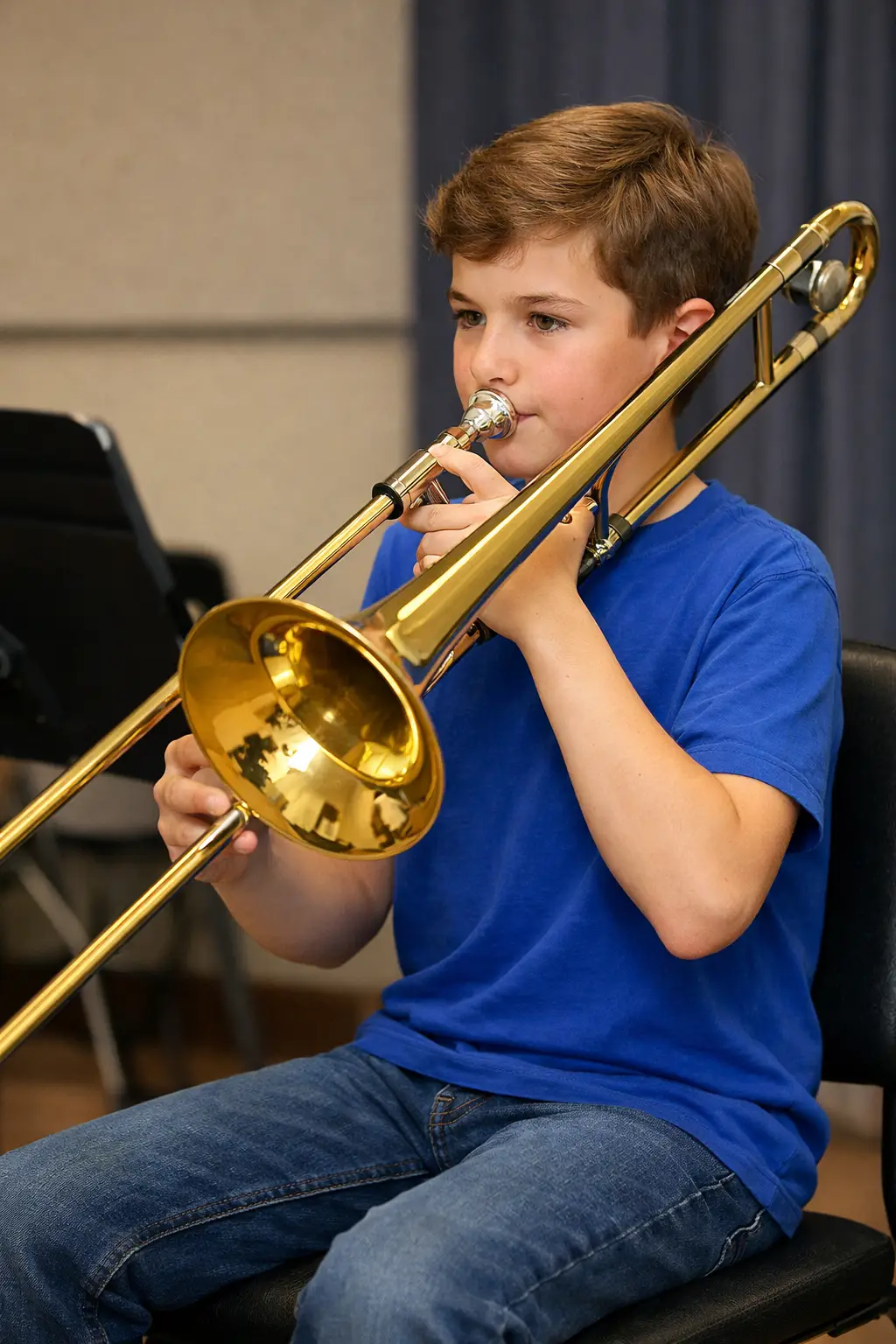
Beginner Practice Roadmap (Months 1-12)
Months 1–2: Building the Foundation
Focus on:
- Holding the trombone correctly
- Proper breathing habits
- Forming a basic embouchure
- Learning the first five notes
- Producing a steady tone
- Reading simple rhythms
Your goal during this stage is not speed or range. Instead, concentrate on producing a clear sound and developing good habits.
Months 3–4: Developing Accuracy
Focus on:
- Slide position accuracy
- Simple scales
- Longer phrases
- Basic articulation
- Reading beginner-level music
This is often when students begin to feel more comfortable with the instrument and gain confidence.
Months 5–6: Expanding Skills
Focus on:
- Lip slurs
- Dynamic control
- Range development
- More challenging rhythms
- Beginning etudes and solos
Students often experience noticeable improvement during this stage.
Months 7–9: Building Musicianship
Focus on:
- Musical expression
- Phrasing
- Articulation variety
- Ensemble playing
- More advanced scales
At this point, students begin sounding more like musicians and less like beginners.
Months 10–12: Refining Technique
Focus on:
- Consistent tone quality
- Extended range
- Faster technical passages
- Solo literature
- Performance preparation
By the end of the first year, many students have developed the skills needed to participate successfully in school ensembles and perform beginner solo literature.
Step 8: Build a Routine
Consistency matters more than marathon sessions. For beginners:
- 30 minutes per day is better than 2 hours once a week.
- Split your time: 5 minutes breathing/buzzing, 5 minutes tone/slide, 20 minutes exercises.
- Increase time as your endurance grows.
- As you improve, expand your routine and learn more scales, notes, rhythms.
Step 9: Listen to Professional Trombonists
One of the most overlooked ways to improve your high range is simply listening to great trombonists. Before your lips can consistently produce beautiful high notes, your ears need a clear idea of what those notes should sound like.
Professional trombonists develop a strong “sound concept” by listening to outstanding performers throughout their careers. When you regularly hear excellent tone, accurate pitch, smooth articulation, and effortless high-register playing, your brain begins to build a model that guides your own playing. Many teachers consider listening an essential part of daily practice.
Listening to recordings can help you learn:
- What a clear, centered high note sounds like
- How professionals maintain a beautiful tone in the upper register
- Proper phrasing and musical expression
- Accurate intonation and articulation
- Different styles of trombone playing
Modern musicians have access to thousands of recordings online, making it easier than ever to study great performers. Research has shown that listening to recordings can support musical development, creativity, self-evaluation, and performance skills.
Whenever possible, attend live performances as well. Hearing a professional trombonist or brass section in person provides an experience that recordings cannot fully capture. Live performances allow you to hear the true projection, resonance, and richness of the instrument while providing inspiration that can motivate your own practice.
Classical Trombonists to Listen To
- Joseph Alessi
- Christian Lindberg
- Jörgen van Rijen
- Ian Bousfield
- Charles Vernon
Jazz Trombonists to Listen To
- J. J. Johnson
- Bill Watrous
- Marshall Gilkes
- Michael Dease
- Robin Eubanks
Please listen to the recording of one of the most famous trombonists of all time – Bill Watrous. Listen to his smooth, silky “tone”, followed by an incredible display of improvisational technique. You will become a fan!
Step 10: Motivation
Your goal as a beginner is to create a solid foundation for more advanced exercises later. Your sound defines you as a musician. Beautiful tone comes from controlled air and relaxed embouchure. Along with everything explained in this guide, comes the best motivation advice for any student wanting to become a great player. Listen to the great trombone players.
Feeling Stuck or Unsure What to Practice Next?
My online trombone lessons provide personalized practice plans, feedback, and step-by-step instruction tailored to your goals. Learn more about Online Trombone Lessons.
How to Set up the Perfect Trombone Practice Space
Your environment directly affects how well you practice.
A good practice space should be:
- Quiet and distraction-free
- Well-lit
- Comfortable and organized
This helps you:
- Focus better
- Hear your tone clearly
- Build consistent habits
Learn more: Trombone Practice: How to Set Up the Perfect Practice Space
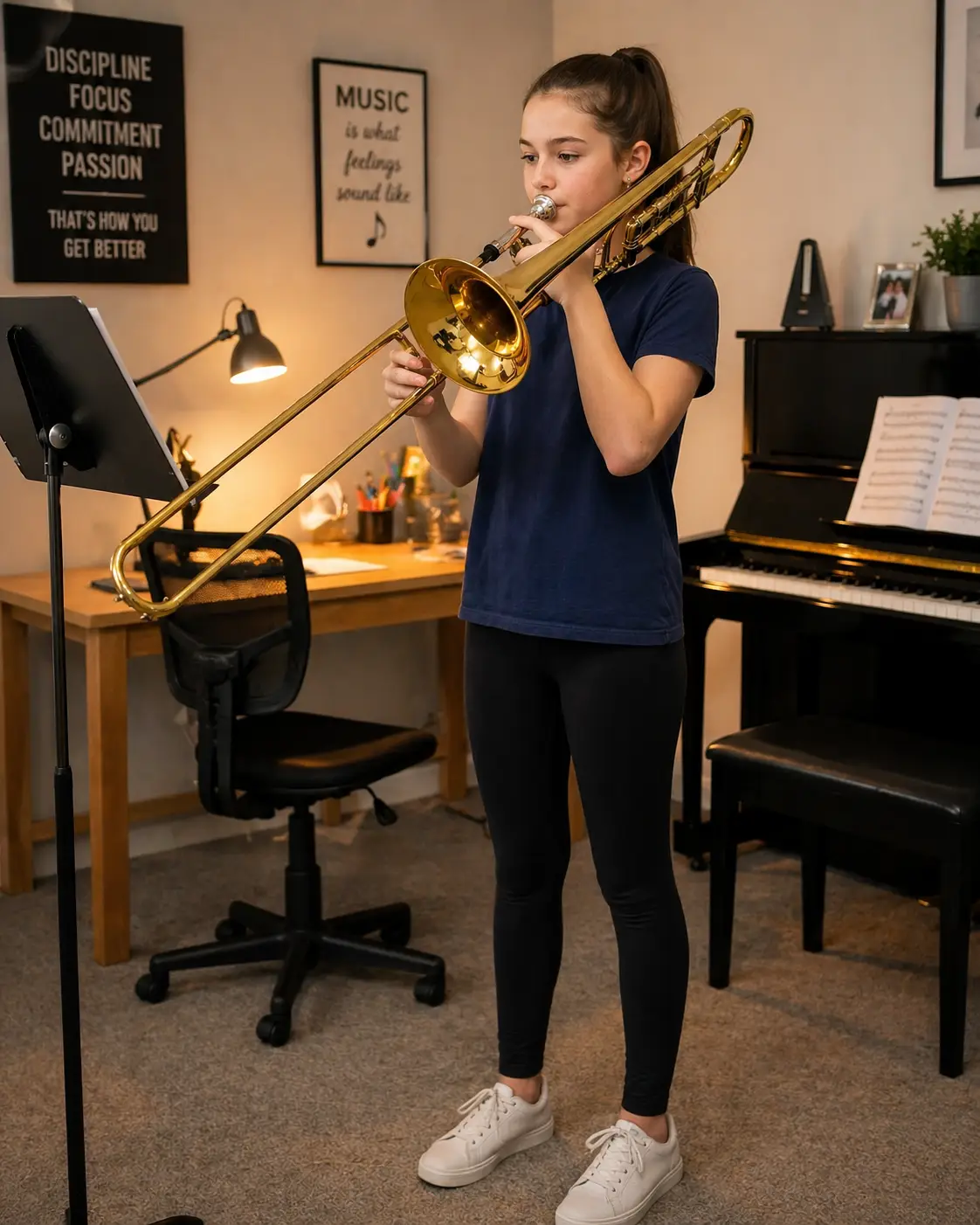
What is Music Theory?
Simply put, music theory is the study of how music works.
For beginner trombonists, music theory helps explain the symbols, notes, rhythms, and markings you see on the page. Instead of guessing what the music means, theory gives you the tools to understand it.
Think of music theory as a roadmap. When you first start learning the trombone, you may be focused on slide positions, making a good sound, and playing your first songs. However, as you progress, you’ll discover that understanding basic theory makes learning music much easier.
For example, music theory teaches you:
- How to read notes on the staff
- How to count rhythms accurately
- What key signatures mean
- How scales are constructed
- How dynamics and articulations affect musical expression
Fortunately, you don’t need to learn everything at once. Most successful beginner trombonists learn music theory gradually while they learn to play their instrument.
Practice Routine for Intermediate Players
Intermediate players should continue refining fundamentals while adding flexibility, articulation, range, and musical expression. Practice sessions should be more structured and goal-oriented. Aim for 40–60 minutes daily.
Intermediate 45-Minute Routine
- Warmup and Breathing (5 minutes)
Gentle long tones, breathing exercises, and mouthpiece buzzing. - Lip Slurs and Flexibility (10 minutes)
Use slur exercises to improve embouchure strength and smooth partial changes. - Scales and Technique (10 minutes)
Practice major, minor, and chromatic scales with a metronome. - Articulation Exercises (10 minutes)
Single tonguing, legato tonguing, and rhythm patterns. - Etudes or Method Book Studies (5 minutes)
Use Bordogni, Rochut, or similar studies for phrasing and musicality. - Solo or Band Music (5 minutes)
Work on current performance music carefully.
Intermediate Goal: Improve tone control, technique, and consistency across the instrument
Learn more: Major Scales for Trombone: A Complete Practice Guide
Advanced Trombonist Practice Routine
Advanced players need a balanced routine that maintains fundamentals while pushing technique, endurance, range, and artistry. Sessions should be highly focused and adjusted to performance goals. Aim for 60–90 minutes or more depending on schedule.
Advanced 75-Minute Routine
- Fundamental Warmup (10 minutes)
Breathing, buzzing, long tones, flow studies, and soft attacks. - Flexibility and Range (15 minutes)
Lip slurs, register connection, upper and lower range development. - Scales and Technical Work (15 minutes)
All major/minor scales, chromatic patterns, multiple tonguing, advanced rhythms. - Etudes (15 minutes)
Rochut, Blazhevich, Tyrell, Kopprasch, or orchestral excerpts. - Repertoire / Audition Material (15 minutes)
Solo literature, ensemble music, excerpts, or recital preparation. - Cool Down / Recovery (5 minutes)
Gentle mid-register playing and relaxed long tones.
Advanced Goal: Perform at a high level with control, endurance, and musical authority.
Common Trombone Practice Mistakes to Avoid
- Practicing without focus
- Ignoring tone quality
- Playing too fast
- Not using a tuner or metronome
Every repetition builds a habit—make sure it’s the right one.
Tips to Improve Faster on Trombone
Practice daily
- Use a tuner for pitch accuracy
- Break music into small sections
- Focus on one goal at a time
Improve airflow: Trombone Breathing Exercises: 7 DIY Tools
How Long Should You Practice Your Trombone?
For beginners:
- 20–30 minutes per day is ideal
- Consistency matters more than duration
Even 15 minutes of focused practice is effective. Consistency means every day. Don’t let anything come between you and your practice time.
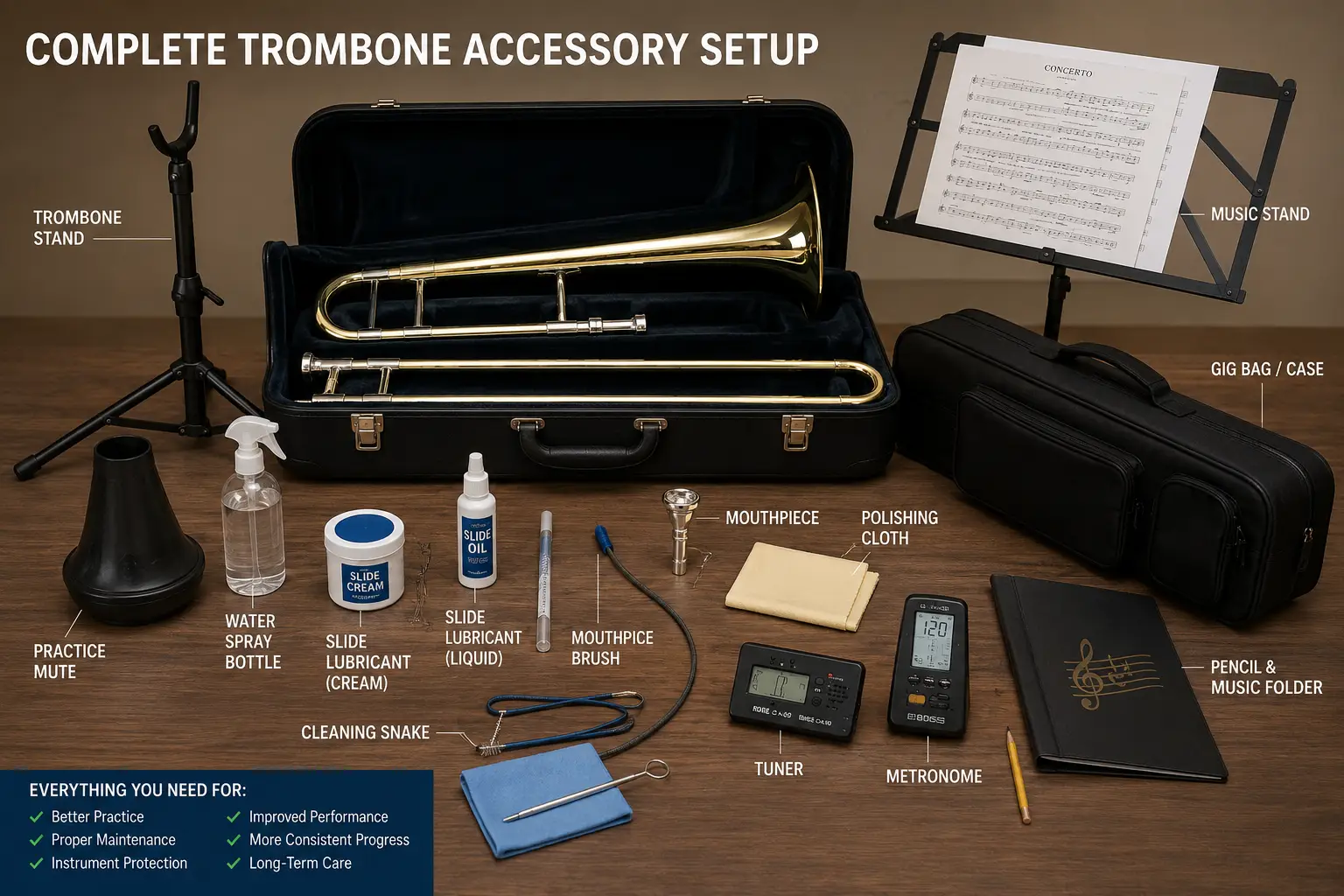
Essential Trombone Practice Materials for Beginners
Using the right tools makes your trombone practice more effective.
Music Stand
Improves posture and reading position
Trombone Stand
Keeps your instrument safe and accessible
Metronome / Digital Tuner
Essential for rhythm and pitch accuracy
Trombone Practice Mute
Allows quiet practice anytime
Method Books
Provide structured learning
Recommended:
How to Know If Your Trombone Practice is Working
You will notice:
- Better tone
- Improved accuracy
- Smoother slide movement
- Increased control
Progress is gradual—but consistent.
How to Track Your Trombone Practice Progress
One of the best ways to stay motivated is to see how far you’ve come. Progress on the trombone doesn’t always happen overnight. In fact, improvement is often gradual, with small gains adding up over weeks and months. By tracking your practice, you’ll recognize those improvements, stay motivated, and identify areas that need more attention.
Keep a Practice Journal
A practice journal is one of the simplest and most effective tools for improving your playing. After each practice session, spend a minute or two writing down what you worked on and how it went. Below are some proven ways to track your practice progress. You don’t have to use them all, but they do work for daily, weekly and monthly tracking mediums.
Trombone Practice Journal
Week of: ____________________________________
| Date | Practice Time | Warm-Up Exercises Completed | Scales / Technical Exercises | Pieces or Songs Practiced | What Improved Today? | Tomorrow’s Focus |
|---|---|---|---|---|---|---|
Weekly Goals
Skills I want to improve:
☐ Tone Quality
☐ Breathing
☐ Embouchure
☐ Slide Accuracy
☐ Rhythm
☐ Scales
☐ Lip Slurs
☐ Articulation
☐ Range
☐ Musical Expression
☐ Sight Reading
☐ Other: __________________________
End-of-Week Reflection
My biggest improvement this week?
What challenged me the most?
My goals for next week?
Over time, your journal becomes a record of your progress and helps you build consistent practice habits.
Setting Your Weekly Goals
Instead of trying to improve everything at once, choose one or two specific goals each week. Clear, achievable goals give your practice direction and make it easier to measure success.
Examples include:
- Produce a steadier tone on long tones.
- Memorize the B-flat Major Scale.
- Improve slide accuracy between first and sixth position.
- Play a song without stopping.
- Increase endurance by practicing for 25 minutes each day.
As you accomplish each goal, replace it with a new challenge.
Record Yourself Once Each Month
One of the most valuable practice tools is your smartphone. Record yourself playing the same warm-up, scale, or short piece at the beginning of each month.
When you compare recordings over time, you’ll often notice improvements that aren’t obvious during daily practice, including:
- A fuller, more centered tone
- Better intonation
- Smoother slide movement
- Improved rhythm and timing
- Greater confidence and musical expression
Listening to yourself objectively is one of the fastest ways to become a better musician.
Use a Practice Checklist
A checklist helps ensure that you cover all of the essential fundamentals during each practice session. As you complete each section, check it off before moving to the next.
A beginner’s checklist might include:
☐ Breathing exercises
☐ Mouthpiece buzzing
☐ Long tones
☐ Slide position practice
☐ Major scales
☐ Lip slurs or flexibility exercises
☐ Rhythm practice with a metronome
☐ Beginner songs or method book exercises
☐ Cool-down
Using a checklist keeps your practice balanced and prevents important fundamentals from being overlooked.
Track Your Tempo with a Metronome
A metronome isn’t just for keeping time—it’s also an excellent way to measure your progress.
Start every new exercise at a slow, comfortable tempo where you can play accurately. Once you can perform it several times without mistakes, increase the metronome by two to four beats per minute.
For example:
- Week 1: Play an exercise at 60 BPM.
- Week 2: Increase to 64 BPM.
- Week 3: Increase to 68 BPM.
Small improvements add up over time, allowing you to build speed without sacrificing accuracy or tone quality.
Celebrate Small Victories
Learning the trombone is a journey, not a race. Every improvement deserves recognition, whether it’s producing a clearer tone, mastering a new scale, or performing a piece with confidence.
Remember, progress isn’t measured by perfection. It’s measured by becoming a little better than you were yesterday. Stay consistent, be patient with yourself, and celebrate each milestone along the way.
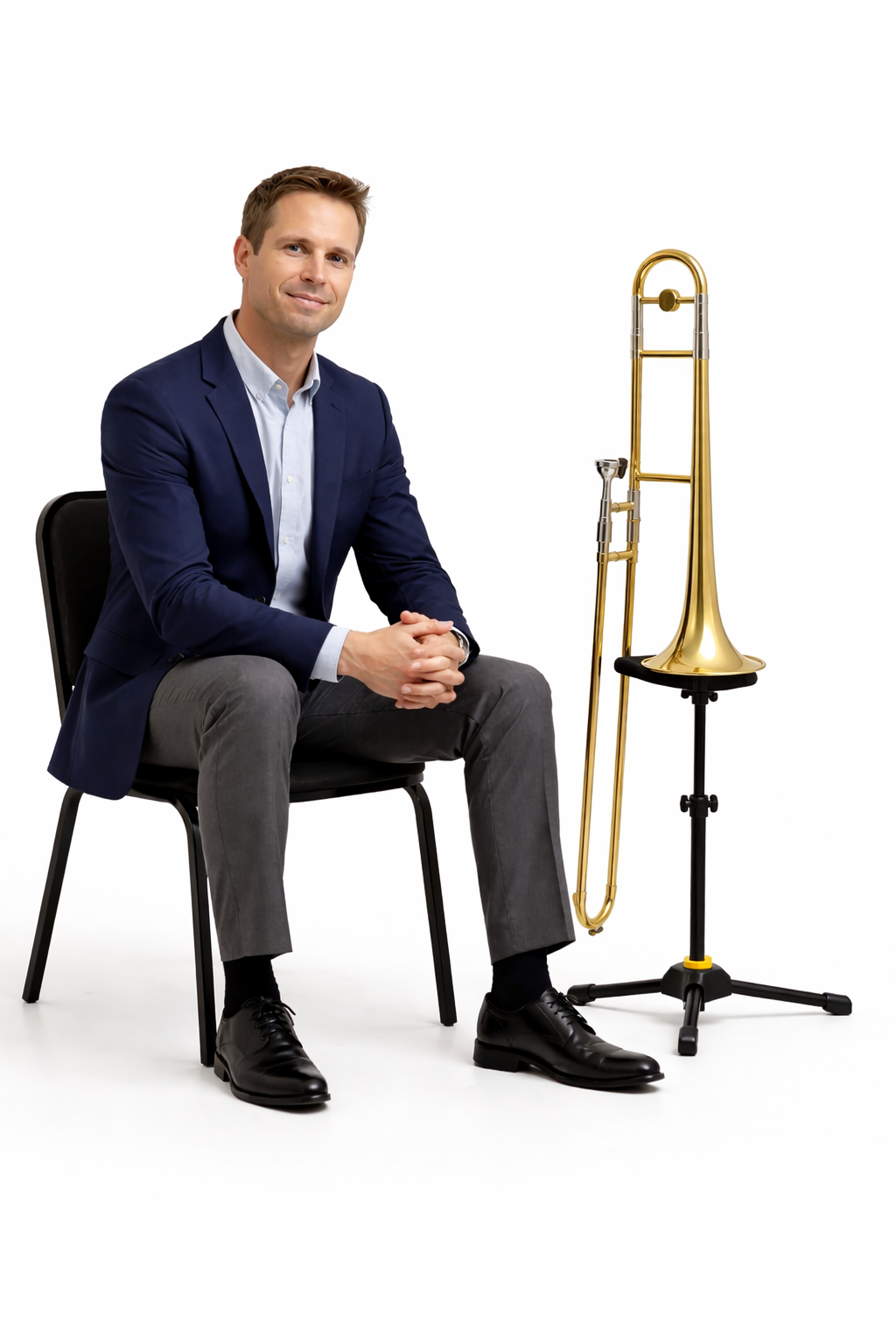
Take Your Trombone Playing to The Next Level
Whether you are just starting trombone or looking to strengthen your tone, technique, and musical confidence, private lessons can help you progress faster with clear guidance and personal support.
With The Trombone Mentor, you receive:
• Step-by-step instruction
• Customized practice plans
• Expert feedback and encouragement
• Online lessons you can take from anywhere
Stop guessing and start making steady progress with lessons designed around your goals.
ᅠ ONLINE TROMBONE LESSONS – Learn Anywhere with a Private Trombone Teacher
Frequently Asked Questions
How many hours should a beginner practice trombone?
If you dedicate yourself to a daily practice time, then about 2 1/2 hours per week is a good start. That comes out to around 20 minutes per day.
What should I practice first?
Your first three notes should be: Low B Flat, F, Higher B Flat – All in First position. Then, your first five notes: B Flat, C, D, E Flat, F.
Is it better to practice longer or more often?
More often is better.
How do I avoid bad habits?
Practice slowly and fix mistakes immediately.
Can I learn trombone without a teacher?
The short answer is – yes! With a good horn, dedicated practice, and a good method book, you can go a log way. But there will be a time when a trombone teacher will take you further faster with your skill development.
Final Thoughts
Learning how to practice trombone is the key to steady improvement.
A structured routine helps you:
- Build strong fundamentals
- Develop consistent tone
- Improve faster with less frustration
Stay consistent, stay focused, and your progress will follow.
Related Trombone Articles
Trombone Practice Mute: A Complete Guide for Quiet, Effective Practice
Trombone Care and Maintenance: How to Protect Your Investment
How to Stay Motivated When Practicing the Trombone
10 Easy Trombone Songs for Beginners (+ Free Practice
About the Author
Rick Lawrence is a music educator, conductor, professional trombonist, and private instructor with more than 40 years of playing and teaching experience. He has performed with orchestras, jazz ensembles, brass bands, and pit orchestras, and studied with John Coffey of the Boston Symphony Orchestra, Donald Knaub of the University of Texas, and Edward J. Madden, composer, arranger, trombonist.
Through The Trombone Mentor website, Rick provides online trombone lessons and educational resources for beginner, intermediate, and advanced trombonists.