Learning how to play high notes on trombone is one of the biggest challenges for beginner and intermediate players. Many trombonists struggle with cracked notes, thin tone, lip fatigue, or feeling “stuck” in their range development. The good news is that high notes are not just about talent — they are built through proper technique, smart practice habits, and consistency.
The upper register requires a combination of efficient air support, strong embouchure coordination, flexibility, and endurance. Most importantly, range develops gradually over time. Trying to force high notes usually creates tension and slows progress.
One of the best ways to improve your upper register is through consistent long tone practice. Long tones help strengthen the muscles used for playing while improving tone quality, control, and endurance.
In this guide, you will learn:
- Why high notes are difficult
- Proper air support and embouchure techniques
- The best exercises for range building
- Common mistakes to avoid
- A daily practice routine for improving high notes safely
Let’s get started!
Disclaimer
This article contains Amazon Affiliate Links. What this means, is that, at no cost to you, if you click a link and follow through with a purchase, this site may earn a small commission.
Why High Notes Are Difficult on Trombone
Playing high notes on trombone requires your body to work more efficiently than it does in the middle or low register. As you ascend higher, your lips must vibrate faster while maintaining control and stability.
Many players mistakenly believe high notes require extreme force or pressure. However, upper register playing is more about efficiency than strength.
The upper register demands:
- Faster air speed
- Better embouchure coordination
- Stronger breath support
- Proper tongue position
- Relaxation and control
One of the biggest problems trombone players face is tension. When players strain for high notes, they often tighten the throat, pinch the lips, or press the mouthpiece too hard into the face. Unfortunately, this usually makes high notes harder instead of easier.
Range development is gradual. Even advanced trombonists continue working on their upper register throughout their playing careers.
The Foundation of Playing High Notes
Proper Air Support
Air support is the foundation of good trombone playing, especially in the upper register.
High notes do not necessarily require more air. Instead, they require faster and more focused air. Think of the difference between slowly blowing through a straw and blowing a fast, concentrated stream of air.
Many beginners take shallow breaths when attempting high notes. This reduces support and causes tension. Instead, practice taking full relaxed breaths from the diaphragm.
A useful way to think about air support is:
- Low notes = warm, slow air
- High notes = fast, focused air
Try practicing breathing exercises away from the trombone. Breathe deeply and exhale with a steady stream of air while keeping your shoulders relaxed.
Embouchure Setup for High Notes
Your embouchure plays a major role in upper register success. A strong trombone embouchure is stable yet flexible.
For high notes:
- Keep the corners of the mouth firm
- Keep the center relaxed enough to vibrate
- Avoid excessive mouthpiece pressure
- Maintain consistent mouthpiece placement
One common mistake is smiling or stretching the lips outward. While this may temporarily produce higher notes, it often creates thin tone and fatigue.
Instead, think about keeping the embouchure compact and controlled.
If your embouchure collapses as you ascend, the tone may crack or disappear completely.
For a complete beginner embouchure guide, see our article on building a trombone embouchure.
Tongue Position and Air Speed
Tongue position has a major effect on air speed.
When playing low notes, the tongue sits lower in the mouth. However, as you move higher, the tongue naturally arches slightly upward.
Many teachers describe this using vowel sounds:
- Low notes = “AH”
- Middle notes = “OH”
- High notes = “EE”
The “EE” shape helps increase air speed without adding unnecessary tension.
Be careful not to tighten your throat while doing this. The throat should remain open and relaxed.
A good analogy is placing your thumb partially over a garden hose. The water moves faster because the opening becomes more focused. Your tongue helps focus the air stream in a similar way.
How Long Tones Help You Play Higher Notes
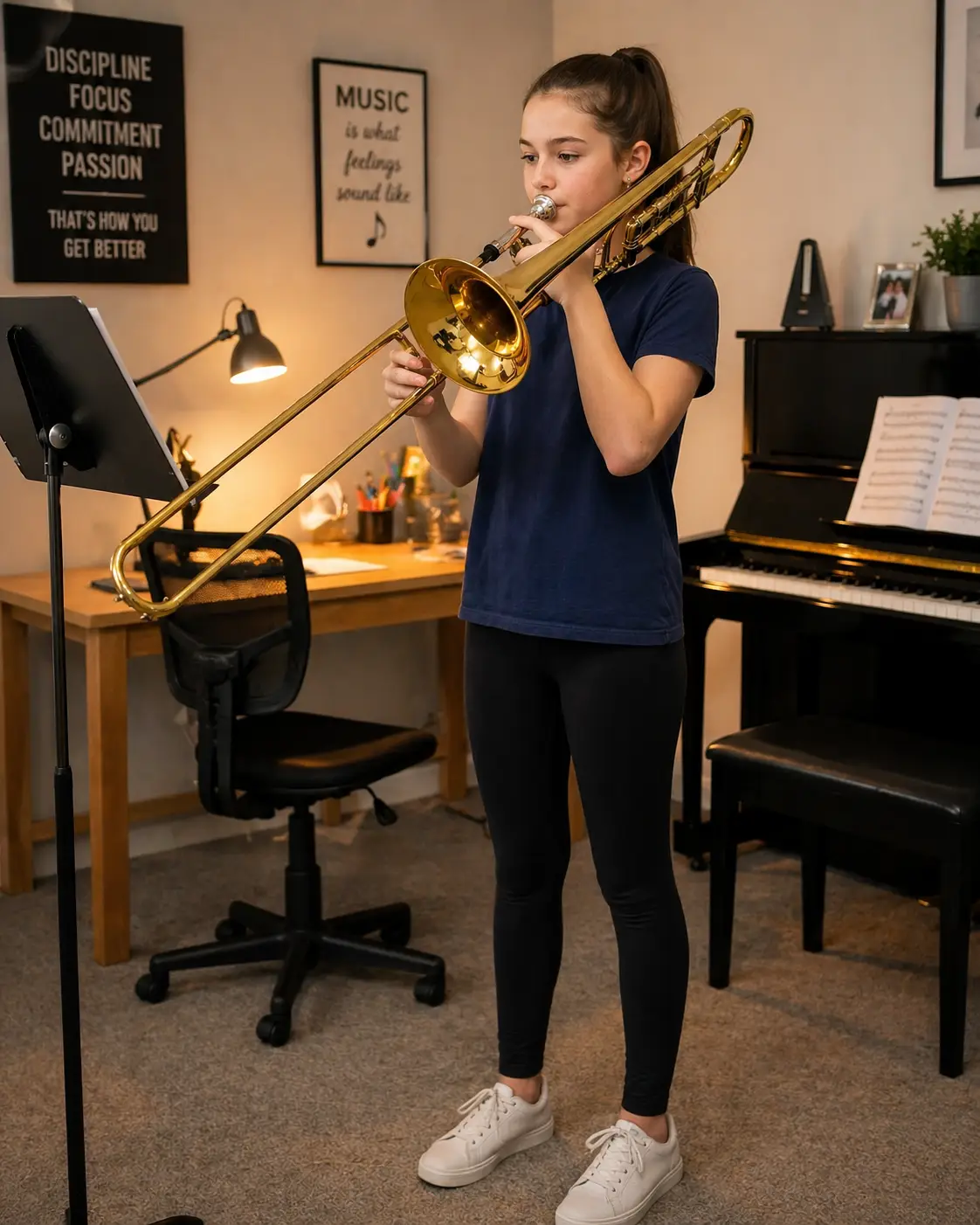
Long tones are one of the most effective exercises for developing high notes on trombone.
They help:
- Strengthen embouchure muscles
- Improve tone consistency
- Build endurance
- Develop air control
- Improve pitch accuracy
- Increase stability in the upper register
Consistent long tone practice trains your body to play efficiently. Instead of forcing range, long tones help range develop naturally over time.
Many professional trombonists still practice long tones daily because they improve every aspect of playing.
If you want a complete long tone practice system, read our guide:
Trombone Long Tones Explained: Why They Matter & Exercises
Listen to Great Trombonists
One of the most overlooked ways to improve your high range is simply listening to great trombonists. Before your lips can consistently produce beautiful high notes, your ears need a clear idea of what those notes should sound like.
Professional trombonists develop a strong “sound concept” by listening to outstanding performers throughout their careers. When you regularly hear excellent tone, accurate pitch, smooth articulation, and effortless high-register playing, your brain begins to build a model that guides your own playing. Many teachers consider listening an essential part of daily practice.
Listening to recordings can help you learn:
- What a clear, centered high note sounds like
- How professionals maintain a beautiful tone in the upper register
- Proper phrasing and musical expression
- Accurate intonation and articulation
- Different styles of trombone playing
Modern musicians have access to thousands of recordings online, making it easier than ever to study great performers. Research has shown that listening to recordings can support musical development, creativity, self-evaluation, and performance skills.
Whenever possible, attend live performances as well. Hearing a professional trombonist or brass section in person provides an experience that recordings cannot fully capture. Live performances allow you to hear the true projection, resonance, and richness of the instrument while providing inspiration that can motivate your own practice.
Classical Trombonists to Listen To
- Joseph Alessi
- Christian Lindberg
- Jörgen van Rijen
- Ian Bousfield
- Charles Vernon
Jazz Trombonists to Listen To
- J. J. Johnson
- Bill Watrous
- Marshall Gilkes
- Michael Dease
- Robin Eubanks
A good goal is to spend at least 10 to 15 minutes each day listening to professional trombone recordings. The more you hear great playing, the easier it becomes to recognize and reproduce those sounds in your own performance. Below, is a recording of one of the “super great” trombone players ever. His name is Bill Watrous. As you listen, pay attention first to his tone. Smooth and silky! Next listen to his incredible range. High note as well as deep low notes. Most of the notes that are coming out of his trombone are all improvised. Incredible!
Best Exercises for Building High Notes on Trombone
Long Tone Exercises
Start your range practice with long tones in the middle register before gradually moving upward.
Hold each note with:
- Steady air
- Relaxed posture
- Consistent tone quality
A simple progression could look like:
Bb – C – D – Eb – F
Move upward slowly without straining. If tension appears, stop and rest before continuing.
The goal is consistency, not forcing extreme range.
Lip Slur Exercises
Lip slurs are essential for upper register development because they improve flexibility and coordination.
Simple patterns include:
- Bb – F – Bb
- F – Bb – D
- Bb – D – F – Bb
As you improve, gradually expand these exercises upward.
Focus on smooth airflow and minimal movement. Avoid jerking the jaw or using pressure to “jump” between notes.
Lip slurs help train the embouchure to adjust naturally between partials, which is critical for high note playing.
Scale Exercises for Range Building
Scales are excellent for building control and confidence in the upper register.
Practice:
- Major scales
- Chromatic scales
- Arpeggios
Ascend gradually over time rather than trying to reach your highest note immediately.
Consistency is more important than extreme range attempts.
Playing scales softly can also improve upper register control because soft playing requires efficiency.
Mouthpiece Buzzing Exercises
Mouthpiece buzzing can help improve pitch center and note focus.
Buzz simple melodies or scale patterns while maintaining a clear and steady sound.
However, avoid overdoing buzzing exercises. Too much buzzing may create fatigue.
Buzzing should supplement your trombone practice, not replace it.

Common Mistakes That Prevent High Notes
Using Too Much Pressure
Many players push the mouthpiece harder into their lips when attempting high notes.
Unfortunately, excessive pressure reduces lip vibration and creates fatigue.
Instead of pressing harder:
- Increase air speed
- Maintain firm corners
- Stay relaxed
Less pressure usually produces better tone and endurance.
Playing With Too Much Tension
Tension is one of the biggest enemies of upper register playing.
Watch for:
- Tight shoulders
- Clenched jaw
- Tight throat
- Stiff neck muscles
Relaxation improves airflow and flexibility.
During practice, pause frequently and check your posture and body tension.
Overblowing
Loud playing does not automatically create high notes.
Many players try to blast high notes with excessive air volume. This often causes the tone to spread or crack.
Instead, focus on:
- Focused air
- Controlled airflow
- Efficient embouchure use
Fast air is more important than massive air.
Practicing High Notes Too Long
Upper register practice is physically demanding.
If you practice high notes for too long without rest, your embouchure becomes fatigued and technique breaks down.
A helpful rule is:
Rest as much as you play.
Short focused sessions are far more effective than long exhausting sessions.
Daily Practice Routine for Improving High Notes
A structured daily routine can help you build range safely and consistently.
Warm-Up
Start with:
- Relaxed breathing exercises
- Easy long tones
- Gentle flexibility work
Never begin practice by immediately playing high notes.
Flexibility Exercises
Practice:
- Lip slurs
- Smooth partial changes
- Slow flexibility patterns
Focus on efficiency and relaxation.
Range Work
Spend a few minutes gradually extending your range upward.
Do not force notes beyond your comfortable limit.
Small daily improvements add up over time.
Recovery Playing
After range work, play:
- Soft low notes
- Easy melodies
- Relaxed long tones
This helps reduce tension and recover the embouchure.
How Long Does It Take to Improve your High Range?
Every trombone player develops differently.
Some players improve quickly, while others need more time to build coordination and endurance. The key is consistent daily practice.
Range development is usually measured in months and years rather than days.
The players who improve the most are often the ones who:
- Practice consistently
- Avoid forcing
- Focus on good fundamentals
- Stay patient
Even professional trombonists continue working on their upper register throughout their careers.
Recommended Equipment for Upper Register Playing
Good technique matters far more than equipment. However, the right setup can still help support your playing.
Helpful equipment may include:
- Quality mouthpieces
- Properly maintained trombones
- Breathing trainers
- Tuners and metronomes
- Music stands for proper posture
Smaller mouthpieces may make high notes easier temporarily, but they are not a substitute for proper fundamentals.
Always focus on developing efficient playing habits first.
Final Thoughts
Learning how to play high notes on trombone takes patience, consistency, and smart practice habits. The best results come from building strong fundamentals rather than forcing range.
Remember:
- Use fast, focused air
- Keep the embouchure efficient
- Avoid excessive tension
- Practice flexibility exercises
- Rest frequently
- Develop range gradually
Most importantly, make long tones part of your daily routine. Long tones build the control, endurance, and stability needed for confident upper register playing.
About the Author
Rick Lawrence is a music educator, conductor, professional trombonist, and private instructor with more than 50 years of playing and teaching experience. He has performed with orchestras, jazz ensembles, brass bands, and pit orchestras, and studied with John Coffey of the Boston Symphony Orchestra, Donald Knaub of the University of Texas, and Edward J. Madden.
Through The Trombone Mentor, Rick provides online trombone lessons and educational resources for beginner, intermediate, and advanced trombonists.