Learning to play the trombone has never been easier thanks to today’s technology. Free Apps for Trombone Students is a guide to some of the best free digital tools available to help trombone players improve their practice sessions. Whether you’re a beginner learning your first notes, a middle school band student, or a high school musician preparing for auditions, the right apps can help you practice more effectively and make faster progress.
In this guide, you’ll discover 15 free apps every trombone student should consider adding to their practice routine. Each app serves a different purpose, and together they can help you become a more confident, consistent, and well-rounded musician.
Whether your goal is earning first chair in band, making All-State, preparing for college auditions, or simply becoming a better trombone player, these free tools can help you practice smarter—not just longer.
Let’s get started!
Disclaimer
Some of the links below are affiliate links. The Trombone Mentor participates in the Amazon Services LLC Associates Program. What this means, is that at no cost to you, if you click on a link and follow through with a purchase, this site may earn a small commission.
Why Every Trombone Student Should Use Practice Apps
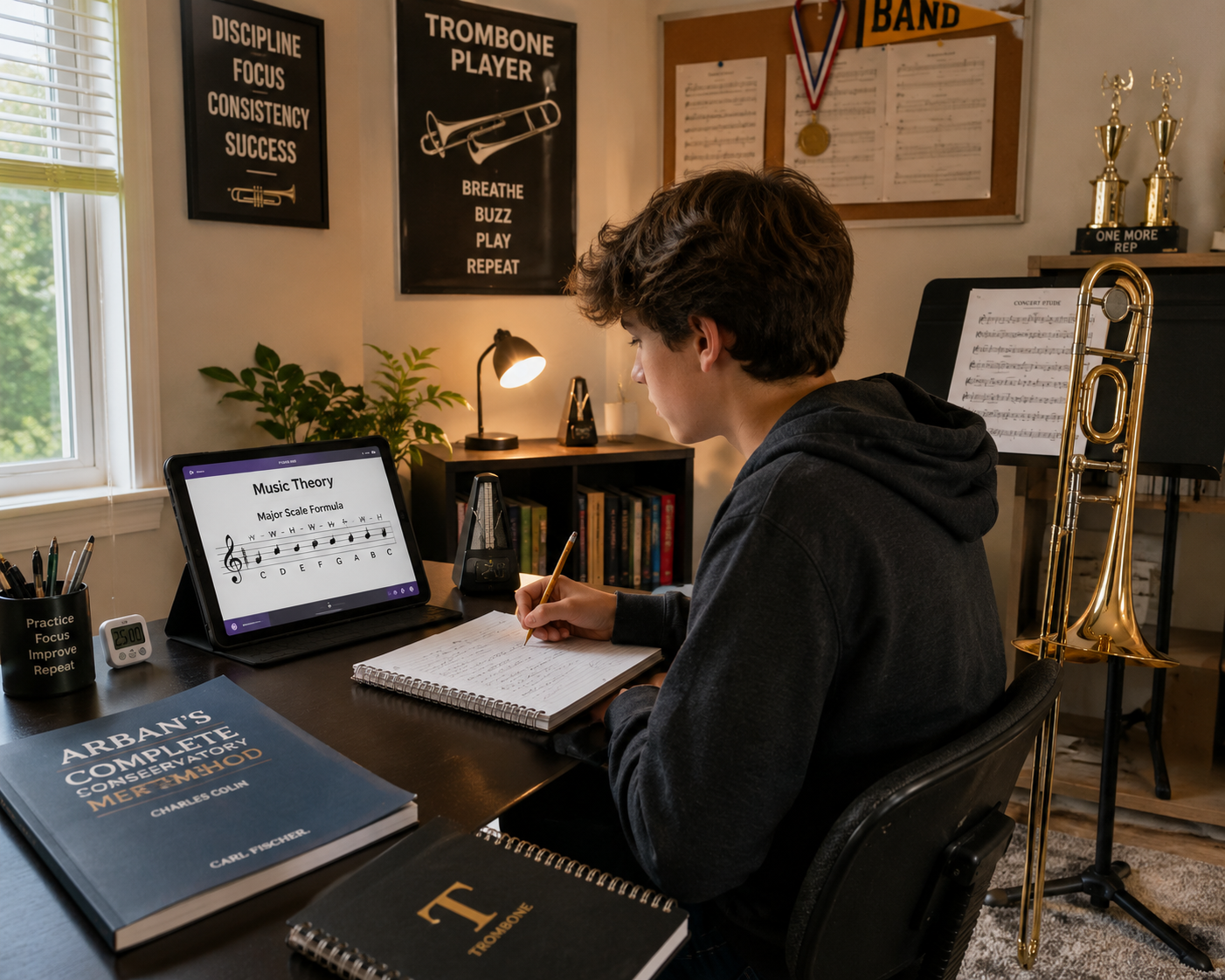
Successful practice sessions arn’t just about spending more time with your trombone—it’s about making every minute count. Free practice apps can provide instant feedback, keep you organized, and help you develop skills that are difficult to improve on your own. I recommend that you read: Online Trombone Lesson Setup Guide: What You Need for Success
Here are some of the biggest benefits these apps offer:
Improve Your Intonation
One of the greatest challenges for trombone players is learning where each slide position belongs. Unlike many other instruments, the trombone has no keys or valves to guarantee the correct pitch. A quality tuner app provides immediate visual feedback, helping you make small adjustments that lead to better intonation over time.
Develop Better Rhythm
Even talented musicians can struggle with steady tempo. Practicing with a metronome teaches consistency, improves counting, and develops the rhythmic accuracy that directors and audition judges expect.
Strengthen Your Ear
Ear training apps help you recognize intervals, chords, and melodies. As your listening skills improve, you’ll naturally become a more accurate and expressive trombone player.
Become a Better Sight Reader
Band directors often hand students music they’ve never seen before. Apps that focus on note recognition and sight-reading help you become more confident when learning new music quickly.
Stay Organized
Many students keep their lesson assignments, recordings, sheet music, and practice journals in one place using cloud storage apps. Staying organized makes practice sessions smoother and more productive.
Record Your Progress
One of the fastest ways to improve is by recording yourself regularly. Listening back allows you to notice tone quality, articulation, rhythm, and musical phrasing in ways you simply can’t hear while playing.
You’ll also enjoy hearing how much you’ve improved after several weeks or months of consistent practice.
Practice More Independently
The best teachers encourage students to become independent musicians. Practice apps provide tools and feedback that help students solve problems on their own between lessons, making lesson time even more productive.
Best All-in-One Practice App for Trombone Students
App #1 – Soundcorset
If you could only download one free app for practicing trombone, Soundcorset would be an excellent choice. It combines several essential practice tools into one easy-to-use application, making it especially useful for beginners and students who want a simple setup.
Key Features
-
-
-
Accurate chromatic tuner
-
Metronome with adjustable tempo
-
Audio recorder
-
Practice timer
-
Pitch monitor
-
Tempo trainer
-
-
Because everything is located in one app, there’s no need to switch between multiple programs during your practice session.
Pro Tip: Think of these apps as practice assistants—not replacements for a qualified teacher. They provide helpful feedback, but your teacher remains your best source for personalized instruction, technique correction, and musical guidance.
Why Trombone Students Love It
The tuner responds quickly to the trombone’s sound, making it easy to check slide positions and improve intonation. The built-in recorder also allows you to immediately listen back to your performance after practicing scales, etudes, or band music.
Best Practice Uses
-
-
-
Daily warmups
-
Long tones
-
Lip slurs
-
Scale practice
-
Preparing solo music
-
Recording lessons
-
-
Practice Tip
Start every practice session by playing long tones while watching the tuner. Focus on producing your best tone first, then make small slide adjustments until each note is centered. Developing this habit will improve both your intonation and your overall sound quality.
App #2 – Pro Metronome
Best Free Metronome App for Building Rock-Solid Rhythm
Every great trombone player has one thing in common: excellent rhythm. Whether you’re playing a lyrical solo, a fast technical passage, or a marching band drill, keeping a steady pulse is essential.
Pro Metronome is one of the most popular free metronome apps available, offering far more than a simple clicking sound. It gives students the flexibility to practice at any tempo and gradually increase speed as they improve.
Key Features
- Adjustable tempo from slow to fast
- Multiple time signatures
- Subdivision options
- Tap tempo function
- Visual beat indicators
- Customizable sounds
Why Trombone Students Love It
Many students rush difficult passages or slow down during challenging rhythms without realizing it. Practicing with a metronome builds consistency and confidence, making performances more accurate and musical.
Best Practice Uses
- Daily warm-ups
- Lip slurs
- Scales
- Arban exercises
- Marching band music
- Solo preparation
Practice Tip
Don’t always practice at full speed. Start difficult music at a slow tempo where you can play every note correctly. Increase the tempo by 3–5 beats per minute only after you’ve played the passage accurately several times in a row. Slow, consistent practice leads to faster long-term improvement.
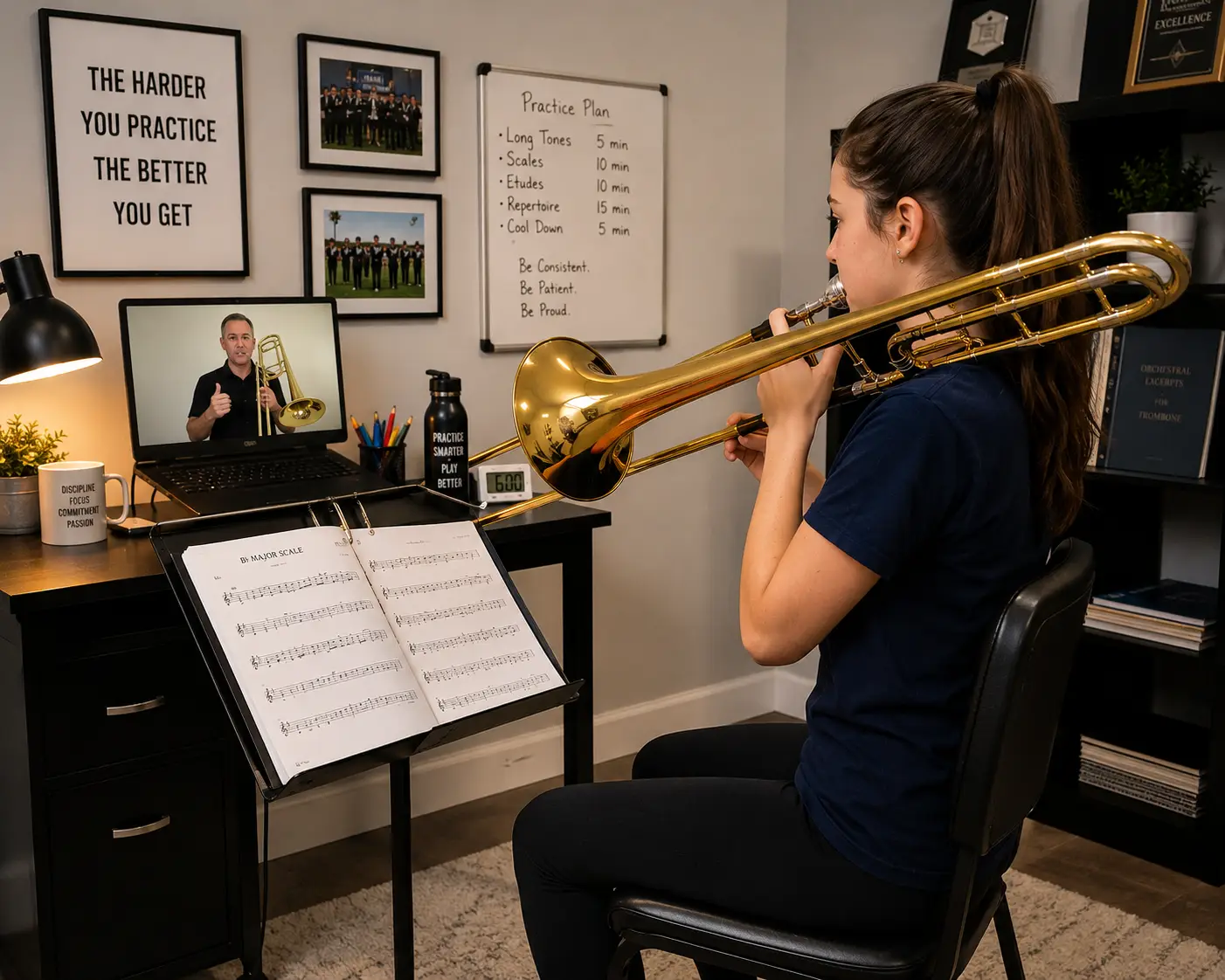
App #3 – Music Tutor
Improve Your Sight-Reading Skills
One of the quickest ways to become a stronger band musician is to improve your music reading. Music Tutor is a free app designed to help students recognize notes more quickly, making sight-reading less intimidating.
Instead of struggling to identify every note, you’ll begin recognizing them almost automatically.
Key Features
- Bass clef practice
- Tenor clef practice
- Adjustable difficulty levels
- Timed quizzes
- Progress tracking
Why Trombone Students Love It
Beginning trombone players spend most of their time reading bass clef, while advanced high school and college students often encounter tenor clef in solo and orchestral music. Music Tutor allows you to practice both, helping you become a more versatile musician.
Best Practice Uses
- Five-minute daily note drills
- Bass clef review
- Learning tenor clef
- Preparing for auditions
- Building reading speed
Practice Tip
Spend just five minutes a day using Music Tutor before you pick up your trombone. Improving your note recognition away from the instrument allows you to spend more time making music during your actual practice session.
App #4 – Complete Music Reading Trainer
Take Your Reading Skills to the Next Level
Once you’ve mastered basic note recognition, Complete Music Reading Trainer helps develop more advanced reading skills through interactive exercises and progressively challenging lessons.
Rather than simply memorizing note names, you’ll learn to read music fluently and confidently.
Key Features
- Progressive reading exercises
- Bass and tenor clef support
- Rhythm reading activities
- Multiple difficulty levels
- Achievement-based lessons
Why Trombone Students Love It
The app feels more like a game than a lesson, making it enjoyable to use consistently. Students earn achievements as they improve, helping maintain motivation over time.
Best Practice Uses
- Daily music reading
- Clef transitions
- Reading unfamiliar music
- Audition preparation
- Summer practice
Practice Tip
Challenge yourself to identify notes quickly instead of counting staff lines every time. Fast note recognition frees your attention to focus on rhythm, articulation, dynamics, and musical expression.
App #5 – Functional Ear Trainer
Train Your Ears Like Professional Musicians
Playing in tune isn’t just about watching a tuner. Great trombone players learn to hear when notes are in tune before making adjustments. My favorite expression is this- “We Hear with Our Ears, But We Listen With Our Brain” This app will help prove that concept.
Functional Ear Trainer helps students develop this important skill by teaching them to recognize the relationships between notes within a key.
Key Features
- Interval recognition
- Scale degree training
- Progressive lessons
- Piano-based exercises
- Beginner-friendly interface
Why Trombone Students Love It
Unlike apps that simply drill interval names, Functional Ear Trainer teaches students to hear how notes function within a musical key. This develops stronger musical instincts that transfer directly to ensemble playing, improvisation, and intonation.
Best Practice Uses
- Ear training
- Intonation development
- Melody recognition
- Preparing for music theory classes
- College audition preparation
Practice Tip
Use this app for five to ten minutes several times a week. Over time, you’ll begin recognizing familiar melodic patterns more easily, making it simpler to learn new music by ear and play more confidently with your ensemble.
Why These Five Apps Work So Well Together
Each of these apps develops a different aspect of musicianship:
| App | Primary Skill |
|---|---|
| Soundcorset | Tuning, recording, and practice organization |
| Pro Metronome | Rhythm and tempo |
| Music Tutor | Note recognition and sight-reading |
| Complete Music Reading Trainer | Advanced music reading |
| Functional Ear Trainer | Ear training and intonation |
Together, they create a strong foundation for every trombone student. By spending just a few minutes each day with these tools, you’ll strengthen the core skills that every successful musician needs.
The Trombone Mentor Tip: Don’t feel like you need to use every app every day. Instead, choose one or two that match your current goals. For example, if you’re preparing for an audition, focus on rhythm and sight-reading. If you’re working on improving your tone, spend more time with your tuner and recording app. Consistent, focused practice is always more effective than trying to do everything at once.
Schedule a free consultation lesson with Rick Lawrence
ONLINE TROMBONE LESSONS – Learn Anywhere with a Private Trombone Teacher
App #6 – Perfect Ear
Build Better Musicianship Through Ear Training and Music Theory
While many apps focus on one skill, Perfect Ear combines ear training, rhythm exercises, interval recognition, and music theory into one free app. It’s an excellent choice for trombone students who want to become stronger all-around musicians.
As you advance through middle school and high school, you’ll encounter more challenging music that requires a solid understanding of intervals, scales, chords, and rhythm. Perfect Ear helps develop these skills in a fun, interactive way.
LEARN MORE: Music Theory for Trombone Players
Key Features
- Interval recognition
- Chord identification
- Scale exercises
- Rhythm practice
- Music theory lessons
- Custom practice sessions
Why Trombone Students Love It
Students preparing for honor bands, All-State auditions, or college auditions often need stronger music theory and ear training skills. Perfect Ear provides bite-sized lessons that are easy to complete in just a few minutes each day.
Best Practice Uses
- Ear training
- Music theory review
- Rhythm practice
- Preparing for auditions
- Daily musicianship exercises
Practice Tip
Spend 10 minutes with Perfect Ear before practicing your instrument. Training your ears first helps you listen more carefully while playing.
App #7 – MuseScore
Access Thousands of Free Sheet Music Scores
Finding quality music to practice can sometimes be difficult. MuseScore gives students access to a massive online library of sheet music contributed by musicians around the world.
Whether you’re looking for a solo, duet, movie theme, or classical piece, you’ll likely find several versions available.
Key Features
- Large online music library
- Playback feature
- Adjustable playback speed
- Digital score viewing
- Music organization
Why Trombone Students Love It
Listening to a piece while following the music can make learning much easier. Slowing down playback also helps students learn difficult rhythms and passages more accurately.
Best Practice Uses
- Learning new solos
- Listening to unfamiliar music
- Following along with recordings
- Discovering new repertoire
- Supplemental practice music
Practice Tip
Before learning a new piece, listen to it while following the printed music. Understanding how it should sound makes practicing much more efficient.
Note: Always make sure you’re using music legally and respecting copyright. Many scores on MuseScore are public domain or shared by users under specific licensing terms.
App #8 – BandLab
Record, Share, and Listen to Your Playing
Although BandLab is widely known as a music recording platform, it’s also a valuable practice tool for trombone students.
Recording yourself is one of the fastest ways to improve because it allows you to hear your playing from the listener’s perspective.
Key Features
- High-quality audio recording
- Cloud storage
- Easy playback
- Simple editing tools
- Collaboration options
Why Trombone Students Love It
Many students don’t realize they’re rushing, dragging, or missing articulations until they hear themselves. Recording regularly helps identify these issues much more quickly.
Best Practice Uses
- Weekly progress recordings
- Solo preparation
- Lesson assignments
- Audition recordings
- Performance reviews
Practice Tip
Record the same exercise once each week. After a month, compare your recordings—you’ll be surprised by how much you’ve improved.
App #9 – Instrument Tuner & Metronome
A Simple App That Covers the Essentials
If you’re looking for an easy-to-use practice companion, Instrument Tuner & Metronome combines two of the most important practice tools into one free app.
Its clean interface makes it especially useful for beginning trombone students.
Key Features
- Chromatic tuner
- Adjustable metronome
- Pitch display
- Tempo controls
- Simple interface
Why Trombone Students Love It
Rather than switching between multiple apps, students can quickly check tuning and immediately begin practicing with the metronome.
Best Practice Uses
- Daily warm-ups
- Tuning before rehearsals
- Scale practice
- Long tones
- Lip slurs
Practice Tip
Check your tuning several times during practice—not just at the beginning. As your embouchure becomes tired, your pitch can begin to change.
App #10 – Rhythm Trainer
Master Counting and Rhythmic Accuracy
Many trombone students spend lots of time practicing notes but very little time practicing rhythm by itself.
Rhythm Trainer helps musicians develop one of the most important skills in any ensemble: accurate counting.
Key Features
- Rhythm exercises
- Interactive quizzes
- Progressive difficulty
- Visual counting practice
- Immediate feedback
Why Trombone Students Love It
Students preparing for auditions often discover that rhythm mistakes cost more points than missed notes. A strong sense of rhythm helps every part of your playing.
Best Practice Uses
- Counting exercises
- Marching band preparation
- Concert band music
- Jazz rhythms
- Audition preparation
Practice Tip
Practice clapping difficult rhythms before playing them on the trombone. Once the rhythm feels natural, add the notes. This simple approach can dramatically improve accuracy.
Combining These Apps for Maximum Progress
By now, you’ve assembled an impressive digital practice toolbox. Here’s how these apps work together:
| Skill | Recommended App |
|---|---|
| Ear Training | Perfect Ear |
| Sheet Music | MuseScore |
| Recording Yourself | BandLab |
| Tuning | Instrument Tuner & Metronome |
| Rhythm | Rhythm Trainer |
Each app strengthens a different part of your musicianship. Instead of relying on a single tool, you’ll be developing your ears, eyes, timing, tone, and overall musical understanding.
The Trombone Mentor Tip: You don’t have to use every app every day. Rotate them throughout the week based on your goals. For example, dedicate one day to rhythm and sight-reading, another to ear training and recording yourself, and another to refining your tone and intonation. Variety keeps practice engaging while ensuring steady progress in every area.
Are Apps Enough?
These apps are excellent practice companions, but remember that they work best when combined with thoughtful instruction and consistent practice habits.
A tuner can show whether you’re sharp or flat, but it can’t explain why. A recording can reveal a problem, but it can’t demonstrate the best way to fix it. That’s where an experienced trombone teacher can make all the difference.
Think of these apps as your personal practice assistants—they provide valuable feedback and help you stay focused between lessons, allowing you to make the most of every practice session.
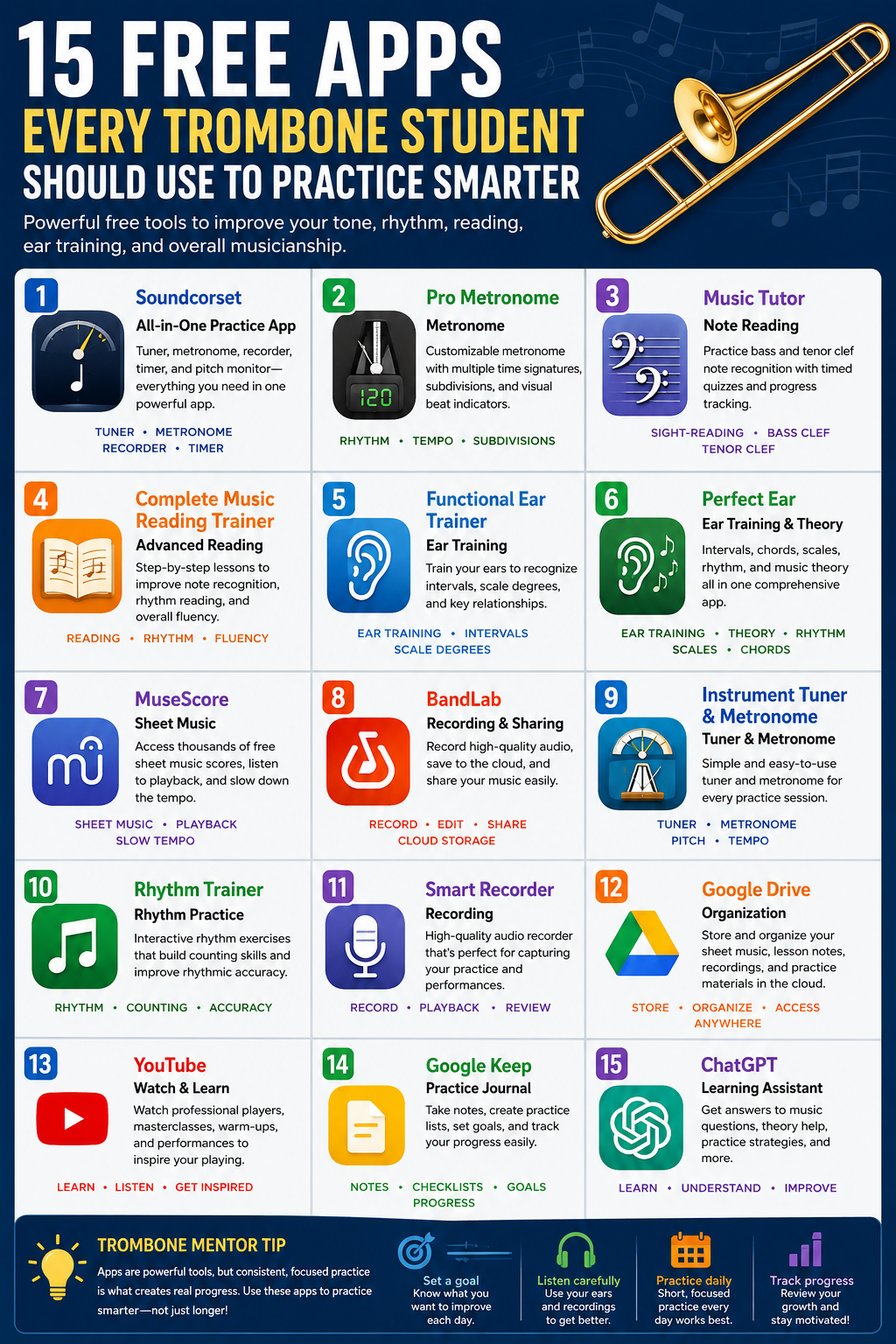
App #11 – Smart Recorder
Record Yourself and Become Your Own Teacher
As part of the free apps for trombone students, this next app is one of the most useful tools a trombone student can have.
You don’t need expensive recording equipment to benefit from recording yourself. Your smartphone, tablet, or computer can provide enough audio quality to help you hear things you might not notice while you’re playing.
What Can You Listen For?
When you listen to a recording of yourself, pay attention to:
- Tone quality
- Intonation
- Rhythm
- Articulation
- Dynamics
- Note accuracy
- Phrasing
- Breathing
- Musical expression
Why Recording Yourself Works
When you’re playing, your attention is focused on producing the sound. When you listen back, you can concentrate entirely on evaluating the performance.
This makes recording yourself particularly valuable when preparing:
- Solo music
- Band auditions
- All-State auditions
- College auditions
- Recitals
- Concert repertoire
Practice Tip
Don’t record everything you practice. Instead, choose one short passage each week and record it.
Listen to the recording without your trombone in your hands. Write down two things you like and two things you want to improve.
Then record the same passage again a week later.
Over time, you’ll create a record of your progress.
App #12 – Google Drive
Keep Your Music and Lesson Materials Organized
Google Drive isn’t specifically a music app, but it can become one of the most useful tools in your digital practice system.
A trombone student can use Google Drive to keep important practice and lesson materials together instead of having them scattered across a phone, computer, email account, and music folder.
You Can Store:
- Lesson assignments
- Practice plans
- PDF sheet music
- Practice recordings
- Audition music
- Music theory worksheets
- Practice logs
- Teacher feedback
Create a Trombone Folder
Consider creating a main folder called:
Trombone Practice
Then create folders such as:
- Current Music
- Lessons
- Scales
- Etudes
- Solos
- Auditions
- Recordings
- Practice Logs
This simple organization system can save you a tremendous amount of time.
Practice Tip
After each lesson, place your assignment and any supporting materials into your lesson folder.
That way, when it’s time to practice, you don’t have to remember what your teacher assigned—you can simply open the folder and get started.
App #13 – YouTube
Learn by Listening to Great Trombone Players
YouTube isn’t technically a practice app, but it can be an incredibly valuable free learning resource for trombone students. I recommend that you use this a the “go-to” outlet for your listening sessions.
One of the best ways to become a better musician is to listen to great musicians.
You can find performances, masterclasses, warm-ups, interviews, and educational videos from professional musicians.
What Should You Watch?
Look for videos featuring:
- Professional trombone players
- College trombone professors
- Professional orchestras
- Concert bands
- Jazz ensembles
- Trombone masterclasses
- Solo performances
Don’t Just Watch—Listen
Watching a professional player is useful, but listening critically is even more important.
Ask yourself:
- How does the player begin each phrase?
- What does their tone sound like?
- How do they shape long notes?
- Where do they breathe?
- How do they approach high notes?
- How do they use vibrato?
- How do they articulate?
- How do they shape dynamics?
You don’t need to copy another player’s sound. Instead, listening helps you develop your own concept of what you want your trombone to sound like.
Practice Tip
Choose one professional performance of the piece you’re studying.
Listen to it several times before practicing.
Then play along with the recording at a slower speed if possible.
This can help you develop musical phrasing while improving your ability to hear how your part fits into the larger musical picture.
App #14 – Google Keep
Turn Your Phone Into a Simple Practice Journal
A practice journal doesn’t need to be complicated.
Google Keep can provide a simple way to keep track of what you’re working on and what you need to accomplish.
Create a Note Called:
Today’s Trombone Practice
Then list your goals.
For example:
- Warm-up – 10 minutes
- Major scales – 10 minutes
- Arban exercise – 15 minutes
- Solo – 20 minutes
- Band music – 20 minutes
- Sight-reading – 5 minutes
You can check off each item as you complete it.
Why This Helps
One of the biggest problems students face is practicing without a plan.
They pick up the trombone, play a few familiar exercises, play through their favorite song, and stop.
That’s playing—but it isn’t necessarily effective practicing.
A practice journal forces you to decide:
What am I trying to improve today?
Practice Tip
At the end of every practice session, write down one sentence:
“Tomorrow I need to work on…”
When you begin practicing the next day, you’ll immediately know where to start.
App #15 – ChatGPT
Use AI as a Practice and Learning Assistant
AI tools such as ChatGPT can provide another useful resource for trombone students when they’re used appropriately.
For example, students can ask questions about:
- Music theory
- Rhythm
- Scales
- Key signatures
- Musical terminology
- Practice strategies
- Audition preparation
- Composer information
- Trombone history
You could ask:
“Explain how to practice a difficult trombone passage slowly.”
Or:
“Explain the difference between a major and minor scale.”
Or:
“Give me a five-minute rhythm practice exercise for a high school trombone student.”
But There Is an Important Limitation
ChatGPT should supplement your music education—not replace your teacher.
An AI system can’t listen to you play and provide the same personalized feedback as an experienced trombone teacher.
If you’re struggling with embouchure, tone production, breathing, slide technique, range, or another physical aspect of playing, work with your teacher rather than relying exclusively on an AI-generated answer.
Practice Tip
Use AI to help you understand what you’re practicing, then use your trombone teacher to help you play it correctly.
That’s a much more effective combination.
Your Free Apps for Trombone Students Toolkit
You’ve now seen all 15 tools. But remember—you don’t need to download and use every one.
Here’s a simple way to organize them:
| App | Primary Purpose | Best Use |
|---|---|---|
| Soundcorset | Tuner/Metronome/Recorder | Daily practice |
| Pro Metronome | Rhythm | Scales & technique |
| Music Tutor | Note reading | Sight-reading |
| Complete Music Reading Trainer | Music literacy | Advanced reading |
| Functional Ear Trainer | Ear training | Pitch development |
| Perfect Ear | Ear training/theory | Musicianship |
| MuseScore | Sheet music | Repertoire |
| BandLab | Recording | Self-evaluation |
| Instrument Tuner & Metronome | Tuning/rhythm | Fundamentals |
| Rhythm Trainer | Rhythm | Counting |
| Smart Recorder | Recording | Progress tracking |
| Google Drive | Organization | Lesson materials |
| YouTube | Listening/education | Musical development |
| Google Keep | Practice journal | Practice planning |
| ChatGPT | Learning assistant | Questions & explanations |
How to Use These Apps Without Overcomplicating Practice
Please remember this one thing:
More technology doesn’t automatically mean better practice.
It’s easy to spend 20 minutes downloading apps, changing settings, watching videos, and organizing files—and then realize you haven’t actually played your trombone.
Your apps should make practice more efficient, not become the practice.
A simple setup is usually best.
Your Essential Three
If you’re a beginner, start with just:
1. A tuner
Use it to develop good intonation.
2. A metronome
Use it to develop steady rhythm.
3. A recorder
Use it to listen critically to your playing.
Once you’ve developed a consistent practice routine, add ear training, sight-reading, music theory, and organizational tools.
LEARN MORE: How to Practice Trombone: A Beginner Routine That Actually Works
Frequently Asked Questions
What are the best free apps for trombone students?
Some of the most useful free tools include apps for tuning, metronome practice, ear training, sight-reading, recording, and music organization. You don’t need every app; choose the ones that address your current practice needs.
What is the best free tuner app for trombone?
A reliable chromatic tuner is an essential tool for trombone students. Soundcorset and other tuner apps can provide useful visual feedback while you work on intonation.
Is there a free app for practicing trombone scales?
Yes. A metronome app combined with a scale resource is an excellent way to practice major and minor scales. Your goal should be to play every scale accurately, evenly, and with a consistent tone.
For additional help, see Trombone Scales With Slide Positions: Bb, F, and Eb Major on TromboneMentor.
What is the best app for learning to read music?
Apps such as Music Tutor and Complete Music Reading Trainer can help students improve note recognition and music-reading speed.
Can an app replace a trombone teacher?
No. Apps can provide useful practice tools, but they cannot replace personalized instruction from a qualified trombone teacher.
A teacher can listen to your playing, identify technical problems, demonstrate solutions, and create a practice plan based on your individual needs.
Should beginners use practice apps?
Absolutely. Beginners can benefit from a tuner, metronome, recorder, and simple practice journal from the beginning of their musical journey.
The key is to keep the technology simple and focus primarily on developing good playing habits.
How long should I use these apps each day?
You don’t need to spend hours using apps. Even 5–10 minutes of daily focused use can be valuable.
The majority of your practice time should still be spent actually playing your trombone.
Final Thoughts
Free apps for trombone students can give today’s players access to practice tools that previous generations of musicians could only dream about.
You can carry a tuner, metronome, recorder, ear-training program, sight-reading exercises, sheet music, and practice journal in your pocket.
But remember the most important point:
The app doesn’t make you a better trombone player. Your practice does.
About the Author
Rick Lawrence is a music educator, conductor, professional trombonist, and private instructor with more than 40 years of playing and teaching experience. He has performed with orchestras, jazz ensembles, brass bands, and pit orchestras, and studied with John Coffey of the Boston Symphony Orchestra, Donald Knaub of the University of Texas, and Edward J. Madden, composer, arranger, trombonist.
Through The Trombone Mentor website, Rick provides online trombone lessons and educational resources for beginner, intermediate, and advanced trombonists.