Online Trombone Lessons for Beginners
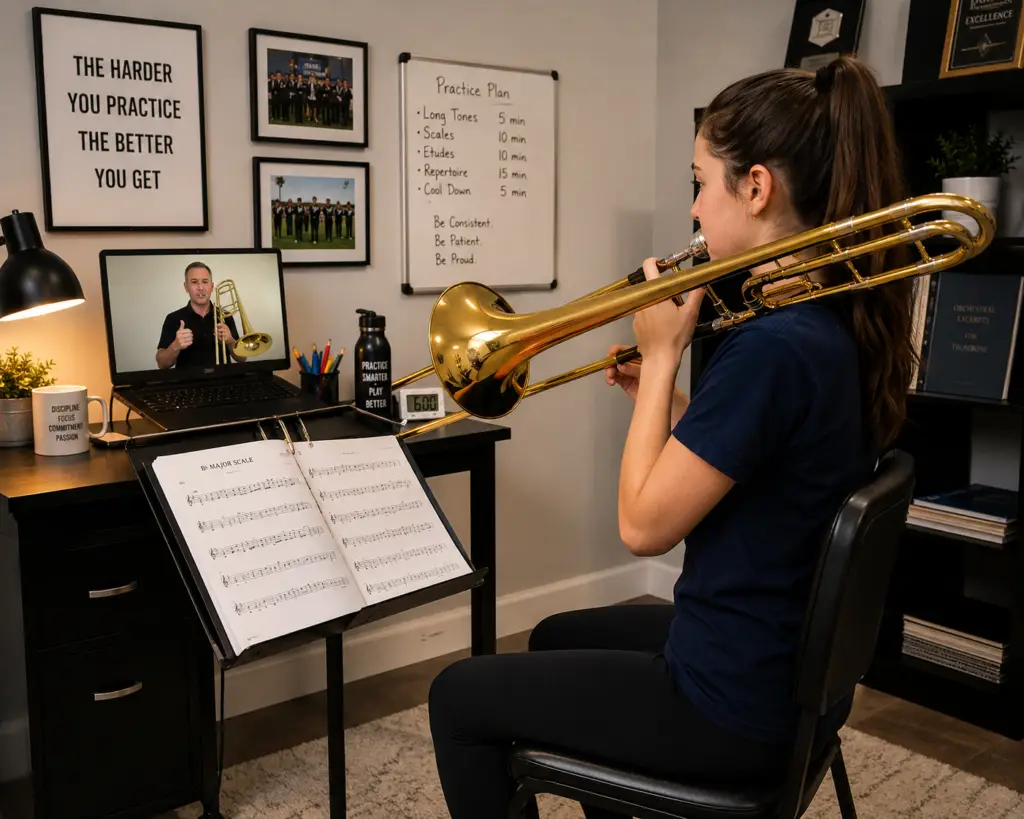
Online trombone lessons for beginners provide a convenient way to learn the instrument while receiving personal instruction and immediate feedback. Learning to play the trombone is an exciting journey, whether your goal is to perform in your middle school band, high school band, jazz ensemble, orchestra, community band, or simply enjoy making music at home.
With the right instruction, beginning students can develop strong fundamentals and build confidence from the very first lessons.
Let’s get started!
Disclaimer
Some of the links below are affiliate links. The Trombone Mentor participates in the Amazon Services LLC Associates Program. What this means, is that at no cost to you, if you click on a link and follow through with a purchase, this site may earn a small commission.
Why Private Trombone Lessons Help Beginners
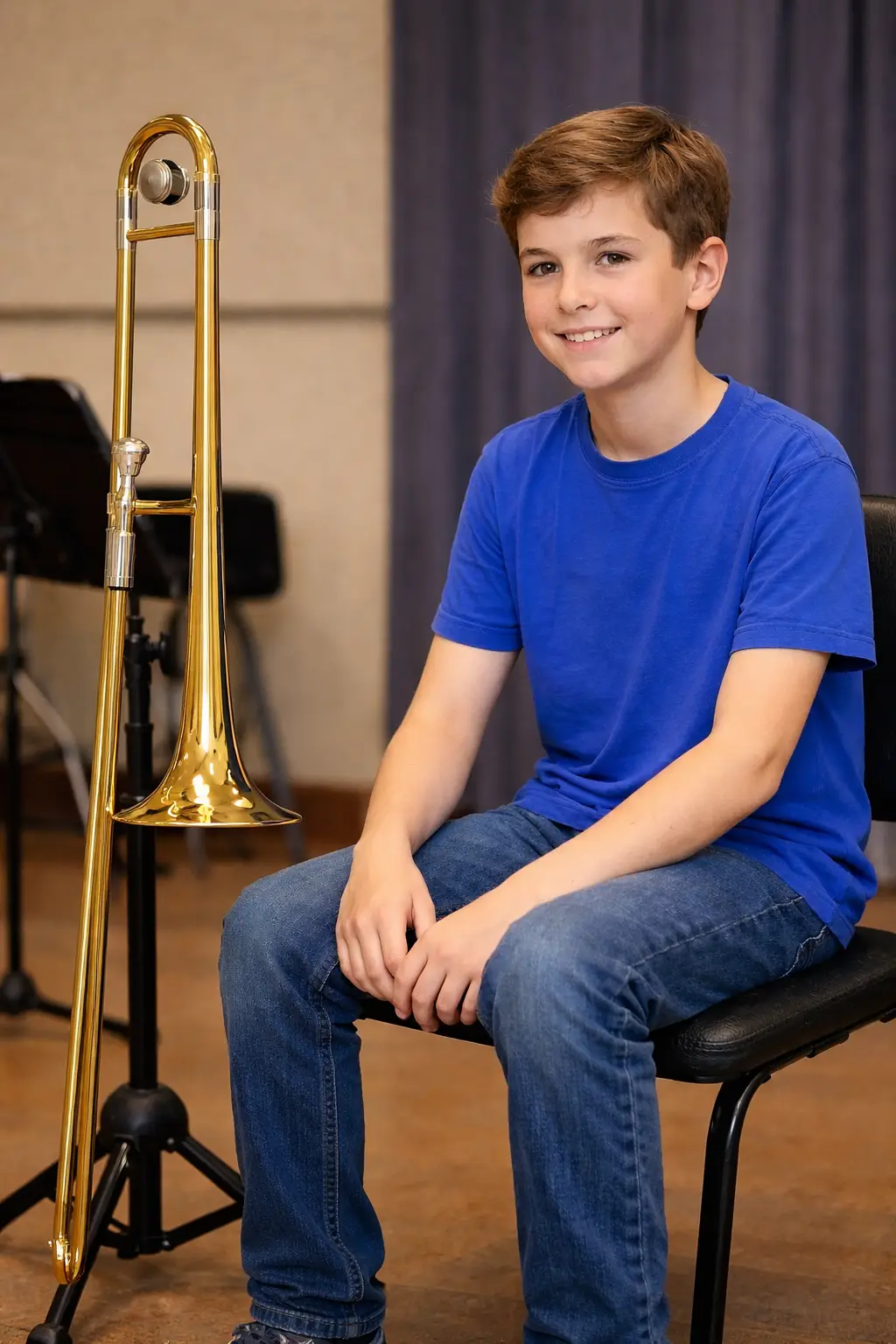
Beginning a musical instrument is exciting, but it can also be confusing.
A school beginning band program teaches students how to become musicians and ensemble members.
A private trombone lesson can concentrate on how to become a better trombone player.
Both are important.
The school band provides the student with the opportunity to make music with other students. A private lesson provides the individual attention needed to examine the student’s technique, identify problems, demonstrate solutions, and build skills at the student’s own pace.
That combination can be especially valuable for a beginning student.
Your school band director provides the foundation for becoming a successful member of the ensemble. A private trombone teacher can provide additional specialized instruction focused entirely on the trombone.
For many students, these two forms of instruction work very well together.
A new student has many things to learn at the same time:
- How to hold the trombone
- How to breathe correctly
- How to form the embouchure
- How to produce a good sound
- How to move the slide
- How to read music
- How to count rhythms
- How to practice effectively
Trying to figure everything out alone can lead to habits that are difficult to correct later.
A private teacher can help you learn the fundamentals correctly from the beginning.
That is one of the biggest advantages of private trombone instruction.
Learn Good Habits From the Beginning
Your first online trombone lessons for beginners establish the foundation for everything that follows.
Good instruction can help you develop proper breathing, posture, embouchure, tone production, slide technique, and music-reading skills.
You don’t need to become an expert during your first lesson. You simply need to begin developing the right habits.
Avoid Common Beginner Mistakes
Many beginning trombone players struggle with the same problems.
They may use too much or too little air. Another problem is holding the trombone incorrectly. They may move the slide without listening carefully to the pitch. Or, they may try to play too loudly before developing a good tone.
These problems are much easier to prevent than to correct later.
A teacher can listen to what you are doing and help you make small adjustments before those mistakes become habits.
Basic Equipment for a Beginning Trombone Player
A beginner doesn’t need a large collection of accessories. However, a few basic items can make learning and practicing the trombone much easier.
A trombone care kit is one of the first things I recommend. Learning how to properly care for the instrument is part of becoming a responsible musician. A basic kit can provide supplies for cleaning and maintaining the trombone.
One of the most essential items for any trombone players is a trombone stand. This piece of equipment saves the instrument from potential damage by falling off a chair or table or worse, someone stepping on it if the trombone is on the floor.
The most obvious and important is a good music stand. Too many beginners try and prop their music on a case, chair or some other place. These three items will get the beginning trombone player off on the right foot.
Can Beginners Really Learn the Trombone Online?
Yes.
A live online lesson is not a recorded video or a computer program that tells you what to do. You are working directly with your teacher.
During the lesson, I can listen to your playing, watch your technique, ask questions, demonstrate exercises, and give you specific suggestions.
You can also ask questions as they come up.
That personal interaction is especially important for beginners.
Online lessons can also make learning easier for families. You don’t have to drive across town, wait in a studio, or rearrange your schedule around travel time.
You simply need your trombone, a suitable space, and the technology needed for the lesson.
For a complete overview of how online instruction works, see my Online Trombone Lessons: Complete Guide.
What Happens During Your First Online Trombone Lesson?
Your first lesson is about more than simply picking up the trombone and playing a few notes.
It is an opportunity for us to get to know each other and determine how I can best help you.
1. We Get to Know Each Other
I want to learn about you as a musician.
Are you completely new to the trombone?
Are you preparing to join your school band?
Have you played another instrument?
Are you returning to the trombone after several years?
Do you have a particular musical goal?
Your answers help me understand where we should begin.
2. We Check Your Equipment
We’ll make sure your trombone and basic equipment are ready for lessons.
For a beginning student, having a properly functioning instrument and a few basic accessories can make learning much easier.
If you’re still deciding which trombone to purchase, my guide to choosing your first trombone can help.
3. We Assess Your Playing
If you have already started playing, I will listen to you play.
This isn’t a test that you can pass or fail.
It simply gives me information about your current skills.
I’ll listen for things such as tone, breathing, posture, embouchure, slide movement, rhythm, and music reading.
For a student who has never played before, we’ll simply start at the beginning.
4. We Establish Goals
Every student is different.
One student may want to make the school band.
Another may want to prepare for auditions.
Another may simply want to learn an instrument for enjoyment.
Together, we’ll establish reasonable goals and develop a plan for future lessons.
Learn More
What Beginners Learn in Trombone Lessons
Online trombone lessons for beginners should develop more than the ability to play a few notes.
My goal is to help students understand how and why they are doing something.
Producing Your First Good Sound
One of the first challenges for a beginning trombone player is producing a clear, controlled sound.
We work on the relationship between the lips, air, and instrument.
Learning to produce a good sound takes time. There is no need to rush it.
A good tone becomes the foundation for everything you will play later.
Breathing
Air is the energy behind your sound.
Beginning students sometimes think that playing the trombone simply means blowing harder. It doesn’t.
Good breathing involves taking in enough air and learning how to use that air efficiently.
We work on breathing so that it becomes a natural part of playing.
Embouchure and Mouthpiece Buzzing
The embouchure is the way you use your lips and facial muscles to produce sound.
Beginning students may also work with mouthpiece buzzing as a way to understand how the lips and air work together.
These exercises are not about making everything perfect immediately. They are about learning how the instrument responds to you.
Learning Slide Positions
The trombone is different from many other band instruments because you must learn where the slide positions are and how they relate to pitch.
But learning positions is only part of the process.
You also need to listen.
This is where your ear becomes an important part of playing.
Reading Music
Beginning students should start learning to read music as they learn to play.
We work with notes, rhythms, rests, time signatures, and musical symbols as they become appropriate for the student’s level.
Learning to read music early helps you become an independent musician.
Developing Musical Skills
Playing the correct notes is only the beginning.
Eventually, we want to develop:
- Good tone
- Accurate rhythm
- Intonation
- Articulation
- Dynamics
- Musical expression
- Sight-reading
- Confidence
For more detailed instruction, see my Beginner Trombone Guide and How to Play a Trombone: Beginner Step-by-Step Guide.
Building Good Practice Habits
One of the most important things online trombone lessons for beginners can learn is how to practice.
You don’t need to practice for hours every day.
You need to practice with a purpose.
A good practice session should have a goal.
For example:
What do I want to improve today?
You might work on a difficult measure, a scale, a rhythm, a slide movement, or your tone.
Then play it carefully, listen to yourself, make adjustments, and try again.
This approach is much more productive than simply playing through music from beginning to end.
For more help, read How to Practice Trombone for Beginners.
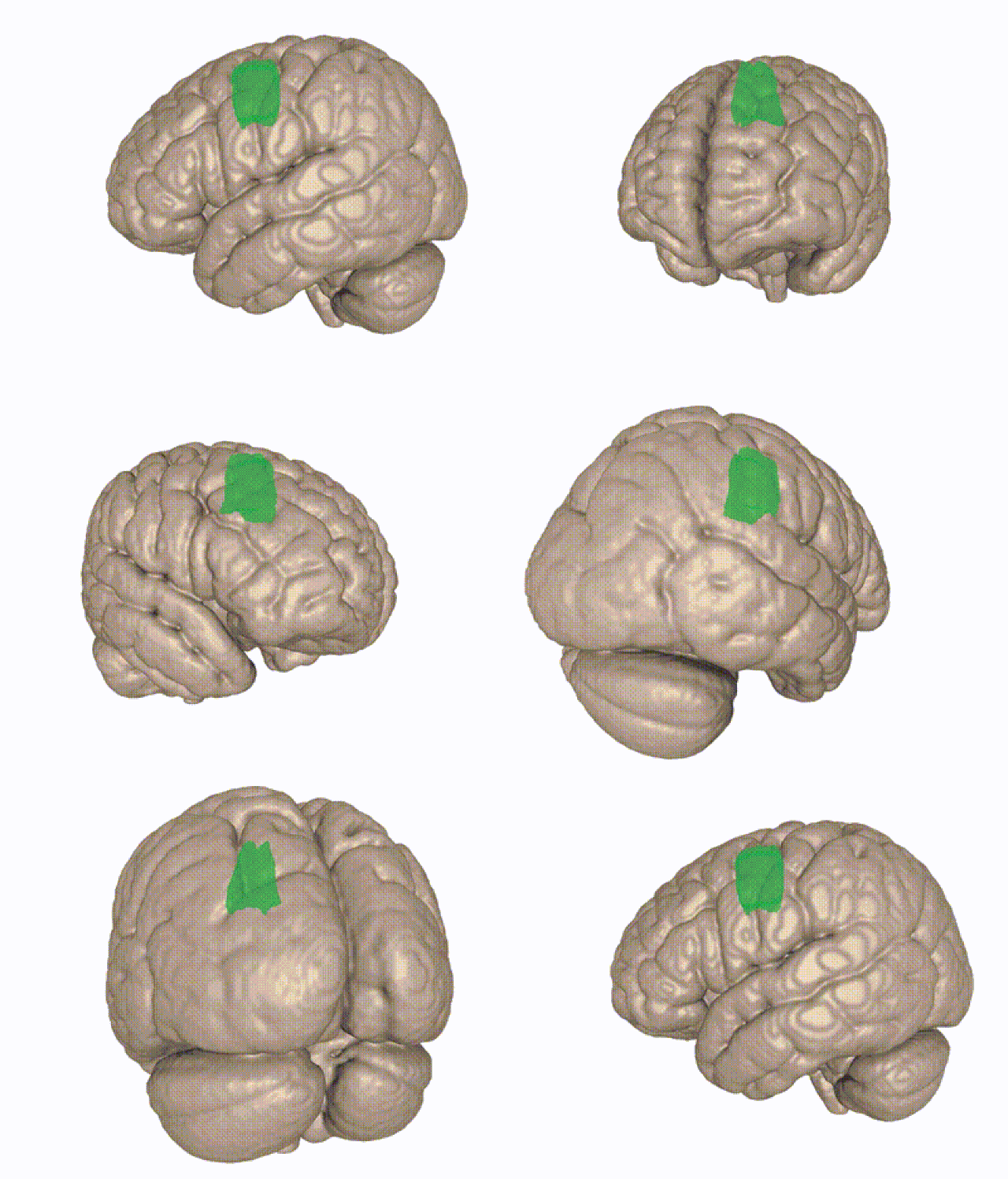
We Hear With Our Ears, But We Listen With Our Brain
One of the ideas I emphasize with my students is:
We hear with our ears, but we listen with our brain.
Your ears receive the sound, but your brain has to recognize what that sound means.
Is the pitch correct?
Check that the tone is clear?
Is the rhythm accurate?
Intonation – is the note too sharp or too flat?
Is the musical phrase moving in the right direction?
Learning to listen critically is one of the most important skills a musician can develop.
The trombone is an excellent instrument for developing this skill because the player must constantly listen and make adjustments to the pitch.
Why Experience Matters When Choosing a Trombone Teacher
Learning an instrument is a relationship between teacher and student.
A teacher should do more than tell you which notes to play.
A good teacher should understand how students learn and know how to explain difficult ideas in a way that makes sense.
I have spent more than 40 years playing the trombone and have taught students of different ages and ability levels.
My experience includes teaching, conducting, and performing in orchestras, jazz ensembles, brass bands, pit orchestras, and other musical settings.
I’ve also had the opportunity to study with accomplished trombonists and teachers, including John Coffey of the Boston Symphony Orchestra, Donald Knaub of the University of Texas, and Edward J. Madden of Brookline, Massachusetts.
That experience has shaped the way I teach.
My goal is not simply to tell students what to do.
I want students to understand what they are doing and why it matters.
Why Choose The Trombone Mentor?
The Trombone Mentor provides personalized, one-on-one online instruction for beginning and developing trombone players.
Lessons can focus on the skills that matter most to your individual goals, including:
- Tone production
- Breathing
- Embouchure
- Slide technique
- Music reading
- Rhythm
- Ear training
- Practice strategies
- Sight-reading
- Musical expression
- Performance preparation
Whether you are just picking up the trombone for the first time or have already been playing for a while, lessons can be adjusted to your current level.
A Teacher Whoo Understands Your Goals
A beginning student may have a very different goal from an experienced high school player.
You may want to:
- Prepare for school band
- Improve your tone
- Learn to read music
- Prepare for an audition
- Become a stronger sight-reader
- Prepare for All-State or regional auditions
- Build confidence
- Become a better overall musician
Your lessons should reflect those goals.
Online Trombone Lessons for Different Students
Beginning Students
If you have never played the trombone before, we start with the fundamentals.
There is no expectation that you already know how to play.
Middle School Students
Middle school is an important time to establish good playing habits.
Lessons can supplement school band instruction and provide individual attention that isn’t always possible in a large ensemble.
High School Students
High school trombone players often have more specific goals.
You may be preparing for auditions, honor bands, All-State, solo and ensemble festivals, college auditions, or advanced musical opportunities.
Online lessons can provide individualized instruction that complements your school band program.
Learn more about Online Trombone Lessons for High School Students.
Adult Beginners
It is never too late to learn the trombone.
Adults often bring a different set of goals and experiences to music lessons. Some want to return to an instrument they played years ago. Others are picking up the trombone for the first time.
Lessons can be adjusted to fit your experience, schedule, and musical goals.
Read more about Online Trombone Lessons for Adult Beginners.
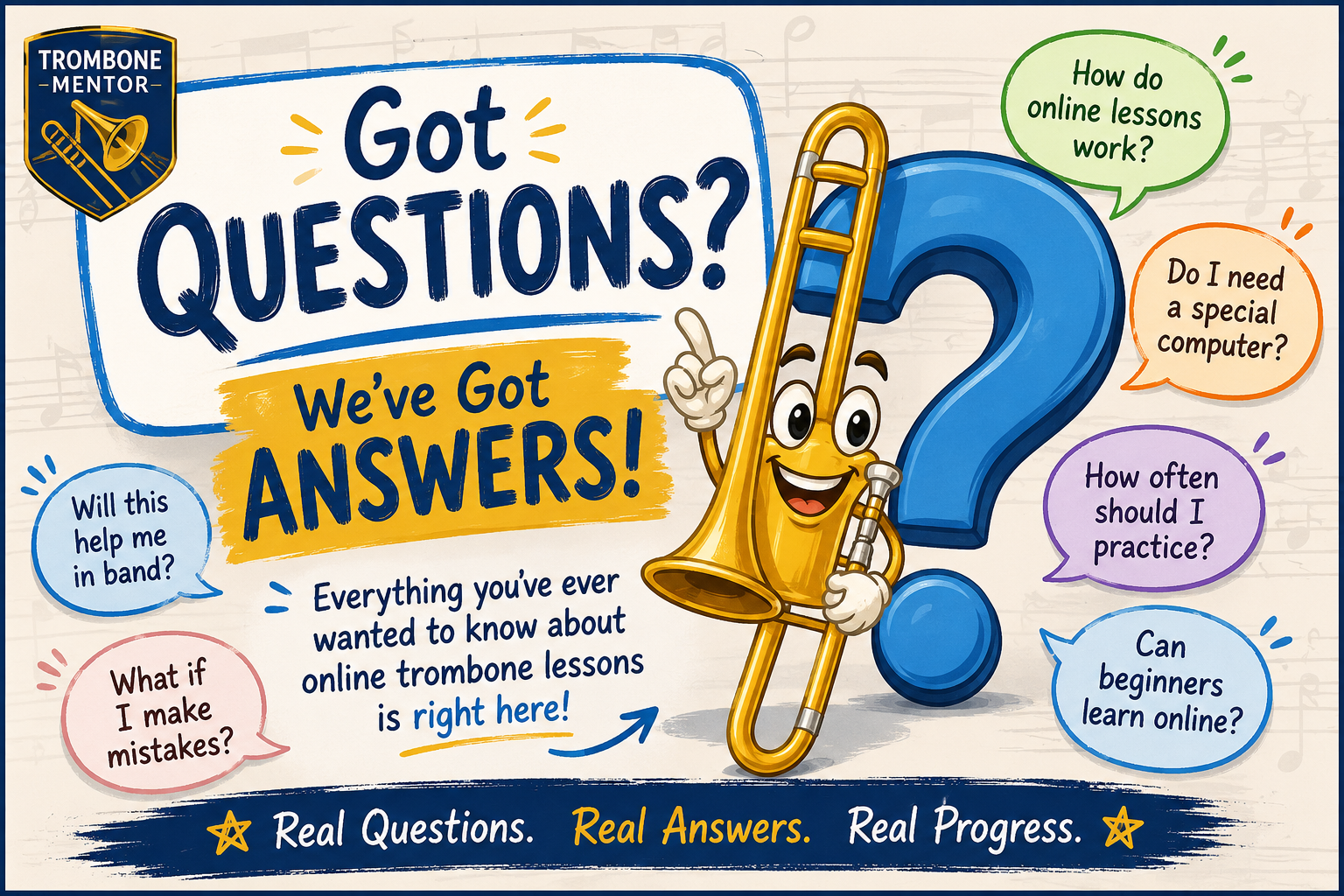
What age should a student be to begin trombone lessons?
There is no single perfect age for every student.
Physical development, interest, attention span, and the student’s ability to handle the instrument all matter.
For younger students, I recommend considering the advice of the student’s school band director or music teacher.
Does a beginner need to own a trombone before starting lessons?
Ideally, you should have access to a trombone before beginning regular lessons.
If you are still deciding what to purchase, I can help you understand what to look for in a beginner instrument.
How long does it take to learn the trombone?
There is no single answer.
Students develop at different rates. Your progress depends on your practice habits, previous musical experience, goals, and consistency.
The important thing is to build your skills one step at a time.
How often should a beginner practice?
Regular practice is more important than occasional long practice sessions.
Even a shorter, focused practice session can be productive when you know what you are trying to accomplish.
What if I’ve never played an instrument before?
That’s okay.
Beginners are welcome.
We start with the fundamentals and build from there.
Can adults learn the trombone online?
Absolutely.
Adults can learn the trombone for many of the same reasons younger students do: enjoyment, personal growth, returning to music, or joining a musical group.
What technology do I need for online lessons?
You need a reliable internet connection, a device with a camera and microphone, your trombone, and a suitable place to play.
We’ll discuss the specific setup before your first lesson.
Can online lessons prepare a student for school band?
Yes.
Online instruction can complement school band by providing individual attention to areas such as tone, technique, music reading, rhythm, and practice habits.
Why choose an experienced trombone teacher instead of simply finding someone nearby?
Location doesn’t necessarily determine the quality of instruction.
An experienced teacher can bring years of playing, teaching, and performance experience to the lesson.
With online instruction, you can work with a teacher based on teaching experience and expertise rather than simply geographic convenience.
Ready to Start Your Trombone Journey?
Learning the trombone doesn’t have to be overwhelming.
You don’t have to know everything before your first lesson.
You simply need to be willing to learn.
Whether you are a beginning student, a parent helping your child get started, a high school musician preparing for an audition, or an adult who has always wanted to play, I would be happy to help you develop your trombone skills.
Your progress begins with the first lesson.
Learn More About Online Trombone Lessons
About Rick Lawrence
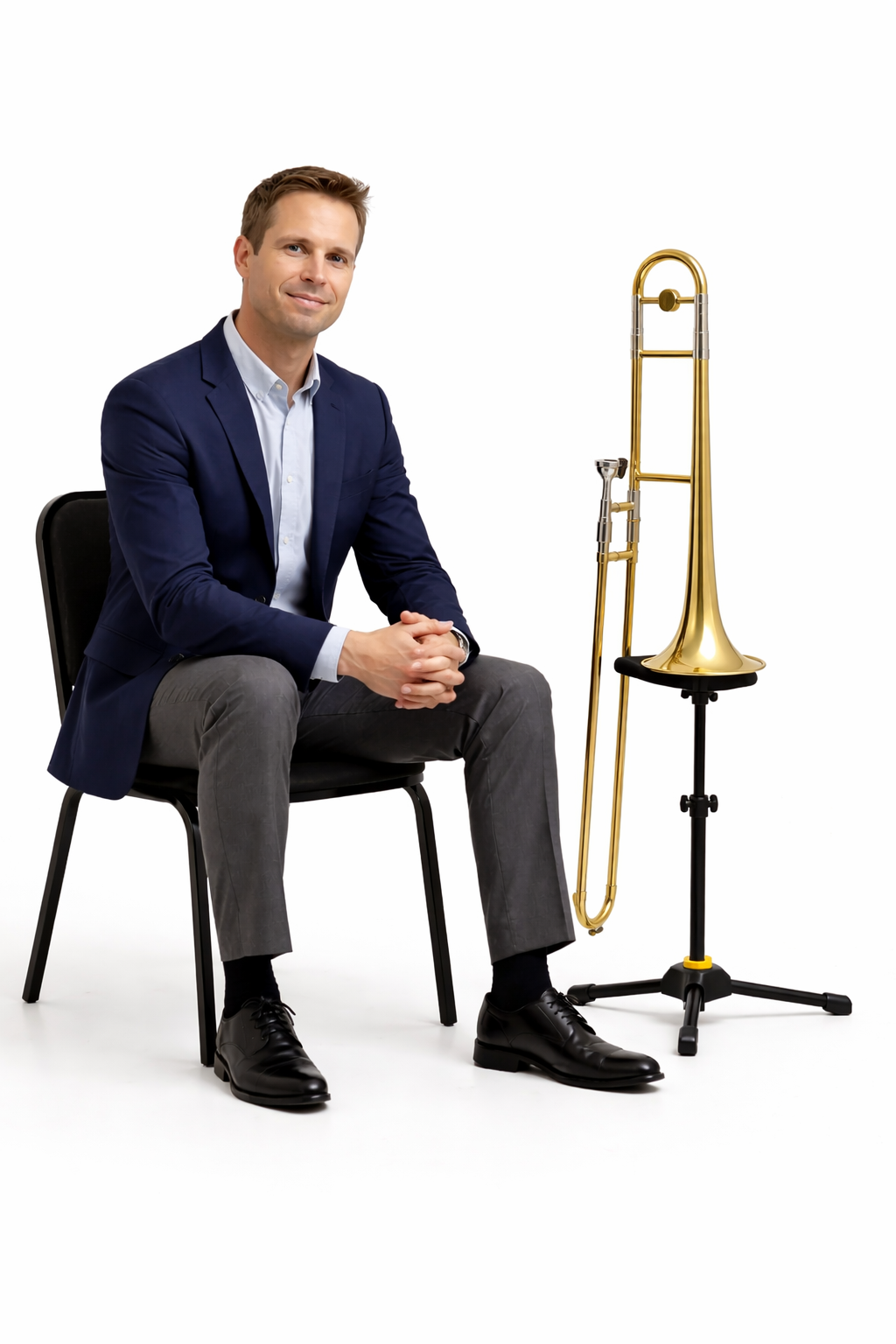
Rick Lawrence is a retired instrumental music educator, conductor, and professional trombonist with more than 40 years of playing and teaching experience.
His musical experience includes orchestras, jazz ensembles, brass bands, pit orchestras, and other performance settings.
He has taught students of different ages and ability levels and believes that good instruction should be supportive, encouraging, clear, and practical.
His teaching focuses on developing strong fundamentals while helping students become confident and independent musicians.
Rick studied with John Coffey of the Boston Symphony Orchestra, Donald Knaub of the University of Texas, and Edward J. Madden of Brookline, Massachusetts.
Through The Trombone Mentor, Rick provides personalized online trombone instruction to students who want to improve their playing from the comfort of their own homes.
Related Trombone Resources
If you are beginning your trombone journey, these resources can help:
- Beginner Trombone Guide: How to Start Playing the Right Way
- How to Play a Trombone: Beginner Step-by-Step Guide
- How to Practice Trombone for Beginners
- How to Choose Your First Trombone: Beginner’s Guide
- Online Trombone Lessons
- Online Trombone Lessons for High School Students
- Online Trombone Lessons for Adult Beginners