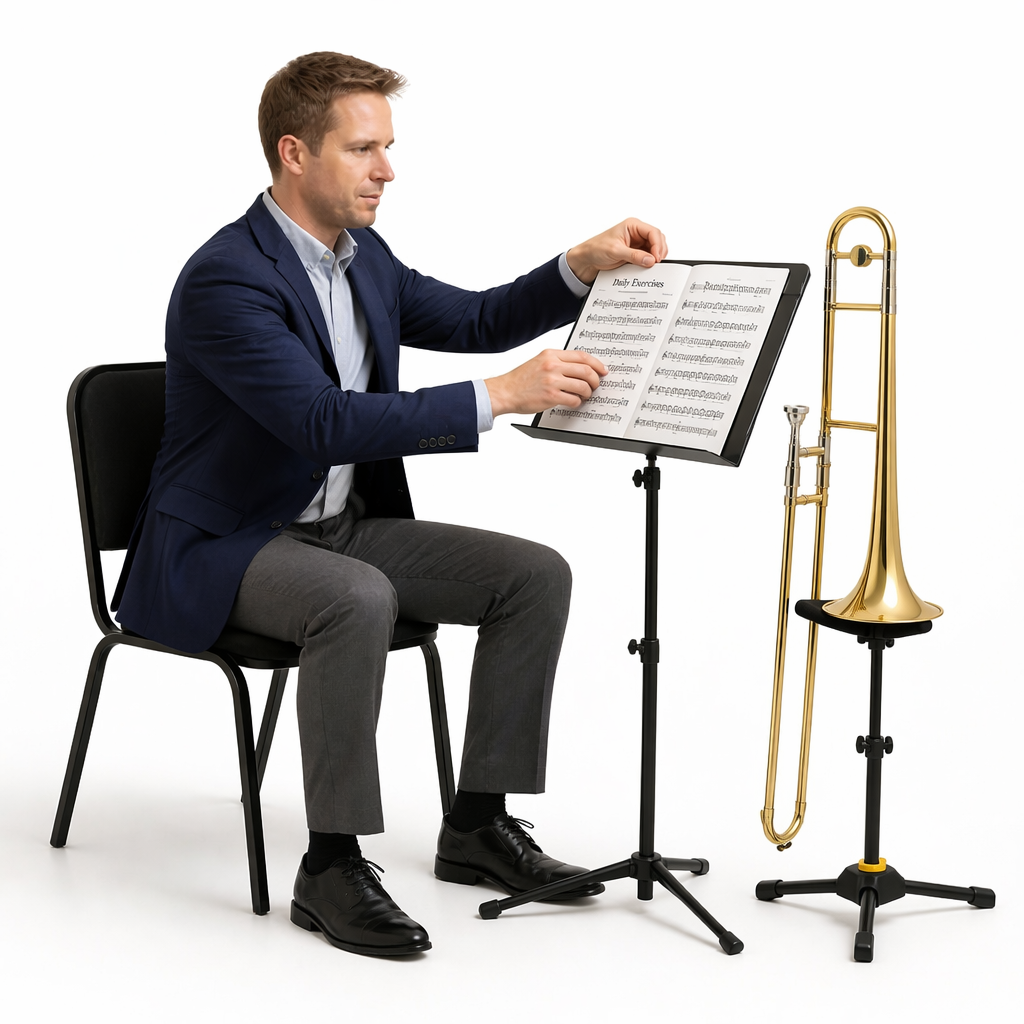
Music theory for trombone players does not have to be complicated. Many students tell me they simply want to learn how to play the trombone and are not interested in studying theory. However, after more than 50 years of performing and teaching, I’ve found that understanding a few basic music theory concepts can make learning the trombone much easier.
The good news is that you don’t need a college-level theory course to become a better musician. Instead, you only need to understand the concepts that help you read music, learn scales, count rhythms, and perform with confidence.
Think of music theory as the language of music. Just as learning the alphabet helps you read a book, learning music theory helps you understand what is happening on the page when you open a piece of music.
In this guide, I’ll explain the essential concepts of music theory specifically for trombone players. Along the way, you’ll learn how notes, rhythms, scales, key signatures, and musical symbols work together to help you become a stronger and more confident musician.
Let’s get started!
Disclaimer
This article contains Amazon Affiliate Links. What this means, is that, at no cost to you, if you click a link and follow through with a purchase, this site may earn a small commission.
What is Music Theory?
Simply put, music theory is the study of how music works.
For beginner trombonists, music theory helps explain the symbols, notes, rhythms, and markings you see on the page. Instead of guessing what the music means, theory gives you the tools to understand it.
Think of music theory as a roadmap. When you first start learning the trombone, you may be focused on slide positions, making a good sound, and playing your first songs. However, as you progress, you’ll discover that understanding basic theory makes learning music much easier.
For example, music theory teaches you:
- How to read notes on the staff
- How to count rhythms accurately
- What key signatures mean
- How scales are constructed
- How dynamics and articulations affect musical expression
Fortunately, you don’t need to learn everything at once. Most successful beginner trombonists learn music theory gradually while they learn to play their instrument.
Throughout this guide, I’ll explain the theory concepts that are most useful for trombone players and show you how they apply to real music. As a result, you’ll build a stronger foundation and become a more confident musician.
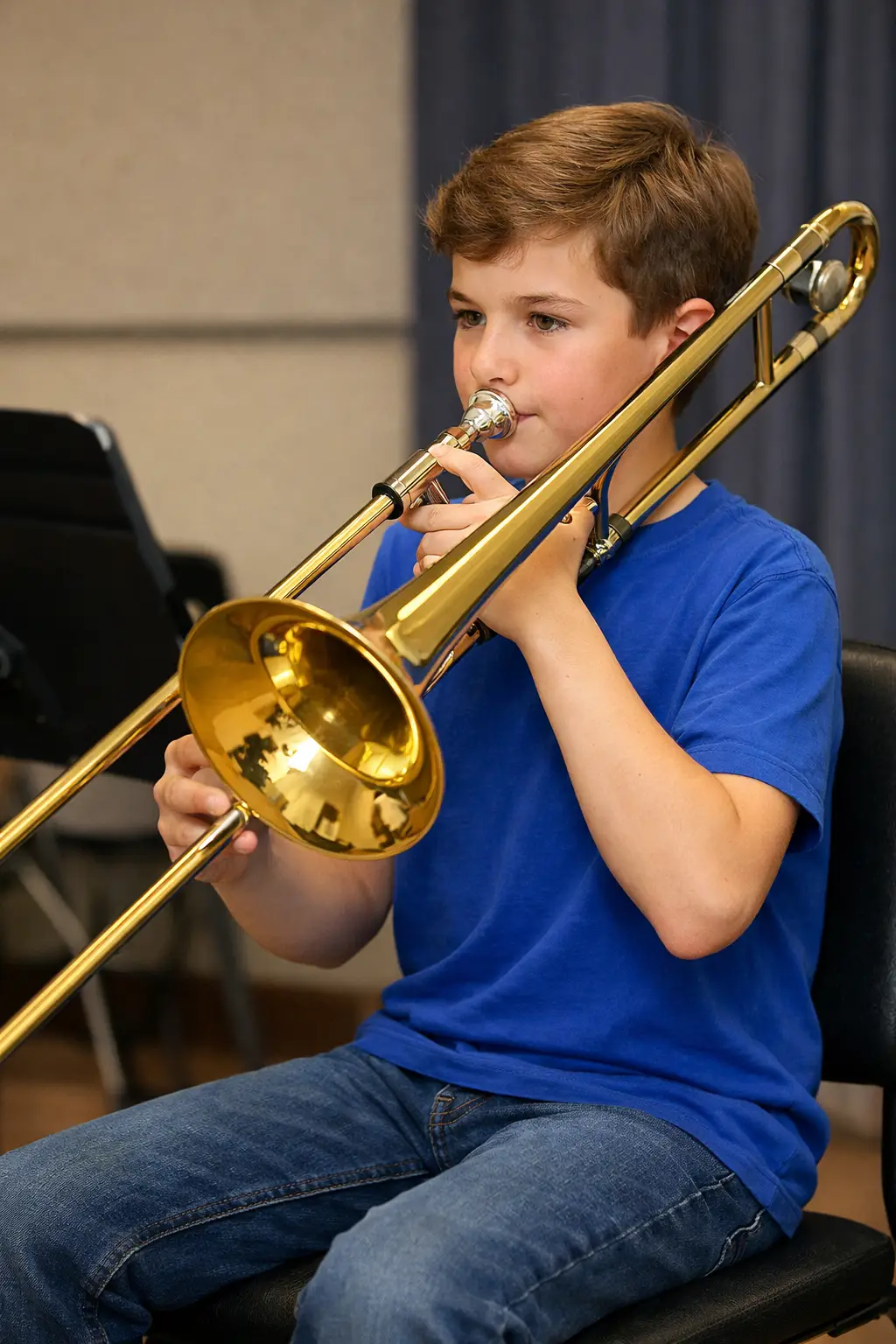
Why Music Theory Matters for Trombone Players
One of the most common questions I hear from students is:
“Do I really need to learn music theory?”
My answer is always yes—but probably not for the reasons you think.
Music theory isn’t about memorizing complicated rules. It’s about understanding how music works.
When you understand music theory, you can:
- Learn new music faster
- Sight-read more accurately
- Understand your band director’s instructions
- Play scales with confidence
- Recognize patterns in music
- Improve your ear training
- Become a more complete musician
I’ve taught many students who struggled with reading music. Often, the problem wasn’t their playing ability—it was that they didn’t understand the theory behind what they were seeing on the page.
The more theory you understand, the less confusing music becomes.
Need Help Learning Music Theory?
Many students find music theory easier to understand when it is taught alongside their instrument. In my private online trombone lessons, I help students connect music theory directly to what they are playing so that concepts like scales, rhythms, and key signatures become practical skills rather than confusing rules.
Learn more about my Online Trombone Lessons.
The Musical Alphabet
Let’s start with the foundation of all music.
The musical alphabet contains only seven letters:
A – B – C – D – E – F – G
After G, the pattern repeats:
A – B – C – D – E – F – G – A
Unlike the alphabet you learned in school, music keeps cycling through these seven letters over and over.
As a trombone player, you’ll encounter these notes constantly in scales, exercises, and songs.
Whole Steps and Half Steps
The distance between notes is measured using steps.
A half step is the smallest distance commonly used in Western music.
Examples:
- B to C
- E to F
A whole step equals two half steps.
Examples:
- C to D
- F to G
Understanding whole and half steps becomes important when learning scales and key signatures.
When I teach scales to beginners, this is one of the first theory concepts we discuss because every major scale follows a specific whole-step and half-step pattern.
Understanding the Staff and Bass Clef
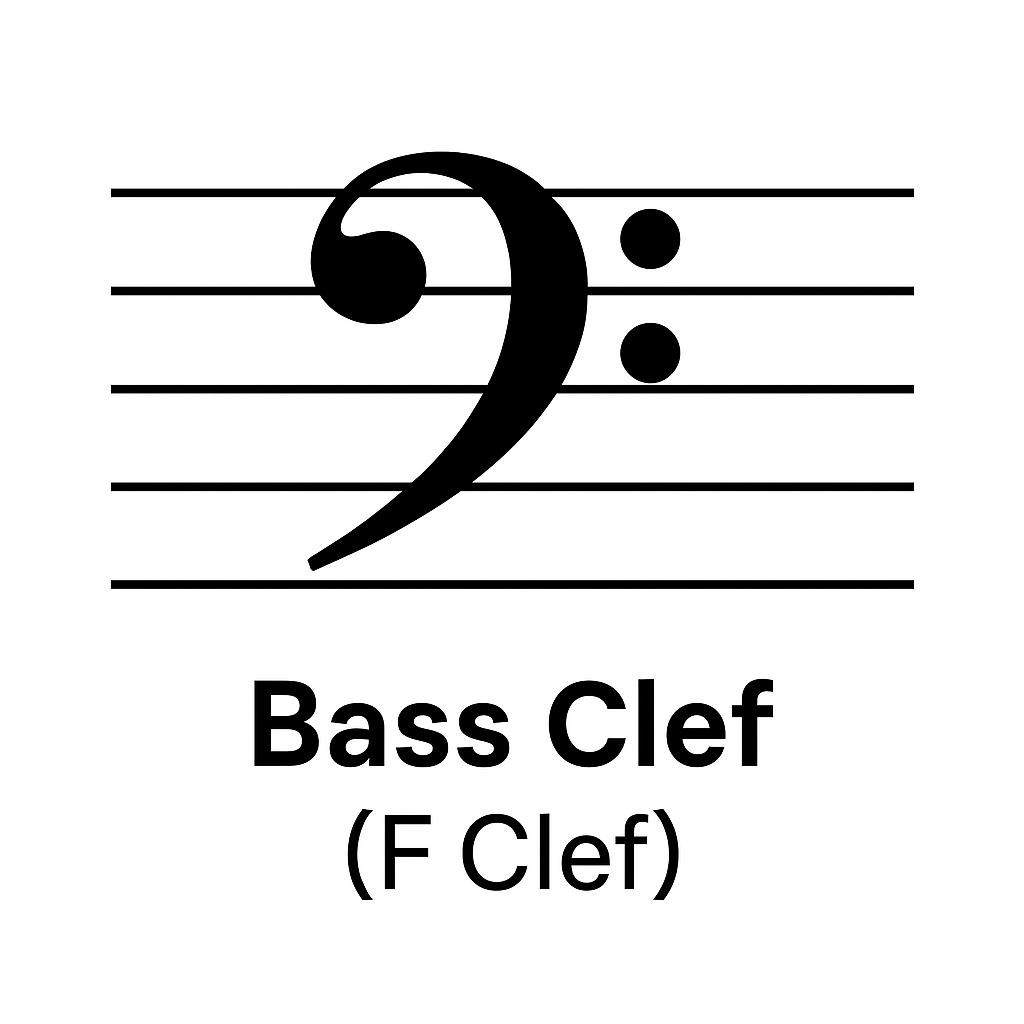
Music is written on a staff consisting of five horizontal lines and four spaces.
Each line and space represents a specific pitch.
Since trombone is primarily a bass clef instrument, learning bass clef is essential.
Bass Clef Notes
The lines of the bass clef are:
G – B – D – F – A
The spaces are:
A – C – E – G
At first, students often feel overwhelmed by memorizing notes on the staff. That’s completely normal.
The key is repetition.
Every time you practice reading music, identifying notes becomes easier.
Over time, you’ll stop thinking about individual note names and begin recognizing them automatically.
Ledger Lines
Trombone music often extends above and below the staff.
These extra notes are written using ledger lines.
For beginners, ledger lines can seem challenging, but they quickly become familiar as your reading skills improve.
Don’t try to memorize every ledger line note at once. Learn them gradually through scales, exercises, and repertoire.
Connecting Notes to Trombone Slide Positions
This is where theory becomes practical.
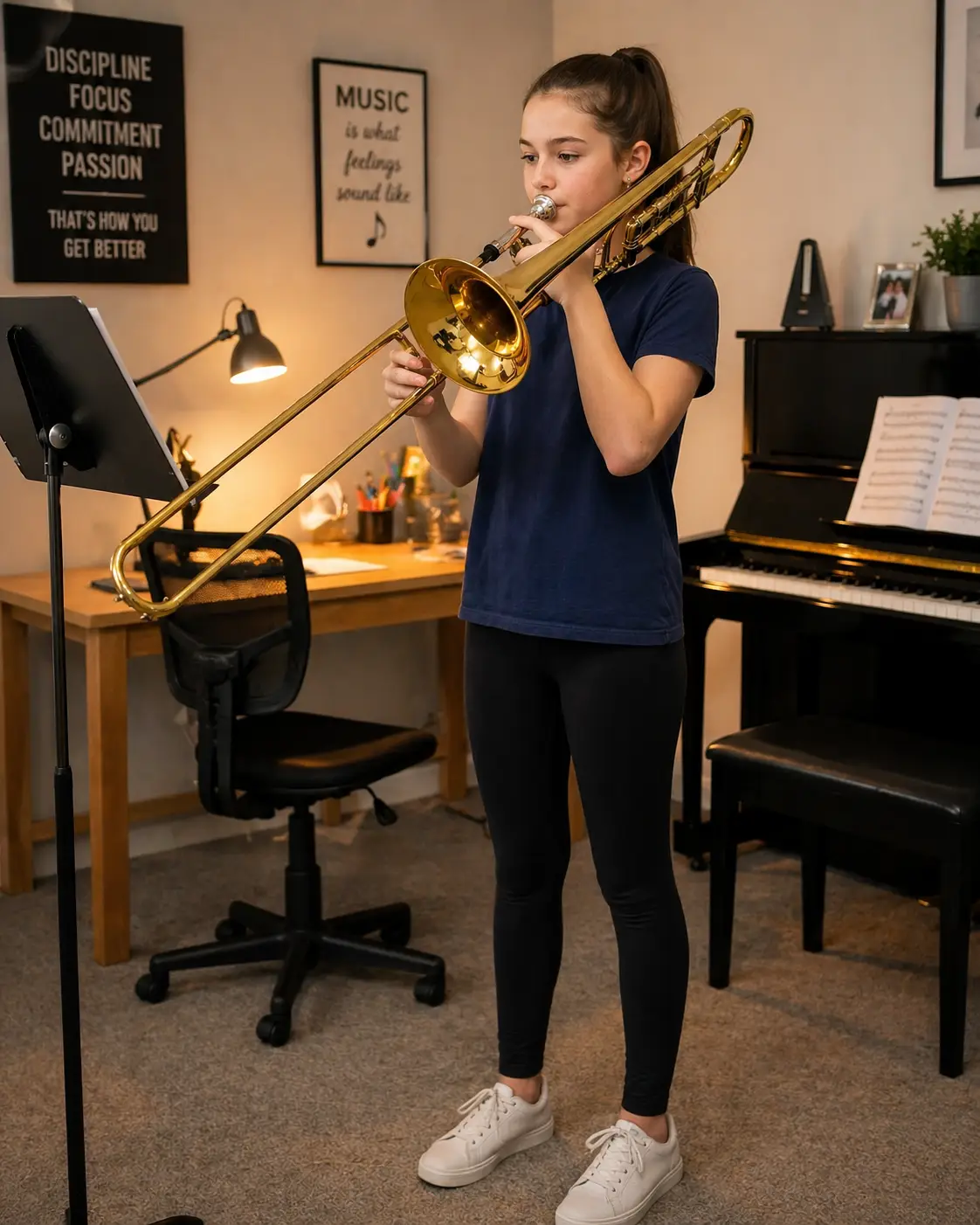
Unlike trumpet or clarinet players who press valves or keys, trombonists use slide positions to produce different pitches.
Every note you see on the staff corresponds to a specific slide position.
For example:
- Bb = 1st Position
- C = 6th Position
- D = 4th Position
- Eb = 3rd Position
- F = 1st Position
When students first begin reading music, I encourage them to think of both the note name and the slide position.
Eventually, your brain creates a connection between what you see and how you move the slide.
This process is one reason why practicing scales is so valuable.
Scales strengthen the relationship between music theory and physical playing.
Rhythm: The Heartbeat of Music
Many beginners focus entirely on notes and slide positions.
However, rhythm is equally important.
You can play all the correct notes, but if the rhythm is incorrect, the music won’t sound right.
I often tell students:
“Pitch tells us what note to play. Rhythm tells us when to play it.”
Let’s look at the most common note values.
Whole Note
A whole note receives four beats in 4/4 time.
Count:
1 – 2 – 3 – 4
Half Note
A half note receives two beats.
Count:
1 – 2
Quarter Note
A quarter note receives one beat.
Count:
1, 2, 3, 4
Eighth Notes
Two eighth notes fit into one beat.
Count:
1-and, 2-and, 3-and, 4-and
Learning to count rhythms accurately is one of the most important skills a developing trombonist can build.
In my lessons, we often clap and count rhythms before playing them on the instrument.
This simple exercise dramatically improves reading accuracy.
Understanding Time Signatures
A time signature appears at the beginning of a piece of music.
It looks like a fraction but functions differently.
The top number tells us how many beats are in each measure.
The bottom number tells us what type of note receives one beat.
4/4 Time
The most common time signature.
- Four beats per measure
- Quarter note receives one beat
3/4 Time
Often used for waltzes.
- Three beats per measure
- Quarter note receives one beat
2/4 Time
Common in marches.
- Two beats per measure
6/8 Time
A compound meter often felt in two large beats.
Many students find 6/8 confusing at first, but once you understand the pulse, it becomes much easier to read.
Understanding time signatures helps you count correctly and stay with the ensemble.
Key Signatures and Scales
As trombone players, we spend a lot of time practicing scales. Sometimes students view scales as just another exercise they have to get through, but scales are actually one of the best ways to learn music theory and improve your playing at the same time.
Before we talk about scales, we need to understand key signatures.
What Is a Key Signature?
A key signature appears at the beginning of a piece of music, immediately after the clef symbol.
A key signature tells us which notes will be played as sharps or flats throughout the piece.
Instead of writing a sharp or flat sign beside every note, the composer places them in the key signature to make the music easier to read.
For example:
- One flat = Bb Major
- Two flats = Bb and Eb
- Three flats = Bb, Eb, and Ab
As trombone players, we encounter flat keys frequently. Band music is often written in keys such as Bb Major, Eb Major, and F Major, so becoming comfortable with flats is an important skill.
Why Scales Matter
Scales help us understand how notes work together within a key.
When you practice scales regularly, you learn:
- Note relationships
- Slide position patterns
- Key signatures
- Intonation
- Finger memory for reading music
More importantly, scales appear everywhere in music.
Many melodies are simply portions of scales arranged in different ways. Once you recognize these patterns, sight-reading becomes much easier.
The Bb Major Scale
The Bb Major scale is often the first scale trombone players learn.
The notes are:
Bb – C – D – Eb – F – G – A – Bb
Notice that the scale contains one flat: Eb.
As you practice this scale, pay attention to how the notes relate to one another. Don’t simply memorize slide positions. Learn the note names and understand where they fit within the key.
The F Major Scale
The F Major scale contains one flat:
Bb
The notes are:
F – G – A – Bb – C – D – E – F
You’ll encounter this key often in band literature and beginning solos.
The Eb Major Scale
The Eb Major scale contains three flats:
Bb – Eb – Ab
The notes are:
Eb – F – G – Ab – Bb – C – D – Eb
Many students initially find this scale challenging because of the additional flats, but with regular practice it becomes familiar.
Learning Scales Effectively
When practicing scales, I encourage students to do more than simply play them up and down.
Try these approaches:
- Say the note names aloud.
- Identify the key signature before playing.
- Count the rhythm carefully.
- Listen for accurate pitch.
- Play with a tuner and metronome.
- Practice from memory.
The goal is not simply to play scales quickly. The goal is to understand them.
The more you understand scales, the easier it becomes to learn new music.
Struggling With Scales and Key Signatures?
If scales, flats, sharps, and key signatures still feel confusing, you’re not alone. These topics are much easier when someone can demonstrate them and answer your questions in real time.
During my online lessons, I guide students step-by-step through scales, music reading, and theory concepts while applying them directly to the trombone. ONLINE TROMBONE LESSONS
Dynamics and Articulations
Imagine reading a story where every word was spoken at the same volume and with the same expression.
It would become boring very quickly.
Music works the same way.
Dynamics and articulations tell us how music should sound, not just which notes to play.
Dynamics
Dynamic marking in music indicate volume. These are symbols that tell the musician how loud or soft to play.
Here are some of the most common dynamic markings you’ll see in trombone music:
- pp = very soft
- p = soft
- mp = moderately soft
- mf = moderately loud
- f = loud
- ff = very loud
One of the most common mistakes young musicians make is treating dynamics as suggestions instead of instructions.
When a composer writes piano (soft), they expect the performer to play softly.
When a composer writes forte (loud), they expect a full, confident sound.
Learning to follow dynamics adds musicality and expression to your playing.
Crescendo and Decrescendo
A crescendo means gradually getting louder.
A decrescendo means gradually getting softer.
These markings help shape musical phrases and make your performance more expressive.
Think of them as the musical equivalent of raising or lowering your voice when telling a story.
Articulations
Articulations tell us how notes should begin and end. I like to emphasize to students that articulations is the way we “pronounce” the notes.
Legato
Legato means smooth and connected.
The notes should flow naturally from one to the next.
Legato playing is one of the most important skills for trombonists because it creates a beautiful singing sound.
Staccato
Staccato means short and detached.
Each note should be separated slightly from the next.
Accent
An accent indicates that a note should receive extra emphasis.
This does not necessarily mean playing louder. Instead, the note should stand out from the surrounding notes.
Slurs
A slur connects two or more notes.
For trombonists, slurs often require smooth slide movement and careful air support.
Many students initially focus only on moving the slide correctly. However, successful slurring begins with consistent airflow and relaxed playing.
When you see articulations and dynamics in your music, don’t ignore them. They are an essential part of the composer’s instructions and help bring the music to life.
Intervals and Ear Training
One of the most valuable skills a trombone player can develop is the ability to hear music before playing it.
This is where intervals and ear training become important.
Many students think ear training is only for advanced musicians. In reality, every beginner can benefit from developing their listening skills.
The better your ear becomes, the easier it is to:
- Play in tune
- Learn new music
- Sight-read accurately
- Match pitch in an ensemble
- Memorize music
- Recognize mistakes while practicing
What Is an Interval?
An interval is simply the space or distance between two notes.
For example, if you play Bb and then C, you have played an interval.
If you play Bb and then F, you have played a larger interval.
Music is built from intervals. Scales, melodies, chords, and harmonies all depend on the relationships between notes.
Common Intervals
Here are a few intervals that trombone players encounter frequently:
Second
A second is the distance between neighboring notes.
Examples:
- Bb to C
- C to D
- F to G
Seconds appear constantly in scales and simple melodies.
Third
A third skips one note of the scale.
Examples:
- Bb to D
- C to E
- F to A
Many melodies are built from thirds.
Fourth
Examples:
- Bb to Eb
- C to F
- F to Bb
Fourths are especially important for trombone players because many tuning exercises and lip slurs use these intervals.
Fifth
Examples:
- Bb to F
- C to G
- Eb to Bb
Fifths are among the most stable and recognizable intervals in music.
Why Intervals Matter
When students learn to recognize intervals, they become stronger sight-readers.
Instead of seeing individual notes one at a time, they begin recognizing patterns.
For example, rather than thinking:
“That’s a Bb…now a D…now an F…”
They begin recognizing:
“That’s a Bb major triad.”
This type of recognition speeds up reading and improves musical understanding.
Ear Training for Trombone Players
Ear training simply means learning to recognize musical sounds.
You don’t need special software or advanced training to get started.
In fact, some of the best ear-training exercises are very simple.
Sing Before You Play
One exercise I frequently use with students is singing note patterns before playing them.
If you can sing a passage accurately, you’re much more likely to play it accurately.
Don’t worry if you’re not a singer.
The goal isn’t to perform. The goal is to train your ears.
Listen for Pitch Accuracy
As you practice, constantly ask yourself:
- Does this note sound centered?
- Is it sharp?
- Is it flat?
- Does it match the tuner?
- Does it match the accompaniment?
Learning to evaluate your own sound is one of the fastest ways to improve.
Play by Ear
Occasionally try to play a simple melody without looking at sheet music.
Songs such as:
- Happy Birthday
- Amazing Grace
- Ode to Joy
are excellent choices.
This exercise strengthens the connection between your ears, your brain, and your instrument.
Listening Is Part of Practicing
Many students think practice only occurs when the trombone is on their face.
That’s not entirely true.
Listening to great musicians is also an important form of practice.
As you listen to professional performers, pay attention to:
- Tone quality
- Intonation
- Phrasing
- Dynamics
- Articulation
The more great playing you hear, the more clearly you understand what excellent musicianship sounds like.
Common Musical Terms Every Trombonist Should Know
As you begin reading more music, you’ll encounter musical terms that provide important performance instructions.
Many of these terms are written in Italian because Italian was the language used by many early composers.
Fortunately, you only need to learn a handful of common terms to understand most beginning and intermediate music.
Tempo Markings
Tempo tells us how fast or slow the music should be played.
Largo
Very slow.
Adagio
Slow and expressive.
Andante
A comfortable walking speed.
Moderato
Moderate tempo.
Allegro
Fast and lively.
Presto
Very fast.
When students encounter these markings, I encourage them to think about the character of the music rather than focusing only on speed.
Repeat Signs
Repeat signs tell musicians to play a section more than once.
Learning to follow repeats correctly is an important reading skill, especially in band music.
Fermata
A fermata indicates that a note should be held longer than its written value.
The exact length often depends on the conductor or musical context.
D.C. (Da Capo)
Da Capo means “from the beginning.”
It instructs musicians to return to the start of the piece.
Fine
Fine means “the end.”
When paired with a repeat instruction, it tells performers where to stop.
Coda
A coda is a special ending section of a piece.
Students often find codas confusing at first, but they become much easier once you understand how repeat signs work.
The more familiar you become with these common terms, the more confident you’ll feel when reading new music. Visit my Complete A-Z Music Glossary for a great reference for your trombone playing vocabulary.
Ready to Improve Your Music Theory and Trombone Playing?
Music Theory for Trombone Players is one of the best investments you can make as a musician. Whether you’re learning bass clef, counting rhythms, improving sight-reading, or preparing for school band auditions, personalized instruction can help you progress much faster.
As a retired music educator and professional trombonist with more than 40 years of playing experience, I offer private online trombone lessons for beginners, students, and adult learners.
If you’d like individual guidance, I’d be happy to help you reach your musical goals. ONLINE TROMBONE LESSONS – Learn Anywhere with a Private Trombone Teacher