
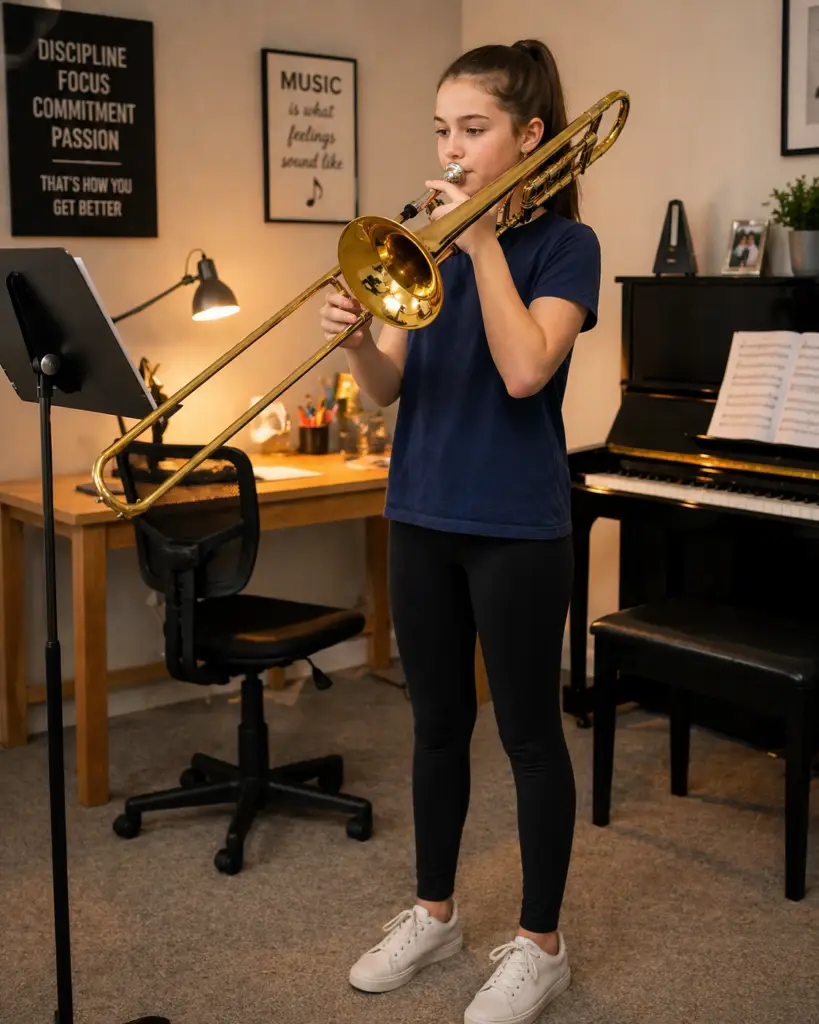
Sight reading is an important skill for every high school trombone player.
Whether you are playing in your school band, preparing for an All-State or regional audition, participating in a festival, or simply trying to become a better musician, you will eventually be asked to play music you have never seen before.
That can be intimidating.
You look at the page and suddenly there are unfamiliar notes, rhythms, accidentals, articulations, dynamics, and difficult slide movements staring back at you.
The good news is that trombone sight reading is a skill you can improve.
You don’t have to be a naturally gifted sight reader. With regular practice and a good strategy, you can become more comfortable reading unfamiliar music and, most importantly, learn how to keep going when you make a mistake.
Let’s get started!
Disclaimer
Some of the links below are affiliate links. The Trombone Mentor participates in the Amazon Services LLC Associates Program. What this means, is that at no cost to you, if you click on a link and follow through with a purchase, this site may earn a small commission.
What Is Sight Reading?
Sight reading is the ability to perform music that you have not previously practiced or prepared.
Sight reading is also a measurement of how well you have developed many of the skills needed to play the trombone.
When you sight read, you are putting several skills to work at the same time:
- Reading the notes on the page
- Understanding the rhythm
- Recognizing the key signature
- Finding the correct slide positions
- Watching articulations and dynamics
- Maintaining a steady tempo
- Listening to your sound and intonation
- Looking ahead to what comes next
That’s a lot to think about!
The goal of sight reading isn’t to play every note perfectly. The goal is to keep the music moving while making accurate musical decisions as you go.
Research on music reading shows that experienced sight readers tend to recognize larger patterns rather than processing every individual note separately. Rhythm recognition, pattern recognition, auditory skills, and anticipation all contribute to fluent sight reading.
For a trombone player, this is especially important because you have to connect what you see on the page with a physical slide movement and the sound you expect to produce.
Learn More: Trombone Scales With Slide Positions: Bb, F, and Eb Major
Why Is Sight Reading Important for High School Trombone Players?
Sight reading becomes increasingly important as you progress through high school.
You may encounter it during:
- Concert band
- Jazz band
- Chamber ensembles
- District band auditions
- Region band auditions
- All-State auditions
- Solo and ensemble festivals
- College auditions
- Placement auditions
Even when sight reading isn’t part of a formal audition, it is an important part of being a successful musician.
Imagine sitting down at a rehearsal and receiving a piece of music you’ve never played before.
A strong sight reader can look through the music, establish a steady pulse, recognize familiar patterns, and begin playing with confidence.
A weaker sight reader may spend much of the rehearsal stopping to figure out individual notes and rhythms.
The difference isn’t necessarily musical talent.
It is often reading experience and preparation.
The Biggest Mistake: Stopping
One of the most important lessons you can learn about sight reading is this:
Don’t stop.
If you miss a note, keep going.
Don’t worry about missing two notes, keep going.
If you completely lose your place, find the next place you can enter and keep going.
Stopping every time you make a mistake may feel like the responsible thing to do, but it actually works against the skill you are trying to develop.
Sight reading requires you to keep processing the music while you are playing. Successful sight-reading guidance emphasizes maintaining the pulse and continuing forward rather than allowing one mistake to derail the performance.
Think about reading a sentence in a book.
If you don’t recognize one word, you don’t normally stop reading for thirty seconds before continuing.
You use the information around the word and keep moving.
Sight reading works in much the same way.
Learn More: Trombone Slide Positions Chart: All Notes for Beginners
What Should You Look at Before You Play?
If you are given a few seconds to look over a sight-reading excerpt, don’t waste that time.
You can’t study every note.
Instead, quickly scan the most important information.
1. Check the Key Signature
Look at the key signature first.
Ask yourself:
What key am I in?
Think through the scale in your head.
This helps you recognize which notes will normally be sharp or flat and prepares your brain for the notes you are about to see.
Knowing your major and minor scales is therefore an important part of becoming a better sight reader.
2. Check the Time Signature
Next, look at the time signature.
Is it:
- 2/4?
- 3/4?
- 4/4?
- 6/8?
- Something less familiar?
Determine where the beat falls and establish a steady internal pulse before you begin.
Rhythm should be one of your highest priorities when sight reading. Maintaining a steady beat is more important than rushing to play every note.
3. Look for Difficult Rhythms
Scan the music for rhythms that might cause problems.
Look for:
- Sixteenth notes
- Dotted rhythms
- Ties
- Syncopation
- Eighth-note rests
- Triplets
- Rhythmic changes
You don’t have to solve every rhythm before you begin.
But you should know where the difficult spots are.
4. Look for Accidentals
Accidentals can surprise you during sight reading.
Look for sharps, flats, and naturals that aren’t part of the key signature.
When you see an accidental, be prepared for it.
5. Look at the Range
Quickly scan the music for unusually high or low notes.
Ask yourself:
Where is the highest note?
Where is the lowest note?
This gives you an idea of what is coming and allows you to prepare mentally for changes in register.
6. Look for Dynamics and Articulations
Don’t ignore the musical markings.
Look for:
- Piano and forte
- Crescendos and decrescendos
- Accents
- Staccato
- Legato
- Slurs
- Breath marks
Sight reading isn’t simply about playing the correct notes.
You are still expected to make music.
Schedule a free consultation lesson with Rick Lawrence
ONLINE TROMBONE LESSONS – Learn Anywhere with a Private Trombone Teacher
Don’t Read One Note at a Time
This is one of the biggest differences between a beginning sight reader and an experienced one.
A beginning reader may think:
B-flat… C… D… E-flat…
An experienced reader starts seeing patterns.
For example:
B-flat–C–D–E-flat
might be recognized as part of a scale pattern.
Instead of processing four completely separate notes, your brain begins to recognize a familiar musical shape.
Look for:
- Scales
- Arpeggios
- Repeated notes
- Repeated rhythms
- Stepwise passages
- Intervals
- Repeated musical phrases
The better you know your scales, intervals, and basic musical patterns, the easier it becomes to recognize these patterns while sight reading. Research into sight-reading expertise also emphasizes pattern recognition and the ability to process larger musical groups rather than isolated notes. One of the best books for trombone is the Arban Method. I teach my students to use exercises from this book for sight reading. It is fun and very effective.
Trombone Players Have an Extra Challenge
Sight reading on trombone has some unique challenges.
You aren’t simply identifying a note.
You have to immediately connect that note to a slide position.
For example, when you see a note on the staff, your brain needs to quickly answer:
What note is that?
Then:
Where is that note on the slide?
Then:
What does that note sound like?
And finally:
How do I move to the next note?
This is one reason why knowing your slide positions extremely well is so important.
You don’t want to spend valuable mental energy calculating every slide position.
The response should become increasingly automatic through practice.
A Simple Way to Practice Trombone Sight Reading
You don’t need an hour every day to improve your sight reading.
In fact, a short, consistent practice routine can be extremely effective.
Try adding 5–10 minutes of sight reading to your regular practice session.
Here’s a simple routine.
Step 1: Choose Easy Music
Choose music that is somewhat easier than the hardest music you are currently learning.
This is important.
If the music is so difficult that you stop every few measures, you aren’t really practicing sight reading. You’re practicing how to struggle through difficult music.
Music teachers commonly recommend starting with material below a student’s current performance level so the student can concentrate on reading continuously.
Step 2: Give Yourself a Short Preview
Before playing, spend 20–30 seconds looking over the music.
Check:
- Key signature
- Time signature
- Tempo
- Difficult rhythms
- Accidentals
- Range
- Dynamics
- Articulations
Step 3: Set a Comfortable Tempo
Always use a metronome for sightreading.
Choose a tempo that allows you to keep a steady beat.
Don’t try to prove how fast you can play.
A slower, steady performance is much more valuable than a fast performance that falls apart.
Step 4: Start Playing
Now play the entire excerpt.
Do not stop.
If you make a mistake, keep going.
How about if you miss a note? Don’t go back.
If you lose your place, find the next beat or measure you can recognize and continue.
Step 5: Evaluate Yourself
When you finish, ask yourself:
- Did I maintain a steady beat?
- Did I stop?
- Which rhythms caused problems?
- Which notes or slide positions caused problems?
- Did I notice the dynamics?
- Did I recognize the key?
- Did I look ahead?
- Where did I lose concentration?
Don’t simply ask:
“How many wrong notes did I play?”
Instead, ask:
“What caused my mistakes?”
That’s where improvement begins.
Learn More: Practicing Trombone: A High School Student’s Guide
Try the 10-Minute Sight Reading Routine
Here’s a simple routine you can use several times each week.
Minutes 1–2: Preview
Look at the key, time signature, tempo, rhythms, range, accidentals, dynamics, and articulations.
Minutes 3–5: Sight Read
Play an unfamiliar excerpt from beginning to end.
Don’t stop.
Minutes 6–7: Identify Problems
Think about the sections that caused difficulty.
Was it rhythm?
Notes?
Slide positions?
Range?
Articulation?
Minutes 8–10: Sight Read Something New
Choose another unfamiliar excerpt and repeat the process.
The important word here is new.
Once you have practiced a piece several times, you are no longer truly sight reading it.
Practice Sight Reading Every Day You Can
Sight reading improves through repetition.
That doesn’t mean you have to spend a huge amount of time doing it.
Even a few minutes of focused sight reading can become valuable if you do it consistently. Both university music guidance and music-education resources recommend short, regular sight-reading practice rather than relying only on occasional exposure.
You might add sight reading to the end of your normal practice routine:
Warm-up → Technique → Scales → Etudes/Music → Sight Reading
Or, if you only have 30 minutes to practice, give sight reading five minutes of that time.
The important thing is to make it a regular part of your practice.
How to Prepare for a Sight Reading Audition
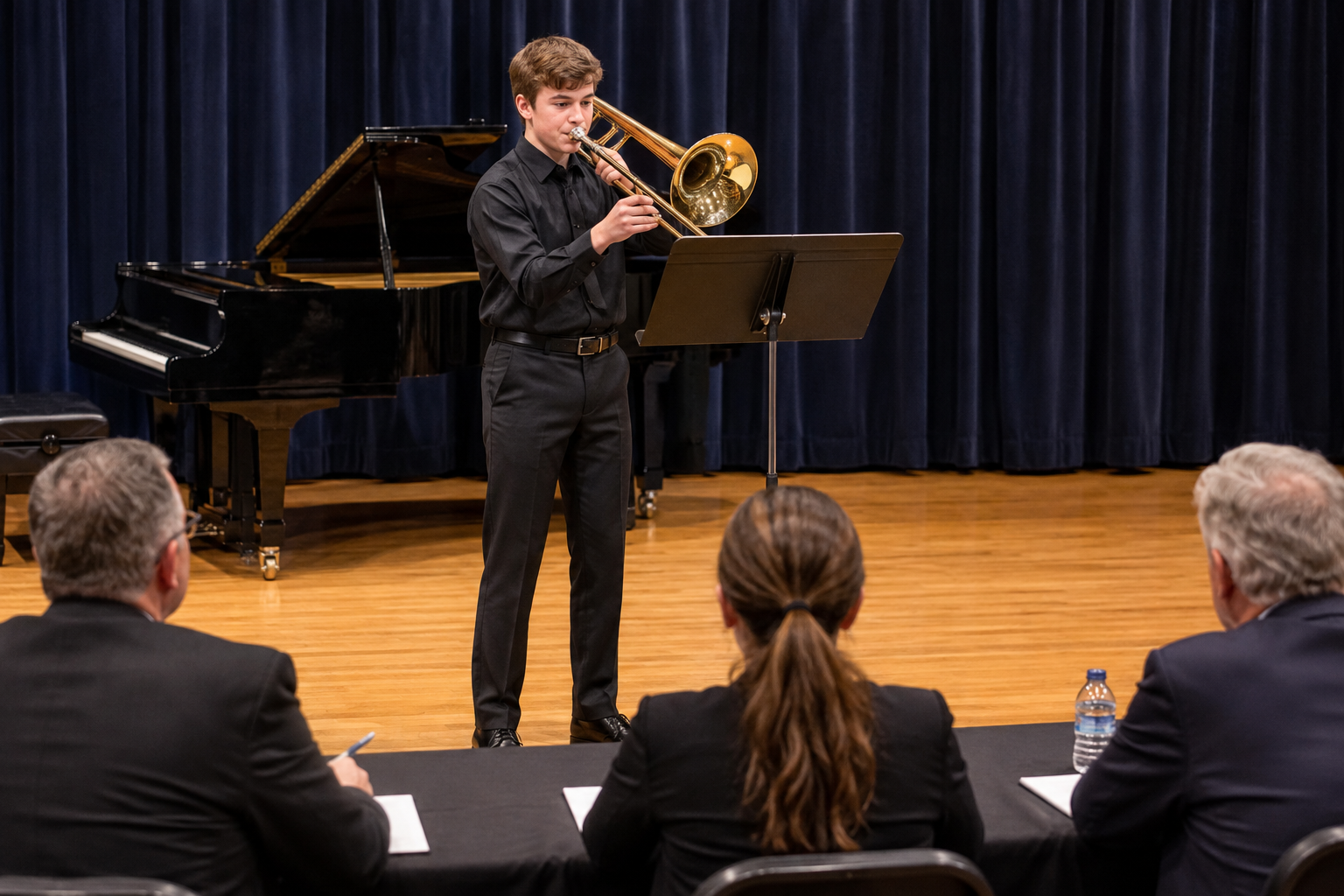
Sight reading can be especially stressful during an audition because you don’t know what music you will receive.
The best preparation is to practice the skill before audition day.
If your upcoming audition includes sight reading, don’t wait until the week before the audition.
Start several weeks ahead.
Practice reading music that includes:
- Different key signatures
- Different time signatures
- Various tempos
- Various rhythmic patterns
- Accidentals
- Different articulations
- Different dynamics
- A variety of registers
You can also ask your private teacher or band director to give you unfamiliar music to read.
The goal is to make the experience of seeing unfamiliar music feel normal.
The more often you do it, the less intimidating it becomes.
Learn More: Trombone Auditions: The Complete Guide for High School Students
What If You Make a Mistake During an Audition?
You probably will.
That’s okay.
Everyone makes mistakes.
The important thing is what you do next.
Don’t let one wrong note turn into five wrong notes because you’re still thinking about the first mistake.
Make the correction mentally and move forward.
Think:
“That note was wrong. It’s over. What’s next?”
Then play the next note.
A good sight reader isn’t necessarily someone who never makes mistakes.
A good sight reader is someone who can recover quickly and keep the music moving.
Common Sight Reading Mistakes
Here are some habits that can make sight reading more difficult.
Stopping
This is probably the biggest problem.
Keep going.
Playing Too Fast
Don’t choose a tempo that is beyond your ability.
Choose a tempo you can maintain.
Reading Only One Note Ahead
Try to look farther ahead on the page.
Your eyes should be preparing for what you are about to play.
Ignoring Rhythm
A wrong note is one thing.
Losing the pulse can cause the entire performance to fall apart.
Ignoring Musical Markings
Dynamics and articulations are part of the music.
Don’t play every note the same way.
Practicing Music That Is Too Difficult
If you are constantly stopping, simplify your material.
Build your skills gradually.
Getting Frustrated
Sight reading can be uncomfortable.
That’s normal.
Don’t judge yourself by one bad attempt.
Judge yourself by whether you are improving over time.
The Secret to Becoming a Better Sight Reader
There really isn’t a secret.
Read more music.
But read it in the right way.
Choose manageable music.
Preview it.
Establish the beat.
Look for patterns.
Keep your eyes moving ahead.
Keep playing when you make mistakes.
Then evaluate what happened and try again with something new.
Over time, the things that once required conscious thought will become more automatic.
Your note recognition will improve.
Slide-position response will improve.
Rhythms will improve.
Your confidence will improve.
And eventually, you will look at a page of unfamiliar music and think:
“I can play this.”
Ready to Take Your Trombone Playing to the Next Level?
Whether you are just starting trombone or looking to strengthen your tone, technique, and musical confidence, private lessons can help you progress faster with clear guidance and personal support.
With The Trombone Mentor, you receive:
• Step-by-step instruction
• Customized practice plans
• Expert feedback and encouragement
• Online lessons you can take from anywhere
Stop guessing and start making steady progress with lessons designed around your goals.
ONLINE TROMBONE LESSONS – Learn Anywhere with a Private Trombone Teacher
Final Thoughts
Trombone sight reading is not a talent that you either have or don’t have.
It is a musical skill that can be developed.
As a high school trombone player, you have a great opportunity to make sight reading part of your regular practice. Even five or ten focused minutes can help you become more comfortable with unfamiliar music.
And remember the most important rule:
Don’t stop.
The goal isn’t perfection.
The goal is to become a confident trombone player who can pick up unfamiliar music and keep going.
If you’re preparing for a high school band audition, sight reading is just one part of the preparation process. Be sure to also learn how to prepare your scales, excerpts, tone, rhythm, and other audition requirements.
About the Author
Rick Lawrence is a music educator, conductor, professional trombonist, and private instructor with more than 40 years of playing and teaching experience. He has performed with orchestras, jazz ensembles, brass bands, and pit orchestras, and studied with John Coffey of the Boston Symphony Orchestra, Donald Knaub of the University of Texas, and Edward J. Madden, composer, arranger, trombonist.
Through The Trombone Mentor website, Rick provides online trombone lessons and educational resources for beginner, intermediate, and advanced trombonists.
Related Trombone Articles
Trombone Practice Tools: 10 Tools That Actually Improve Your Playing
How to Play High Notes on Trombone
Best Trombone Method Books for Every Skill Level
15 Free Apps Every Trombone Student Should Use to Practice Smarter