Trombone Auditions: The Complete Guide for High School Students
If you’re a high school trombone player, auditions can open the door to some of the most rewarding musical experiences of your life. Whether you’re trying out for your school’s Wind Ensemble, earning a chair in Jazz Band, preparing for Regional or All-State Band, or auditioning for a college music program, every audition is an opportunity to showcase your growth as a musician.
After more than 40 years of teaching band students and coaching young trombonists, I’ve found that students who begin preparing weeks—or even months—in advance almost always perform with greater confidence than those who wait until the last minute. Great auditions don’t happen by accident. They are the result of good habits, thoughtful practice, and a positive attitude.
In this guide, you’ll learn how to prepare for every aspect of a high school trombone audition, including:
- Symphonic Band and Wind Ensemble auditions
- Jazz Ensemble auditions
- Regional and All-State Band auditions
- Solo & Ensemble Festival preparation
- College entrance auditions
You’ll also discover what judges are really listening for, how to build an effective audition practice plan, common mistakes to avoid, and practical strategies to help you perform at your very best on audition day.
Whether this is your very first audition or you’re preparing for your senior year, the advice in this guide will help you become a more confident and successful trombonist.
Let’s get started!
Disclaimer
Some of the links below are affiliate links. The Trombone Mentor participates in the Amazon Services LLC Associates Program. What this means, is that at no cost to you, if you click on a link and follow through with a purchase, this site may earn a small commission.
Table of Contents
- Why Trombone Auditions Matter
- Types of Trombone Auditions
- What Judges Are Listening For
- How to Prepare for a Trombone Audition
- Trombone Audition Scales
- Sight-Reading Strategies
- Choosing Audition Music
- Common Audition Mistakes
- Audition Day Checklist
- Managing Audition Nerves
- Online Trombone Lessons for Audition Preparation
- Frequently Asked Questions
Why Trombone Auditions Matter
Many students think of auditions simply as a way to determine who sits in the first chair or who makes the top band. While auditions certainly influence band placement, they offer much more than that. Every audition is an opportunity to grow as a musician and develop skills that will benefit you throughout high school and beyond.
Preparing for an audition teaches you how to set goals, organize your practice time, solve musical challenges, and perform under pressure. These are valuable skills that carry over into concerts, solo performances, college auditions, and even future careers outside of music.
Auditions Can Open New Opportunities
Strong audition performances may help you earn a place in:
- Wind Ensemble
- Symphonic Band
- Concert Band
- Jazz Ensemble
- Regional Honor Band
- All-State Band
- Youth Orchestra
- Solo & Ensemble Festival events
- College music programs
- Music scholarship opportunities
Each of these experiences introduces you to more challenging music, outstanding conductors, and talented musicians who can inspire you to continue improving.
Auditions Build Confidence
Confidence doesn’t come from hoping you’ll play well—it comes from knowing you’ve prepared well.
Each successful audition teaches you how to trust your preparation. Even if you don’t earn the chair or ensemble you hoped for, you’ll gain valuable experience that makes your next audition less intimidating.
Some of my former students were disappointed after their first audition because they didn’t achieve the results they wanted. Instead of giving up, they used the judges’ comments and their own recordings to identify areas for improvement. A few months later, many of those same students earned higher chairs, made honor bands, or achieved goals they once thought were out of reach.
Every Audition Is a Learning Experience
One of the biggest mistakes students make is judging an audition only by the final result.
Ask yourself questions like:
- Did my tone improve?
- Was my rhythm more accurate than last time?
- Did I stay calm under pressure?
- Did I prepare earlier?
- Did I perform with confidence?
If the answer to these questions is “yes,” then your audition was a success—even if there is still room for improvement.
The best trombonists understand that every audition is another step in becoming a stronger musician.
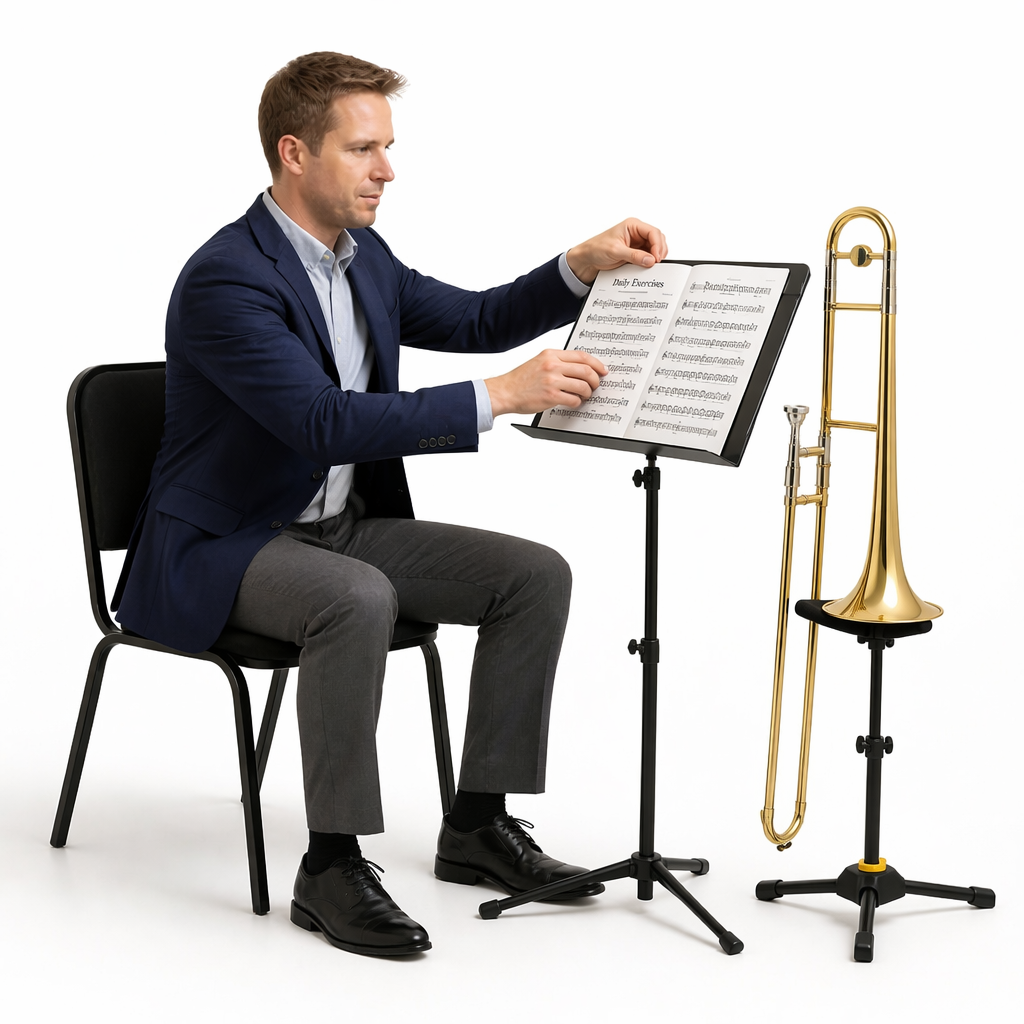
Schedule a free consultation lesson with Rick Lawrence
ONLINE TROMBONE LESSONS – Learn Anywhere with a Private Trombone Teacher
Types of Trombone Auditions Every High School Student Should Know
As you progress through high school, you’ll likely encounter several different types of auditions. While each one has its own requirements, they all evaluate the same core musical skills: tone quality, rhythm, technique, musical expression, and preparation.
Understanding what to expect from each type of audition allows you to practice more effectively and perform with greater confidence.
School Band Placement Auditions
Most large high school band programs use auditions to determine placement in their concert ensembles. A large band program will have a number of different size groups to audition for:
- Concert Band
- Symphonic Band
- Wind Ensemble
- Orchestra
These auditions often include major scales, chromatic scales, sight-reading, and a prepared musical selection.
Although earning first chair is exciting, remember that every ensemble plays an important role in your musical development. Focus on giving your best performance rather than worrying about your final ranking.
Jazz Ensemble Auditions
Jazz auditions often require a different set of musical skills than traditional concert band auditions.
In addition to demonstrating good tone and technical ability, directors may evaluate your:
- Swing style
- Rhythmic accuracy
- Articulation
- Improvisation (if required)
- Ability to read jazz notation
- Lead or section playing skills
Listening to outstanding jazz trombonists can help you develop a better understanding of jazz style before your audition.
Regional and All-State Band or Orchestra Auditions
All-State and district or regional band/orchestra auditions are among the most competitive opportunities available to high school musicians.
Students from many schools compete for a limited number of positions, making preparation especially important.
These auditions typically include:
- Major scales
- Chromatic scale
- Sight-reading
- Prepared etudes
- Technical accuracy
- Musical interpretation
Because the level of competition is high, it’s wise to begin preparing several months in advance.
Solo & Ensemble Festivals
Solo & Ensemble festivals are a means for high school musicians to perform solo or chamber music for a set of judges and graded on various areas such as:
- Small group performance
- Dynamics
- Style
- Musical expression
- Phrasing
- Stage presence
For the trombone student, solo and ensemble performance opportunities are confined to a brass quartet, quintet or solo. Although these events aren’t always considered traditional auditions, they provide valuable performance experience. Many students discover that participating in Solo & Ensemble Festival makes future auditions feel much easier.
College Music
Students considering a music major should begin preparing well before their senior year.
College auditions often require:
- Solo literature
- Technical studies
- Scales
- Sight-reading
- Musical interpretation
- An interview with the faculty
Working with an experienced trombone teacher can help you choose appropriate repertoire and develop a preparation plan that highlights your strengths.
What Judges Are Really Listening For
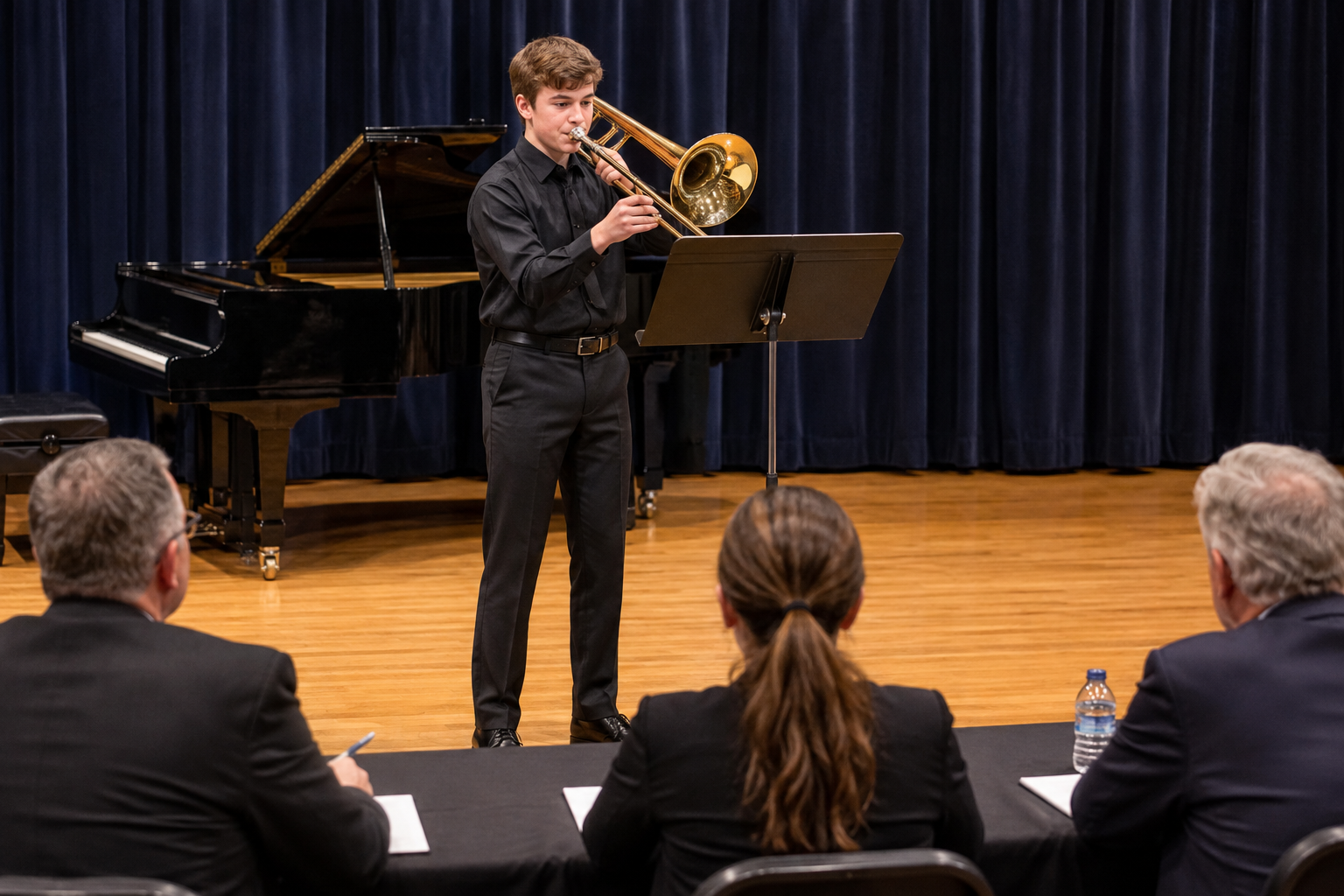
Many high school trombone players believe the student with the highest notes or fastest technique will automatically receive the highest score. In reality, audition judges are looking for something much more important: a complete musician.
Every audition is an opportunity to demonstrate not only your technical ability but also your musical maturity. Judges listen for consistency, preparation, confidence, and musical expression just as much as they listen for difficult passages.
Let’s take a closer look at the qualities that can help your audition stand out.
Tone Quality
If there is one characteristic that separates outstanding trombonists from average players, it’s tone quality.
A warm, full, resonant sound immediately captures a judge’s attention. Even if you make a small mistake, a beautiful tone often leaves a positive impression throughout your performance.
On the other hand, students who focus only on playing louder, higher, or faster sometimes overlook the importance of producing a rich, centered sound.
To improve your tone:
- Practice long tones every day.
- Use steady, well-supported air.
- Listen carefully to the quality of every note.
- Avoid forcing your sound.
- Record yourself regularly to hear what the audience hears.
The Trombone Mentor Tip:
“Your tone is your musical voice. Before judges notice your technique, they notice your tone.”
Learn More: How to Improve Trombone Tone: 15 Proven Tips for a Better Sound
Accurate Rhythm
A beautiful tone is important, but rhythm is equally essential.
Directors need musicians who can keep a steady pulse and perform accurately within an ensemble. A player who rushes difficult passages or slows down unexpectedly can create problems for the entire band.
One of the best ways to improve rhythmic accuracy is by practicing with a metronome.
Start difficult passages at a comfortable tempo where you can play every note correctly. As your accuracy improves, gradually increase the speed until you reach the required tempo.
Excellent Intonation
Playing in tune is another skill judges evaluate carefully.
Even students with excellent technique can lose valuable points if their notes consistently sound sharp or flat.
Developing good intonation requires:
- Listening carefully
- Supporting the air properly
- Using accurate slide positions
- Adjusting quickly while playing
Practicing with a tuner can help, but don’t become dependent on watching the screen. Instead, train your ears to recognize when notes need adjustment.
Smooth Slide Technique
Unlike many wind instruments, trombone players must create accurate pitch through precise slide movement.
Judges pay close attention to:
- Smooth slide motion
- Accurate slide positions
- Clean note connections
- Efficient movement
- Coordination between the tongue and the slide
Large, unnecessary slide movements often make technical passages more difficult.
Instead, practice moving only as much as necessary while maintaining relaxed hands and arms.
Clear Articulation
Every note should begin with confidence.
Whether you’re playing a lyrical solo or a fast technical etude, judges expect clean, consistent articulation.
Practice both:
- Legato tonguing
- Standard articulation
- Staccato passages
- Accent patterns
Avoid using excessive tongue pressure. The tongue should simply start the air—not stop it.
Musical Expression
Playing all of the correct notes is only part of a successful audition.
Judges want to hear music—not just notes.
That means paying attention to:
- Dynamics
- Phrasing
- Style
- Tempo changes
- Musical direction
- Emotional expression
Imagine telling a story through your performance.
Ask yourself:
“Where is the musical phrase going?”
“Which note is the climax?”
“How can I make this melody more expressive?”
Students who think like musicians often receive higher scores than students who simply play accurately.
Consistency
One outstanding measure followed by several weak ones can hurt an otherwise strong audition.
Judges appreciate consistency.
They want to hear that you can perform at a high level from beginning to end—not just during your favorite section.
Consistency comes from repetition.
The more times you’ve successfully performed your music in practice, the more confident you’ll be on audition day.
Confidence and Professionalism
Before you play your first note, judges begin forming an impression.
Walk confidently into the room.
Take a deep breath.
Set your music carefully.
Adjust your stand quietly.
Wait until you’re ready.
Then begin.
If you make a mistake, keep going.
Most judges are far more impressed by students who recover gracefully than by students who stop and start over.
Remember:
Every musician makes mistakes. Great musicians keep making music.
How to Prepare for a Trombone Audition

One of the biggest mistakes high school students make is waiting until the last week before an audition to begin practicing seriously.
Strong auditions are built over time.
Instead of cramming, divide your preparation into manageable goals. This approach reduces stress, builds confidence, and allows your playing to improve naturally.
Eight Weeks Before the Audition
This is the time to get organized.
You should:
- Obtain all audition music.
- Learn the audition requirements.
- Choose your solo or etude.
- Mark difficult passages.
- Begin practicing slowly.
- Create a weekly practice schedule.
Don’t worry about playing fast yet.
Your goal is to establish correct habits from the beginning.
Six Weeks Before the Audition
Now it’s time to strengthen your fundamentals.
Your daily practice should include:
- Long tones
- Lip slurs
- Major scales
- Chromatic scale
- Articulation exercises
- Rhythm studies
- Slow practice of audition music
Begin recording yourself at least once each week.
Listening to your own playing is one of the fastest ways to identify areas for improvement.
Four Weeks Before the Audition
At this point, your notes should be mostly learned.
Now focus on making music.
Work on:
- Dynamics
- Phrasing
- Tempo consistency
- Musical expression
- Tone quality
- Intonation
This is also an excellent time to begin playing for other people.
Ask your band director, private teacher, parents, or friends to listen.
Performing regularly helps reduce audition nerves.
Two Weeks Before the Audition
Practice exactly as if it were the real audition.
Walk into the room.
Announce your selection if required.
Play without stopping.
Accept mistakes and continue.
These mock auditions build confidence because the real audition begins to feel familiar.
Continue recording yourself and comparing performances from week to week.
The Final Week
The work has already been done.
This is not the time to dramatically increase your practice hours.
Instead:
- Maintain your daily routine.
- Review difficult passages.
- Get plenty of sleep.
- Stay hydrated.
- Avoid overplaying.
- Stretch and relax.
Trust your preparation.
Confidence comes from knowing you’ve done the work.
The Trombone Mentor’s Advice
After teaching for more than 40 years, one lesson stands out above all others:
Students who practice consistently almost always outperform students who practice only when they “feel like it.”
You don’t need to practice six hours every day to have a successful audition. A focused, well-organized practice session—even 45 to 60 minutes a day—will produce far better results than occasional marathon sessions.
Remember, auditions don’t reward last-minute effort. They reward weeks of thoughtful preparation, careful listening, and steady improvement.
Essential Skills Every High School Trombone Player Needs for Auditions
A successful trombone audition is built on more than just learning the assigned music. The best audition performances come from students who develop strong fundamentals and apply them consistently.
Think of your audition preparation like building a house. Your audition music is the finished structure, but your fundamentals are the foundation. Without a strong foundation, your performance will not be as confident or reliable as it could be.
Before focusing on the final details of your audition material, make sure your daily practice routine includes these essential skills.
Develop a Consistent Trombone Warm-Up Routine
A great audition begins before you play your audition music.
Professional musicians rarely pick up their instruments and immediately play difficult passages. They prepare their bodies, air, embouchure, and sound through a structured warm-up routine.
Your warm-up should help you develop:
- A beautiful tone
- Flexible range
- Smooth slide movement
- Better intonation
- Consistent articulation
A typical high school trombone warm-up may include:
Long Tones
Long tones are one of the simplest and most effective exercises you can practice.
They help improve:
- Sound quality
- Breath control
- Air support
- Pitch awareness
Focus on producing a full, relaxed sound from the first moment the note begins.
Lip Slurs and Flexibility Exercises
Lip slurs develop coordination between your air, embouchure, and slide.
They help improve:
- Range
- Smooth note changes
- Embouchure flexibility
- Control
A flexible player has greater freedom when performing lyrical passages and technical music.
Scales and Arpeggios
Scales are a common requirement in high school auditions because they demonstrate several important skills at once:
- Pitch knowledge
- Slide accuracy
- Finger-to-slide coordination
- Even technique
- Breath control
Do not simply play scales from memory.
Practice them musically:
- Use a consistent tempo.
- Maintain a beautiful tone.
- Play with accurate rhythm.
- Listen carefully to intonation.
A major scale played beautifully will impress judges more than a rushed scale played incorrectly.
Learn More: The Best Warm-Up Routine for Trombone Players
Mastering Trombone Audition Scales
Many high school trombone auditions require major scales, chromatic scales, and sometimes arpeggios.
Students often underestimate the importance of this section because scales may seem simple. However, scales reveal a great deal about your overall musicianship.
Judges can quickly evaluate:
- Tone quality
- Rhythm
- Slide technique
- Air support
- Confidence
Practice Scales the Right Way
Avoid practicing scales only by running through them quickly.
Instead:
Slow practice helps develop:
- Accurate slide positions
- Better tone
- Stronger muscle memory
Use a Metronome
A steady tempo shows control.
Start at a speed where you can play perfectly. Increase gradually as your accuracy improves.
Practice Multiple Articulations
Be prepared to play scales using:
- Legato
- Single tonguing
- Different rhythms
This improves flexibility and control.
Practice Scales Musically
Remember that a scale is still music.
Avoid:
- Mechanical playing
- Uneven rhythms
- Forced high notes
- Poor tone quality
Your goal is not simply to finish the scale.
Your goal is to demonstrate that you are a confident musician. Learn More:
Improving Your Trombone Sight-Reading Skills
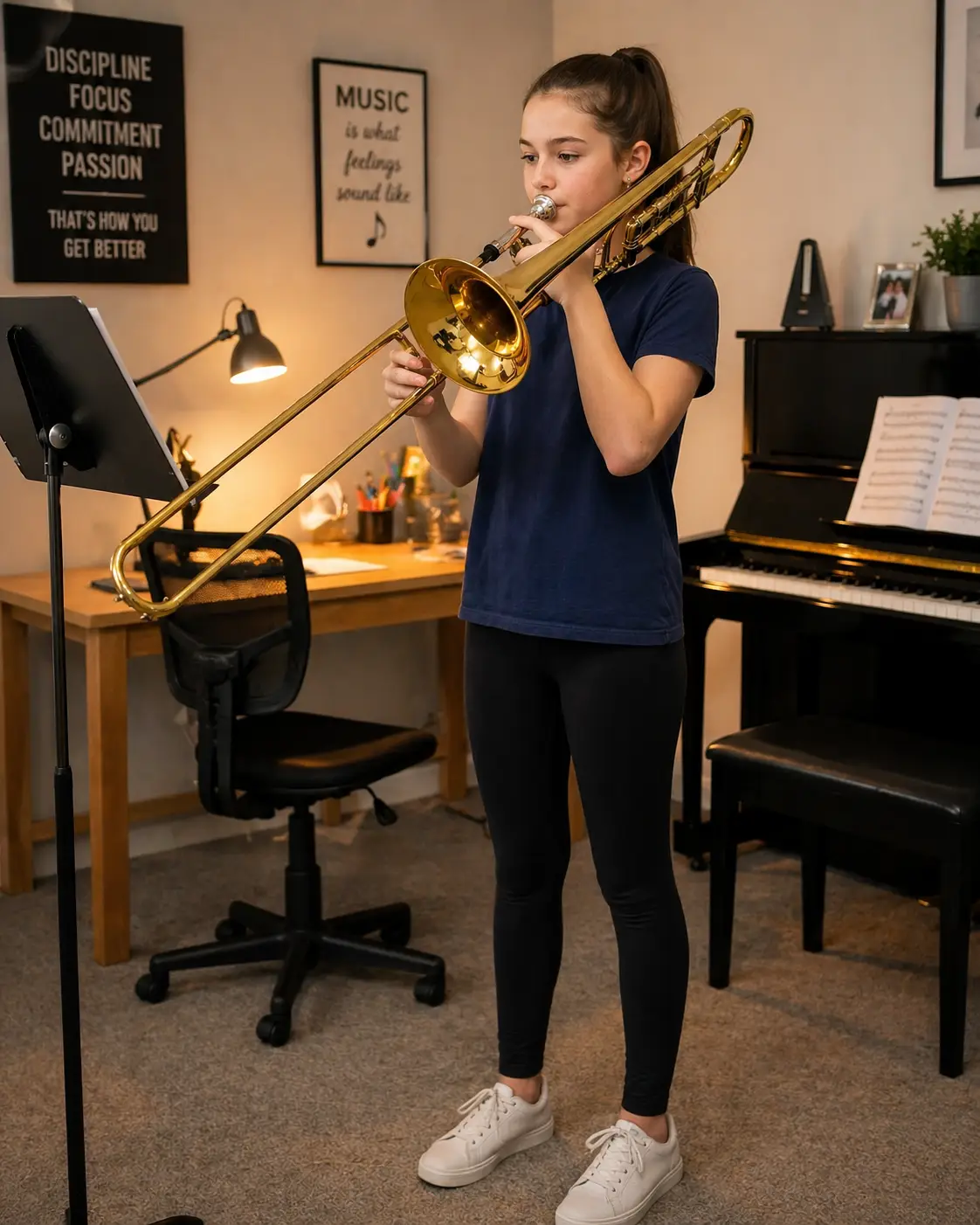
Sight-reading is one of the most challenging parts of any audition because it requires you to perform music you have never seen before.
The good news is that sight-reading is a skill that improves with regular practice.
Many students struggle because they wait until the audition to encounter unfamiliar music.
Instead, make sight-reading part of your weekly practice routine.
A Step-by-Step Sight-Reading Strategy
When the judge gives you music, take a few moments to examine it.
Look for:
- Key signature
- Time signature
- Tempo marking
- Accidentals
- Rhythmic challenges
- Dynamics
- Articulations
Experienced musicians do not immediately start playing. They prepare mentally first.
Step 2: Identify Difficult Sections
Ask yourself:
Where are the challenging rhythms?
Look at the large intervals?
Where are the highest notes?
Where might the slide movement be difficult?
Knowing the difficult areas helps you prepare before the first note.
Step 3: Establish the Tempo
One of the biggest sight-reading mistakes is starting too fast.
Choose a tempo where you can maintain accuracy.
A steady performance with correct rhythms will always score higher than a fast performance filled with mistakes.
Step 4: Keep Going
This is perhaps the most important sight-reading rule:
Do not stop.
Professional musicians make mistakes. The difference is that they continue performing.
If you miss a note:
- Stay with the beat.
- Find your place.
- Continue confidently.
Judges are evaluating your ability to recover.
Choosing the Right Trombone Solo or Audition Music
For many auditions, students are asked to prepare a solo or etude.
Choosing the right piece can make a significant difference.
The most difficult piece is not always the best choice.
A successful audition selection should allow you to demonstrate:
- Beautiful tone
- Musical expression
- Technical ability
- Range
- Control
Choose Music You Can Perform Confidently
A moderately difficult piece played beautifully will usually make a stronger impression than an extremely difficult piece performed inconsistently.
Ask yourself:
Will I play every note accurately?
Can I perform the dynamics?
Will I show musical expression?
Can I perform it confidently under pressure?
If the answers are yes, you have likely chosen appropriate music.
Work With an Experienced Teacher
A private trombone teacher can help you:
- Select appropriate audition music
- Identify technical challenges
- Improve tone and technique
- Develop interpretation
- Prepare mock auditions
Having another set of experienced ears can reveal problems you may not notice on your own.
Common High School Trombone Audition Mistakes
Even talented students sometimes lose points because of avoidable mistakes.
Understanding these mistakes can help you prepare more effectively.
Mistake #1: Waiting Until the Last Minute
This is probably the most common problem.
A student may learn the notes quickly but not have enough time to develop:
- Confidence
- Musical expression
- Consistency
Start early.
Your future self will thank you.
Mistake #2: Practicing Only the Audition Music
Your audition piece is important, but your fundamentals are what make the music successful.
Continue practicing:
- Long tones
- Scales
- Lip slurs
- Articulation
- Sight-reading
Mistake #3: Ignoring Tone Quality
Some students become so focused on playing correct notes that they forget to listen to their sound.
Always ask:
“Does my trombone sound beautiful?”
Mistake #4: Playing Too Fast
Fast playing can impress people only when it is accurate and musical.
Speed without control usually leads to:
- Poor rhythm
- Missed notes
- Tension
- Poor tone
Mistake #5: Stopping After Mistakes
Everyone makes mistakes.
The difference between experienced and inexperienced performers is how they respond.
Keep performing.
Mistake #6: Not Practicing Performing
Practicing alone is different from performing.
Create audition experiences by:
- Recording yourself
- Playing for your director
- Performing for family members
- Scheduling mock auditions
The more you perform, the more comfortable you become.
Audition Day Checklist: How to Perform Your Best
After weeks or months of preparation, audition day has finally arrived. While it is normal to feel nervous, having a plan will help you stay calm, focused, and confident.
Remember: the audition is not the beginning of your preparation. It is the opportunity to demonstrate the work you have already completed.
The goal on audition day is simple:
Play with confidence, make music, and trust your preparation.
What to Bring to Your Trombone Audition
Being prepared means more than knowing your music. Professional musicians arrive with everything they need.
Before leaving for your audition, make sure you have:
- Trombone Mouthpiece
- Clean, working instrument
- Slide lubricant or cream
- Water spray bottle (if needed)
- Audition music
- Pencil
- Tuner
- Metronome
- Extra copies of music
- Comfortable clothing appropriate for the audition
If you are traveling to an honor band or college audition, consider bringing:
- Extra slide lubricant
- A cleaning rod
- Extra valve oil (if applicable)
- Water
- A small towel
- A backup copy of your audition requirements
Small problems become much less stressful when you are prepared.
How to Warm Up Before Your Audition
Many students make the mistake of warming up too much on audition day.
Your goal is not to “practice” your audition right before playing. Your goal is to prepare your body and instrument so you can perform comfortably.
A good audition warm-up might include:
Gentle Long Tones
Focus on:
- Relaxed breathing
- Centered tone
- Consistent air
Easy Lip Slurs
Use flexibility exercises to wake up your embouchure without creating fatigue.
Scales and Short Technical Exercises
Play enough to feel comfortable, but avoid exhausting yourself.
Review Difficult Passages
Touch on challenging sections briefly, but do not repeatedly play them until you become tired.
Rest Before Playing
Many successful musicians spend more time resting before an audition than playing.
A fresh embouchure performs better than a tired one.
Managing Trombone Audition Nerves
Almost every musician experiences nervousness before an important performance.
Even professional players feel extra energy before walking on stage.
The goal is not to eliminate nerves completely.
The goal is to learn how to control them.
Use Preparation to Build Confidence
The strongest solution for audition anxiety is preparation.
When you know you have practiced consistently, your confidence increases naturally.
Instead of thinking:
“I hope I play well.”
Think:
“I have prepared for this moment.”
Practice Deep Breathing
Before your audition:
- Relax your shoulders.
- Take a slow, deep breath.
- Breathe out completely.
- Repeat several times.
Deep breathing helps reduce tension and allows you to use your air more effectively.
Visualize Success
Many successful musicians mentally rehearse before performing.
Imagine yourself:
- Walking into the audition room
- Setting up confidently
- Taking a relaxed breath
- Playing your first note beautifully
- Completing your audition successfully
Your mind and body respond positively when you repeatedly visualize success.
Focus on the Music, Not the Judges
It is easy to become distracted by the people listening.
Instead, focus on:
- Your sound
- Your breathing
- Your musical expression
- Communicating the music
Remember, judges are not hoping you fail.
They want to hear students perform well.
Recovering From Mistakes During an Audition
One mistake does not ruin an audition.
Many students believe:
“I missed that note. The audition is over.”
This mindset creates more problems.
Instead:
- Stay calm.
- Keep the tempo moving.
- Find your place.
- Continue confidently.
A student who recovers professionally often makes a better impression than a student who plays perfectly but panics after a small mistake.
How Online Trombone Lessons Can Help High School Students Prepare for Auditions
Preparing for a major trombone audition can feel overwhelming. Many students know they need to improve but are unsure what to practice, how to practice, or whether they are truly ready.
This is where working with an experienced trombone teacher can make a significant difference.
While your school band director provides valuable musical guidance, a specialist trombone teacher can provide focused instruction on the specific skills needed for successful auditions.
Personalized Audition Preparation
Every student has different strengths and challenges.
A private trombone lesson can help identify areas such as:
- Tone quality
- Range development
- Slide technique
- Articulation
- Rhythm accuracy
- Intonation
- Musical expression
- Audition repertoire
Instead of guessing what needs improvement, students receive specific feedback and strategies.
Mock Auditions Build Confidence
One of the best ways to prepare for an audition is to experience the audition environment before the actual day.
During a mock audition, students can practice:
- Entering the room confidently
- Setting up properly
- Performing without stopping
- Recovering from mistakes
- Receiving constructive feedback
The more familiar the experience becomes, the less intimidating the real audition feels.
Expert Guidance for All-State and College Auditions
Students preparing for advanced opportunities often need additional support.
An experienced trombone teacher can help with:
- All-State Band preparation
- Regional Honor Band auditions
- Solo & Ensemble performances
- College audition repertoire
- Music major preparation
Specialized instruction can help students understand what judges are listening for and how to present their best performance.
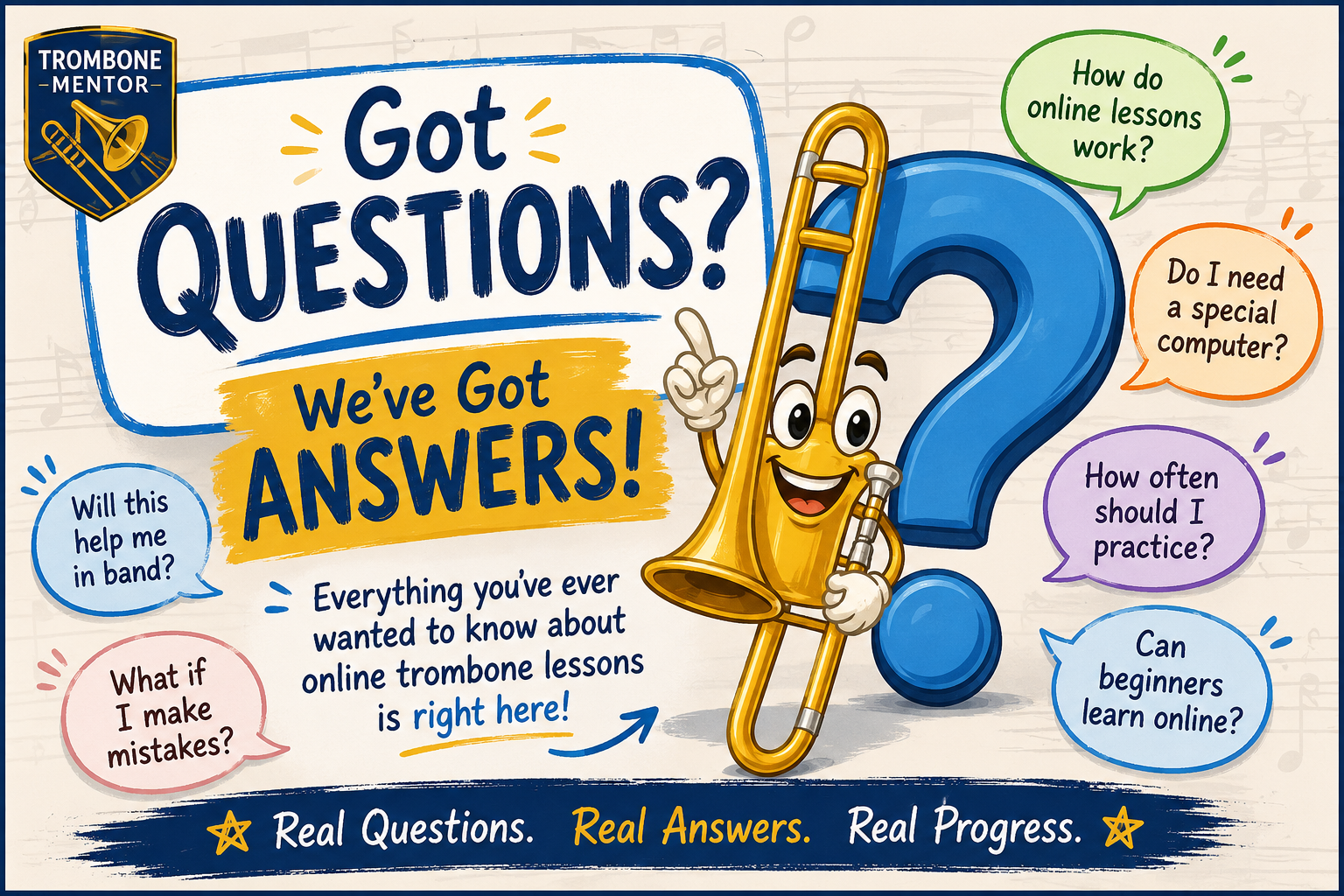
Frequently Asked Questions
How far in advance should I prepare for a trombone audition?
Most students should begin preparing at least 6–8 weeks before an audition. More competitive auditions, such as All-State or college auditions, may require several months of preparation.
How often should I practice for a trombone audition?
A consistent daily practice routine is more effective than occasional long practice sessions. Many high school students can make excellent progress with focused practice sessions of 45–60 minutes per day.
What scales should I know for a trombone audition?
Most auditions include major scales and the chromatic scale. Some auditions may require additional scales or technical exercises. Always check your specific audition requirements.
How important is sight-reading in a trombone audition?
Sight-reading is very important because it demonstrates your ability to learn and perform new music quickly. Directors want musicians who can adapt and contribute in an ensemble.
What should I do if I make a mistake during my audition?
Keep going. Continue the music, maintain your tempo, and recover professionally. Judges understand that mistakes happen.
Can online trombone lessons help me prepare for All-State or honor band auditions?
Yes. Online lessons can provide personalized feedback on tone, technique, audition music, scales, and performance preparation. Working with an experienced trombone teacher can help students develop the skills and confidence needed for competitive auditions.
Final Thoughts
A successful trombone audition is not about playing perfectly. It is about showing your preparation, musicianship, and dedication.
The students who improve the most are those who:
- Practice consistently
- Listen carefully
- Accept feedback
- Set goals
- Continue improving
Every audition is a learning experience. Whether you earn the chair you wanted, make an honor ensemble, or discover areas where you can grow, the process makes you a stronger musician.
Prepare early. Practice with purpose. Trust your work.
And most importantly:
Enjoy the opportunity to share your music.
Ready to Prepare for Your Next Trombone Audition?
Get personalized guidance from an experienced trombone teacher who can help you improve tone, technique, musical expression, and audition confidence.
Online Trombone Lessons with The Trombone Mentor provide one-on-one instruction designed specifically for high school trombone students preparing for auditions, honor bands, and college music programs.
➡️ Schedule Your Online Trombone Lesson Today
ONLINE TROMBONE LESSONS – Learn Anywhere with a Private Trombone Teacher
About the Author
Rick Lawrence is a music educator, conductor, professional trombonist, and private instructor with more than 40 years of playing and teaching experience. He has performed with orchestras, jazz ensembles, brass bands, and pit orchestras, and studied with John Coffey of the Boston Symphony Orchestra, Donald Knaub of the University of Texas, and Edward J. Madden, composer, arranger, trombonist.
Through The Trombone Mentor website, Rick provides online trombone lessons and educational resources for beginner, intermediate, and advanced trombonists.