What Does It Take to Be a Good Trombone Student?
What makes a good trombone player? It isn’t simply natural talent or the ability to play difficult music. Becoming a good trombone player takes patience, consistent practice, good instruction, and a willingness to keep learning.
And that brings us to an important question: What does it take to be a good trombone student?
You don’t have to be the most talented player in the band. You don’t have to learn everything immediately. Some skills will come easily, while others may take weeks or months to develop.
What matters is how you respond to those challenges.
A good student listens, asks questions, practices with a purpose, learns from mistakes, and takes responsibility for his or her own progress.
Becoming a Good Trombone Player Starts With Being a Good Student
Learning to play the trombone is a process.
When you first begin, there are many things you don’t know. You have to learn how to hold the instrument, produce a good sound, move the slide accurately, read music, and coordinate everything you are doing.
Over time, those skills begin to come together.
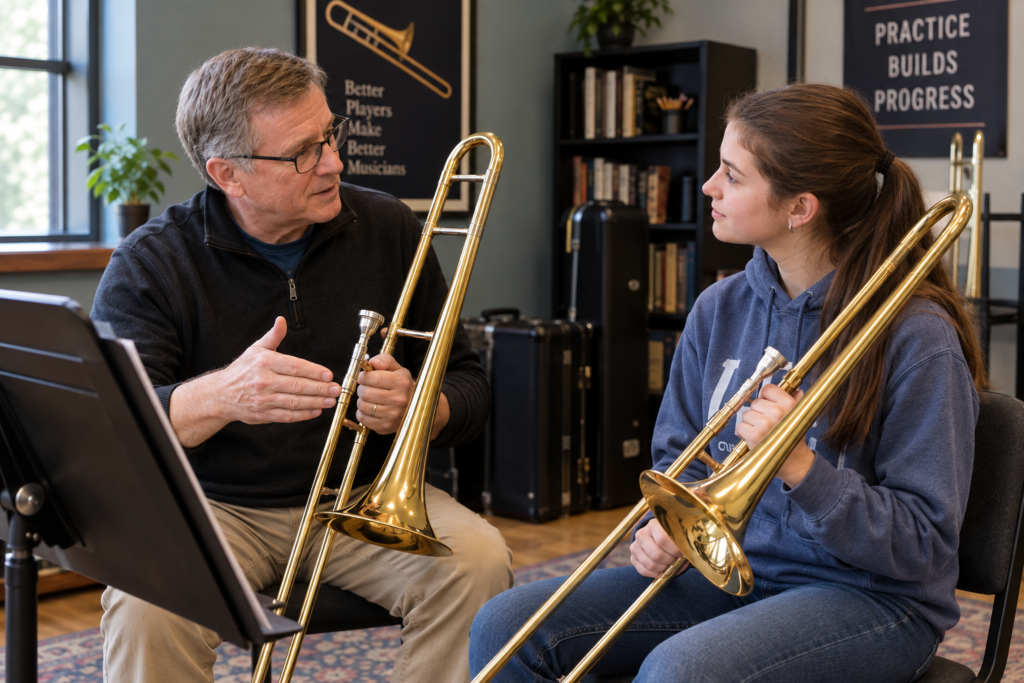
Your teacher can give you the knowledge and direction you need, but you have an important role in the process.
You have to do the learning.
That means listening during your lessons, practicing between lessons, asking questions, and being willing to work on things that don’t come easily.
The goal isn’t simply to get through your next lesson or play the next piece of music.
The goal is to become a better trombone player.
1. Come to Your Lesson Prepared
One of the simplest ways to become a better student is to come prepared for your lesson.
That doesn’t mean you have to play everything perfectly.
It means you have made an honest effort.
Before your lesson, you should know:
- What you were supposed to practice
- Which exercises were difficult
- Which parts of your music need attention
- What questions you want to ask
- What you improved since your last lesson
If your teacher assigned a scale, exercise, etude, or piece of music, spend some time working on it before your next lesson.
And if you struggled with something, tell your teacher.
There is no reason to be embarrassed about making mistakes. Your mistakes give your teacher valuable information about what you need to work on.
2. Listen to Your Teacher
Being a good listener is one of the most important qualities a music student can develop.
When your teacher gives you a correction, don’t immediately try to play the passage again without thinking about what you were told.
Stop.
Listen.
Think about the correction.
Then try it again.
For example, your teacher might tell you:
“Your slide is arriving a little late.”
Instead of simply playing the passage again, think about what that means.
You might need to slow down, practice the slide movement separately, or listen more carefully to the pitch.
Remember:
We hear with our ears, but we listen with our brain.
Learning to listen critically is one of the most important steps toward becoming an independent musician.
3. Practice With a Purpose
Simply playing the trombone is not the same as practicing the trombone.
You can play for thirty minutes and accomplish very little if your mind is somewhere else.
Effective practice has a purpose.
Before you begin, ask yourself:
What am I trying to improve today?
Your goal might be:
- Improving your tone
- Learning a scale
- Correcting a difficult slide movement
- Improving articulation
- Learning a new section of music
- Increasing your range gradually
- Preparing for a performance
A good practice session doesn’t have to be extremely long. It needs to be focused and organized.
For more help, see How to Practice Trombone, where I explain how to organize your practice and make better use of your practice time.
4. Practice What Your Teacher Assigns
There is a reason your teacher gives you specific exercises.
Your teacher isn’t simply trying to fill up your practice time.
An exercise may be designed to improve a particular skill such as:
- Tone
- Breathing
- Flexibility
- Articulation
- Slide accuracy
- Range
- Rhythm
- Reading
- Musical expression
Sometimes you may wonder why you are practicing something that doesn’t seem very exciting.
That’s normal.
Learning an instrument involves developing fundamental skills before you can use those skills in more advanced music.
For example, scales may not seem particularly exciting, but they help develop your understanding of keys, pitch, and slide movement.
If you are still learning your basic slide positions, Trombone Scales With Slide Positions can help you understand how scales and slide positions work together.
5. Don’t Be Afraid to Ask Questions
Good students ask questions.
If you don’t understand something, say so.
There is no such thing as a bad question when you are learning.
You might ask:
- “Why am I having trouble with this note?”
- “Where should my slide be?”
- “Why does my tone sound different today?”
- “How should I practice this passage?”
- “How slowly should I practice it?”
- “What should I work on first?”
Your teacher would much rather know that you don’t understand something than have you go home and practice it incorrectly for an entire week.
Asking questions also helps you become an independent learner.
Eventually, you want to be able to recognize a problem and begin figuring out how to solve it yourself.
6. Be Willing to Make Mistakes
Nobody learns the trombone without making mistakes.
You will miss notes.
You will play wrong rhythms.
Your slide will sometimes go to the wrong position.
You will occasionally crack a note.
You may have days when your tone doesn’t sound the way you want it to.
That’s part of learning.
The important question isn’t:
“Did I make a mistake?”
The better question is:
“What can I learn from the mistake?”
If you make the same mistake repeatedly, slow down and figure out why it is happening.
Your teacher can help you identify the problem, but you also need to develop the ability to recognize problems yourself.
7. Be Patient With Your Progress
One of the hardest lessons for a young musician to learn is that improvement takes time.
You may practice something for a week and feel as though nothing has changed.
Then one day, it suddenly feels easier.
That’s normal.
Trombone playing requires your breathing, embouchure, ears, tongue, slide hand, and musical understanding to work together. These skills develop gradually.
Don’t compare your progress with another student.
Someone else may learn a particular skill faster than you do. That doesn’t mean you won’t eventually learn it.
Instead, compare yourself with the player you were yesterday.
Ask:
- Is my tone improving?
- Are my slide positions becoming more accurate?
- Am I reading music more easily?
- Can I play something today that I couldn’t play a month ago?
Those are meaningful signs of progress.
8. Take Care of Your Trombone
Being a good student also means taking responsibility for your instrument.
Your trombone is your musical partner.
Learn how to:
- Assemble it correctly
- Handle the slide carefully
- Keep the instrument clean
- Keep the slide properly lubricated
- Store it safely
- Report problems before they become serious
You should also develop good habits when transporting your instrument.
Taking care of your trombone isn’t just about protecting an expensive possession. A well-maintained instrument makes it easier for you to practice and play successfully.
9. Create a Good Practice Environment
A good student makes it easier to practice.
That means having a place where you can concentrate and the equipment you need.
At minimum, you should have a comfortable practice area, adequate lighting, and a music stand.
A trombone stand is also useful because it gives you a safe place to put your instrument when you aren’t playing.
Your practice area doesn’t have to be fancy.
It simply needs to allow you to focus.
If you are a high school student, you may also want to read Practicing Trombone: A High School Student’s Guide. The article addresses the importance of purposeful practice and developing good practice habits while managing a busy high school schedule.
10. Develop a Consistent Practice Habit
You don’t need to practice for hours every day to become a better trombone player.
You do need consistency.
Twenty or thirty focused minutes several days a week is much more useful than practicing for two hours once and then ignoring your trombone for the rest of the week.
Try to establish a regular practice time.
For example:
School → Homework → Practice → Free Time
Or perhaps:
Dinner → Practice → Relax
Find a schedule that works for you and make it part of your normal routine.
The goal is to make practicing something you do, rather than something you continually have to decide whether you are going to do.
11. Don’t Only Practice What You Like
Most students have favorite things to play.
That’s perfectly fine.
But if you only practice what you enjoy, you may avoid the areas where you need the most improvement.
Maybe you love playing songs but don’t enjoy scales.
Sometimes the exercise you like least is the one that can help you the most.
Maybe you enjoy playing high notes but don’t enjoy long tones.
Maybe you like fast music but don’t enjoy slow lyrical studies.
A good student learns to appreciate the value of all of these things.
12. Learn to Evaluate Your Own Playing
As you progress, you should become less dependent on your teacher to tell you whether something is right or wrong.
Your teacher will always be an important source of guidance, but you should gradually learn to listen to yourself.
Ask yourself:
How did that sound?
Was the note centered?
How was the pitch?
Was the rhythm correct?
Was the articulation clean?
Could I play it better?
Was the tone consistent?
Was the phrase musical?
This kind of self-evaluation is one of the things that eventually turns a student into an independent musician.
It also helps you become a better trombone player because you learn to recognize problems without always waiting for someone else to point them out.
13. Listen to Great Trombone Players
One of the easiest ways to develop your musical ear is to listen to good trombone players. Listen to the audio example above of one of the finest trombone players – Bill Watrous. The example that I chose is called 4th Floor Walk Up from his album Manhattan Wildlife Refuge. It starts off in a slow melodic ballad and quickly develops into a moderate jazz-rock section followed by an incredible cadenza showing off his technical ability along with his range.
Listen for:
- Tone
- Pitch
- Articulation
- Phrasing
- Dynamics
- Musical expression
- Style
Don’t simply listen to the music in the background.
Listen actively.
Ask yourself:
What do I like about this player’s sound?
What makes this phrase musical?
How does the player begin each note?
How does the player shape the phrase?
Listening gives you a musical goal to work toward.
14. Take Responsibility for Your Own Progress
This may be the most important quality of a good trombone student.
Your teacher can give you excellent instruction.
The teacher can demonstrate an exercise.
Your teacher can identify a problem.
Your teacher can give you a practice assignment.
But once the lesson is over, you are responsible for what happens next.
This is why the learning cycle is so important:
Lesson → Practice → Progress → Next Lesson
Your teacher gives you direction.
You do the work.
You return to the next lesson with new questions, new experiences, and hopefully some progress.
That is how you gradually become an independent musician.
What About Natural Talent?
Let’s talk about something that concerns many students: talent.
Some students seem to learn quickly. Others need more time.
Some students seem to have a naturally beautiful sound. Others have to work hard to develop one.
Some students read music easily. Others struggle with reading for a while.
So, does natural talent matter?
I believe it can help, but I don’t believe it is what makes someone a good trombone player.
When I was young, I was taught an idea about talent that has stayed with me throughout my life:
Talent is 90% perspiration and 10% gifted.
In other words, what we sometimes call “talent” is often the result of a great deal of work that we don’t see.
We see the student who plays beautifully.
The listener doesn’t always see the hours that student spent practicing.
We hear the high notes, but we don’t hear the long tones, scales, lip slurs, and difficult exercises that helped develop them.
We hear the finished performance, but we don’t see all the mistakes that came before it.
That’s why I don’t want a student to decide, “I’m just not talented enough.”
You don’t have to be naturally gifted to make tremendous progress on the trombone.
You need to be willing to work.
A student needs to listen.
Remember to practice with a purpose.
You need to learn from your mistakes.
And you need to be patient enough to allow those efforts to produce results.
I would much rather teach a student who is motivated to improve than a student who has natural ability but isn’t willing to work.
Talent may give you a head start.
Effort is what keeps you moving forward.
What Parents Can Do to Help?
If you are the parent of a young trombone student, you also have an important role.
You don’t have to become a trombone expert.
Instead, you can help your child develop good habits.
You can:
- Provide a reasonable place to practice.
- Help establish a regular practice schedule.
- Make sure the student has the necessary equipment.
- Encourage rather than criticize.
- Ask what the student learned during the lesson.
- Celebrate progress.
- Help the student keep commitments.
- Communicate with the teacher when necessary.
Most importantly, give your child time to develop.
Learning an instrument is a long-term process.
Your encouragement can make a tremendous difference.
The Goal Is to Become an Independent Musician
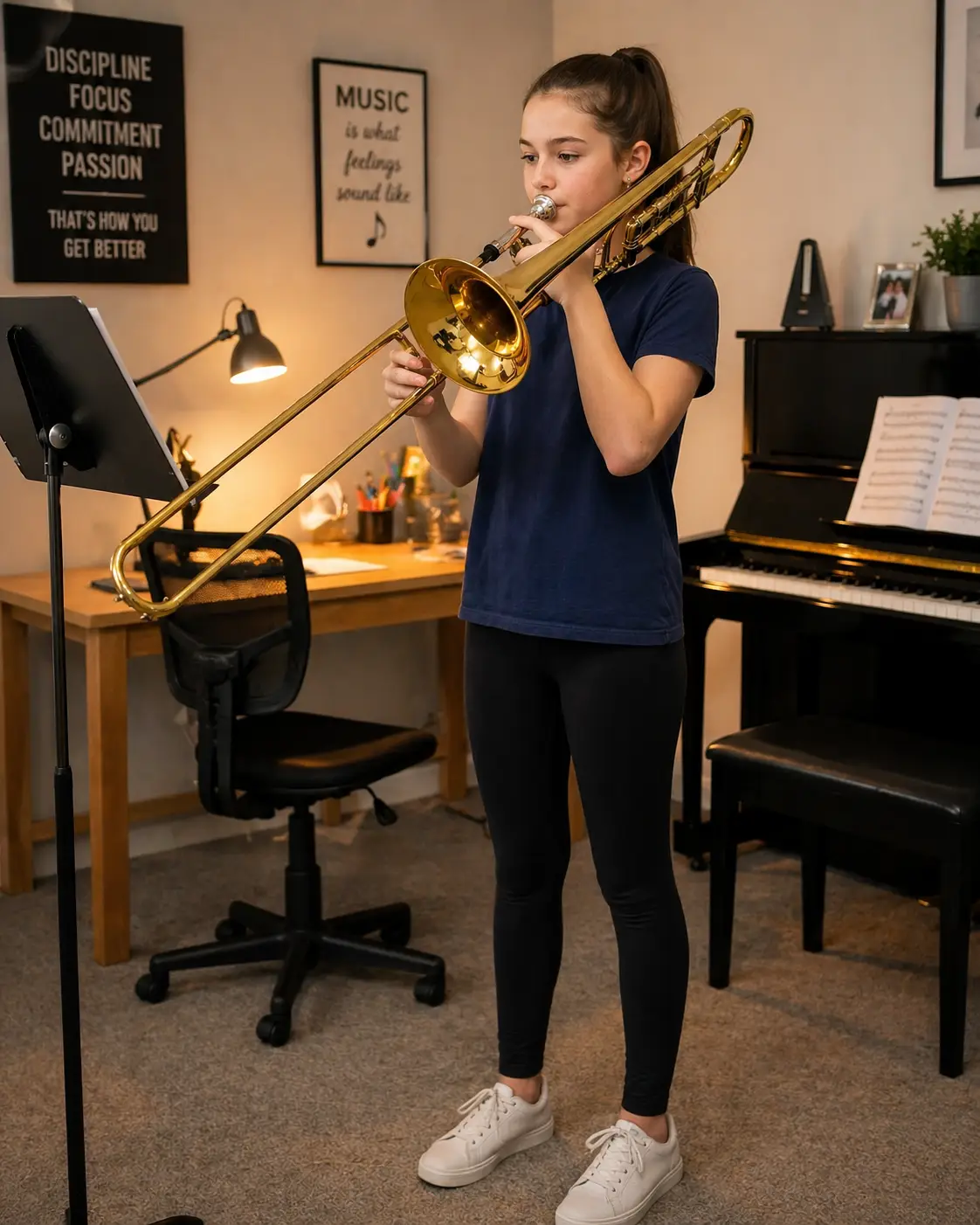
When a student first begins taking lessons, the teacher may need to explain almost everything.
How should I hold the instrument?
Where does the slide go?
How should I practice this?
Why does this note sound wrong?
What should I do next?
That’s perfectly normal.
But over time, something important should happen.
The student begins answering those questions independently.
You begin to recognize problems.
You begin to know how to practice.
Critically listening will become part of your musicianship.
You begin to set goals.
You begin to solve problems.
Eventually, your teacher isn’t simply telling you what to do.
Your teacher is helping you learn how to figure things out for yourself.
That is one of the most important goals of music education.
A Simple Formula for Becoming a Good Trombone Player
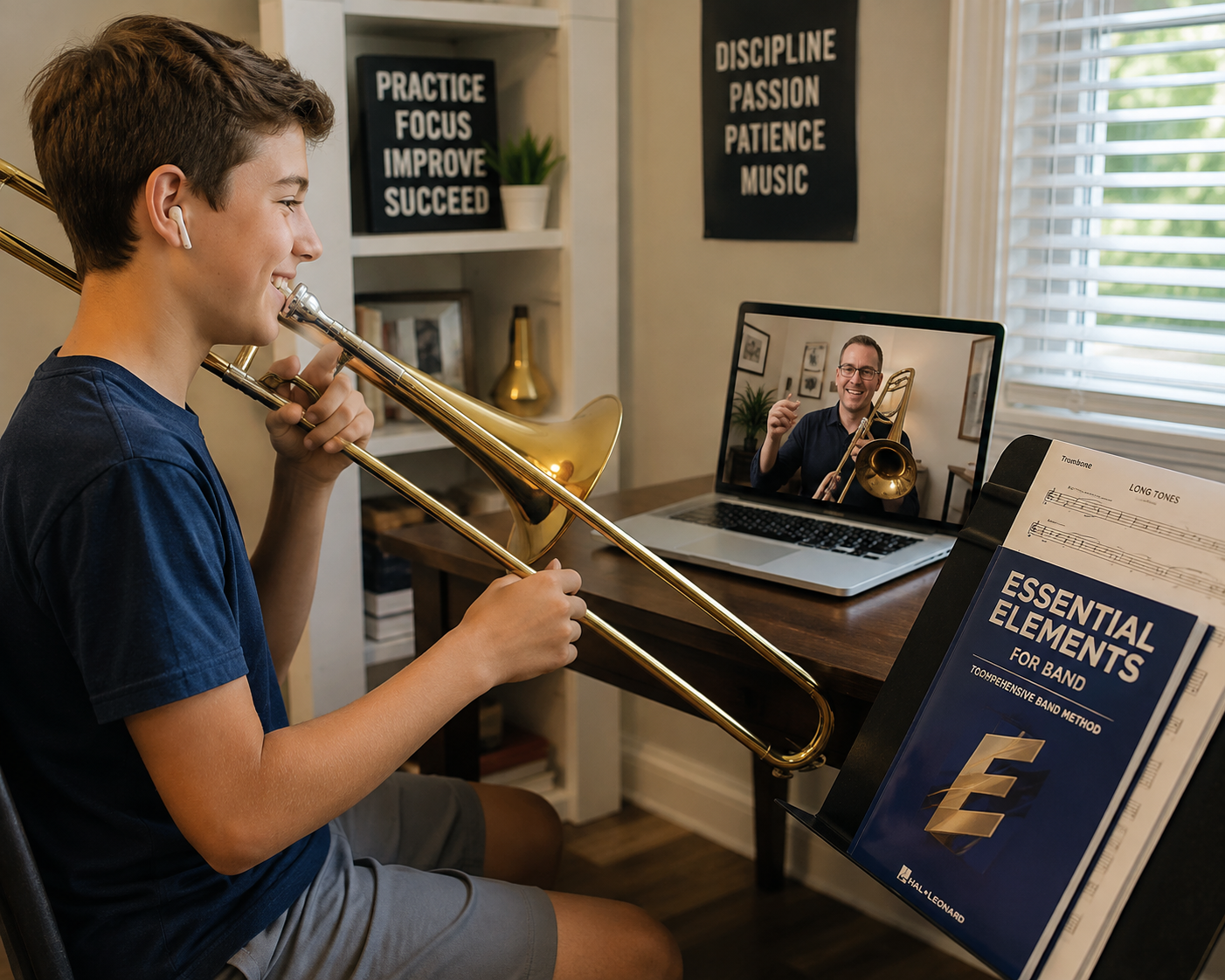
If I had to reduce everything in this article to one simple formula, it would be:
Listen + Practice + Ask Questions + Be Patient + Stay Consistent = Progress
You don’t have to be perfect.
Come to your lessons prepared.
You don’t have to practice for hours.
You don’t have to learn everything immediately.
Listen carefully.
You simply need to keep moving forward.
Practice with a purpose.
Ask questions.
Learn from your mistakes.
Take care of your instrument.
And most importantly, take responsibility for your own progress.
Final Thoughts
Being a good trombone student isn’t about being the most talented person in the band.
It is about having the attitude of someone who wants to learn.
The students who make the greatest progress are usually the ones who understand that improvement is a process. They are willing to work through difficult passages, accept corrections, ask questions, and keep practicing when something doesn’t come easily.
Your teacher can show you the road. You still have to walk it.
And if you approach your trombone lessons with curiosity, patience, consistency, and a willingness to work, you are already developing one of the most important skills a musician can have: The ability to teach yourself.
Ready to Become A Better Trombone Player?
If you are looking for individualized instruction, Online Trombone Lessons with The Trombone Mentor can provide personalized guidance, practice direction, and feedback based on your current ability and musical goals.
About the Author
Rick Lawrence is a music educator, conductor, professional trombonist, and private instructor with more than 40 years of playing and teaching experience. He has performed with orchestras, jazz ensembles, brass bands, and pit orchestras, and studied with John Coffey of the Boston Symphony Orchestra, Donald Knaub at the University of Texas, and Edward J. Madden, composer, arranger, trombonist.
Through The Trombone Mentor website, Rick provides online trombone lessons and educational resources for beginner, intermediate, and advanced trombonists.
Related Trombone Articles
Arban Method for Trombone: Complete Student & Teacher Guide
Trombone Practice Mute: A Complete Guide for Quiet, Effective Practice
Best Trombone Method Books for Every Skill Level
Trombone Warm Ups:10 Exercises Every Player Should Know