Trombone Lessons: Complete Guide for Students and Parents
If you or your child is thinking about learning the trombone, you may have questions about trombone lessons. What do students learn? How often should they take lessons? How much should they practice? Are private lessons necessary if the student is already in school band?
Trombone lessons can provide much more than learning the correct notes. Students can develop better tone, slide technique, breathing, music reading, practice habits, and musical expression.
Every student is different. A beginning player has different needs from an experienced high school trombone player preparing for an audition. An adult returning to the instrument may have different goals as well.
Good instruction begins with the individual student. The teacher should understand the student’s current ability, goals, and learning style and then develop instruction that fits those needs.
In this guide, I will explain what students can expect from trombone lessons, what they can learn, how often they should take lessons, how much they should practice, and how to choose the right teacher. I will also explain the differences between school band instruction, private lessons, and online trombone lessons.
Let’s get started!
Disclaimer
Some of the links below are affiliate links. The Trombone Mentor participates in the Amazon Services LLC Associates Program. What this means, is that at no cost to you, if you click on a link and follow through with a purchase, this site may earn a small commission.
What Do You Learn in Trombone Lessons?
A good trombone lesson should develop more than the ability to play the correct notes. The goal is to help the student become a better trombone player and a more complete musician.
Depending on the student’s level and goals, lessons may include tone, breathing, slide technique, articulation, scales, flexibility, range, sight reading, music theory, and musical expression.
Developing a Good Trombone Tone
Tone is the first thing I listen for when working with a student.
A good trombone sound begins with several things working together: the embouchure, air, posture, the way the instrument is played, and the student’s ability to listen.
Students need to learn to recognize the sound they want and compare it with the sound they are actually producing.
I often use this simple concept with my students:
We hear with our ears, but we listen with our brain.
Hearing a sound is only the beginning. A student needs to learn how to listen critically and make adjustments.
Learning to Use the Slide
The trombone’s slide is one of the things that makes the instrument unique.
Students need to learn the seven basic slide positions and develop the coordination needed to move accurately between them.
But knowing the positions is only part of the process. The student also needs to develop an understanding of pitch.
A good trombone player learns to combine slide position, air, embouchure, and listening.
Breathing and Air Support
Breathing is fundamental to brass playing.
Students need to learn how to take a comfortable breath and use the air efficiently. Good breathing helps support tone, phrasing, range, and endurance.
The goal is not simply to take a large breath. The student needs to understand how to use the air while playing.
Articulation and Flexibility
Students also develop control of the tongue and lips.
Lessons may include tonguing, legato playing, slurs, accents, and other forms of articulation. Lip flexibility exercises help students learn to move between notes smoothly and efficiently.
These skills become increasingly important as students progress to more difficult music.
Scales and Technique
Scales are an important part of learning the trombone.
They help students understand keys, notes, pitch relationships, slide positions, and musical patterns. They also develop coordination and technical control.
A teacher can select scales and technical exercises that match the student’s current level.
Sight Reading
Sight reading requires the student to respond to music that has not been practiced beforehand.
The student must recognize notes, rhythms, rests, key signatures, articulation, dynamics, tempo markings, and other musical information.
Sight reading is also an important measurement of a student’s overall trombone skill level.
For students who want to develop this ability, see Trombone Sight Reading.
Musical Expression
Eventually, technique has to become music.
Students need to learn how to use dynamics, phrasing, articulation, tone color, rhythm, and style to communicate with an audience.
The trombone can be a medium for performance in concert bands, wind ensembles, jazz ensembles, orchestras, brass bands, marching bands, pit orchestras, and other musical settings.
The goal of lessons is not simply to produce correct notes. The goal is to give the student the skills needed to communicate through the instrument.
Who Can Benefit From Trombone Lessons?
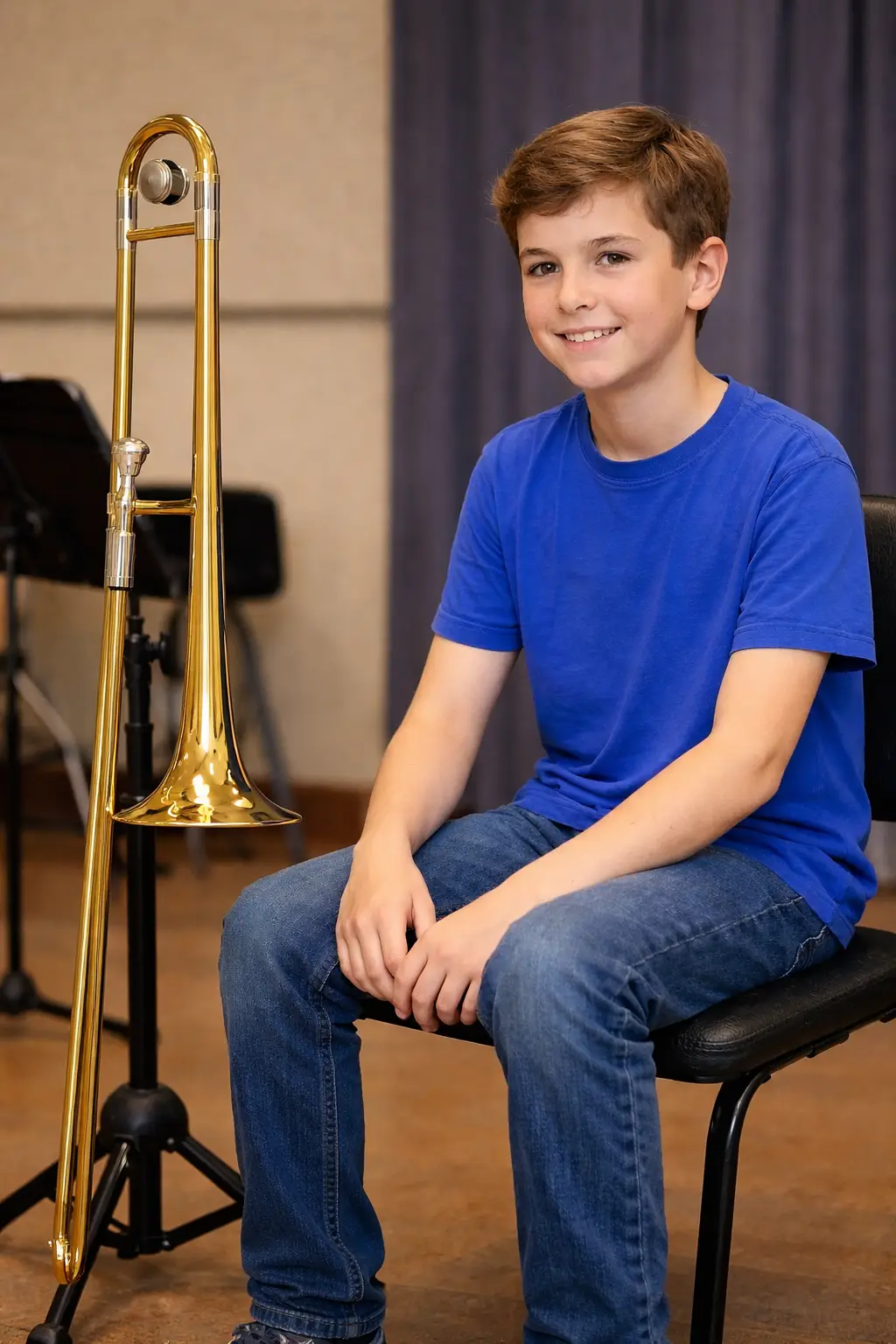
Trombone lessons can benefit students at many different stages.
Beginning Students
Beginners need a strong foundation.
Early instruction may include posture, holding the instrument, producing the first sound, breathing, embouchure, slide positions, notes, rhythms, music reading, articulation, and practice habits.
The goal is to establish good habits before poor habits become difficult to change.
For students just beginning, see Online Trombone Lessons for Beginners.
Middle School Students
Many middle school students first encounter the trombone through their school music program.
Private instruction can supplement that experience by giving the student individual attention.
A teacher can work on tone, slide accuracy, breathing, articulation, range, scales, and practice habits while helping the student become more comfortable with the instrument.
Private lessons do not replace the school music program. They provide another type of instruction.
High School Students
High school trombone students often have goals that go beyond playing the notes correctly.
They may participate in concert band, symphonic band, wind ensemble, jazz ensemble, marching band, or other musical groups.
They may also be preparing for solos, auditions, all-state or regional ensembles, or college music programs.
At this level, lessons may focus on tone, range, flexibility, scales, sight reading, solo preparation, audition preparation, musical expression, and practice strategies.
See Online Trombone Lessons for High School Students for more information.
Adult Beginners
Adults can learn the trombone.
An adult may begin because of a long-standing interest in music, a desire to join a community ensemble, or simply the desire to learn something new.
The pace of instruction can be adjusted to fit the student’s schedule, experience, and goals.
See Online Trombone Lessons for Adult Beginners for more information.
Returning Trombone Players
Some students return to the trombone after years away from the instrument.
They may remember how to read music and some of the basic skills, but their tone, range, flexibility, endurance, and confidence may have changed.
That is normal.
The student does not have to immediately play at the level they remember. A teacher can evaluate the player’s current ability and develop a gradual plan for rebuilding those skills.
School Band vs. Private Trombone Lessons
School music programs play an extremely important role in music education. For many students, school band is where the musical journey begins.
School band teaches students how to read music, count rhythms, listen to other musicians, follow a conductor, play as part of an ensemble, and perform with other students.
Those are valuable skills that individual lessons cannot completely replace.
Private trombone lessons provide something different: individual attention to one student’s trombone playing.
In a group setting, the teacher must work with the needs of the entire class or section. During a private lesson, the teacher can concentrate on the individual student.
For example, one student may need help with tone. Another may struggle with slide accuracy. A third may need better breathing or articulation.
During a private lesson, the teacher can identify the specific problem and work directly on it.
Private lessons can also be used to examine the music a student is playing in school band. The teacher can help with difficult passages, rhythm, articulation, dynamics, breathing, and musical expression.
I view private instruction as a supplement to school music education, not a replacement for it.
School band provides the ensemble experience and musical community. Private lessons provide individualized attention to the student’s development as a trombone player.
Together, they can provide a strong musical education.
What Happens During a Trombone Lesson?
Every lesson will be somewhat different because every student is different.
However, I believe a lesson should have a purpose.
A typical lesson may include a combination of tone work, technique, music, sight reading, and a practice assignment. One of the areas that I teach is the “warm-up”. This is an essential skill that requires daily attention. After this skill is developed, I do not include it the lesson. I require the student to be warmed prior to his or her lesson. See Trombone Warm Ups:10 Exercises Every Player Should Know for more information.
Tone and Technique
The teacher listens carefully to the student’s playing.
We may work on tone, slide accuracy, breathing, flexibility, range, articulation, rhythm, or endurance.
The exercises should address the student’s needs rather than simply following the same routine for everyone.
Music
The student may work on school band music, solos, audition material, jazz music, orchestral music, or other repertoire.
The lesson should go beyond simply playing the notes.
We consider phrasing, dynamics, articulation, breathing, style, and musical communication.
Sight Reading
Sight reading can be included when appropriate.
The student learns to look at unfamiliar music and make musical decisions without having practiced every note beforehand.
The Practice Assignment
A good lesson should end with a clear idea of what the student should practice.
The student should know:
What to practice.
How to practice it.
Why it matters.
The purpose of the lesson is not simply to fill 30, 45, or 60 minutes. The purpose is to identify what the student needs, work on it, and create a plan for continued improvement.
How Often Should You Take Trombone Lessons?
For many students, a weekly lesson provides a good balance.
The teacher can introduce new material, identify problems, answer questions, and provide a practice assignment. The student then has time to apply what was learned.
Think of the process as:
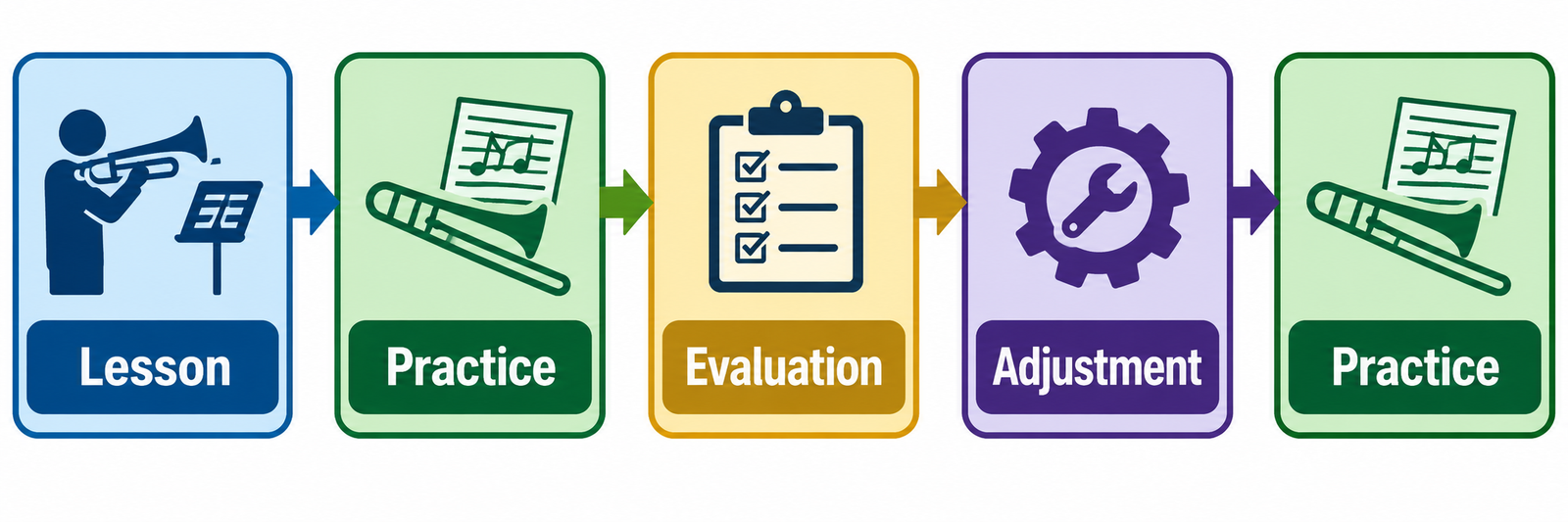
Weekly instruction also makes it easier to catch problems before they become habits.
Students preparing for an important audition, solo, or performance may benefit from additional instruction during a preparation period.
However, frequency is only part of the equation.
A weekly lesson without practice between lessons will not produce the same results as a lesson followed by focused, consistent practice.
How Long Does It Take to Learn Trombone?
There is no single answer.
Students progress at different rates because they have different backgrounds, practice habits, goals, and learning styles.
Previous musical experience can help. A student who already understands rhythm and music reading may have a different starting point from someone learning music for the first time.
Quality instruction also matters. A good teacher can identify problems, explain them clearly, and provide exercises that address those problems.
Practice matters as well.
I like to think about effective practice this way:
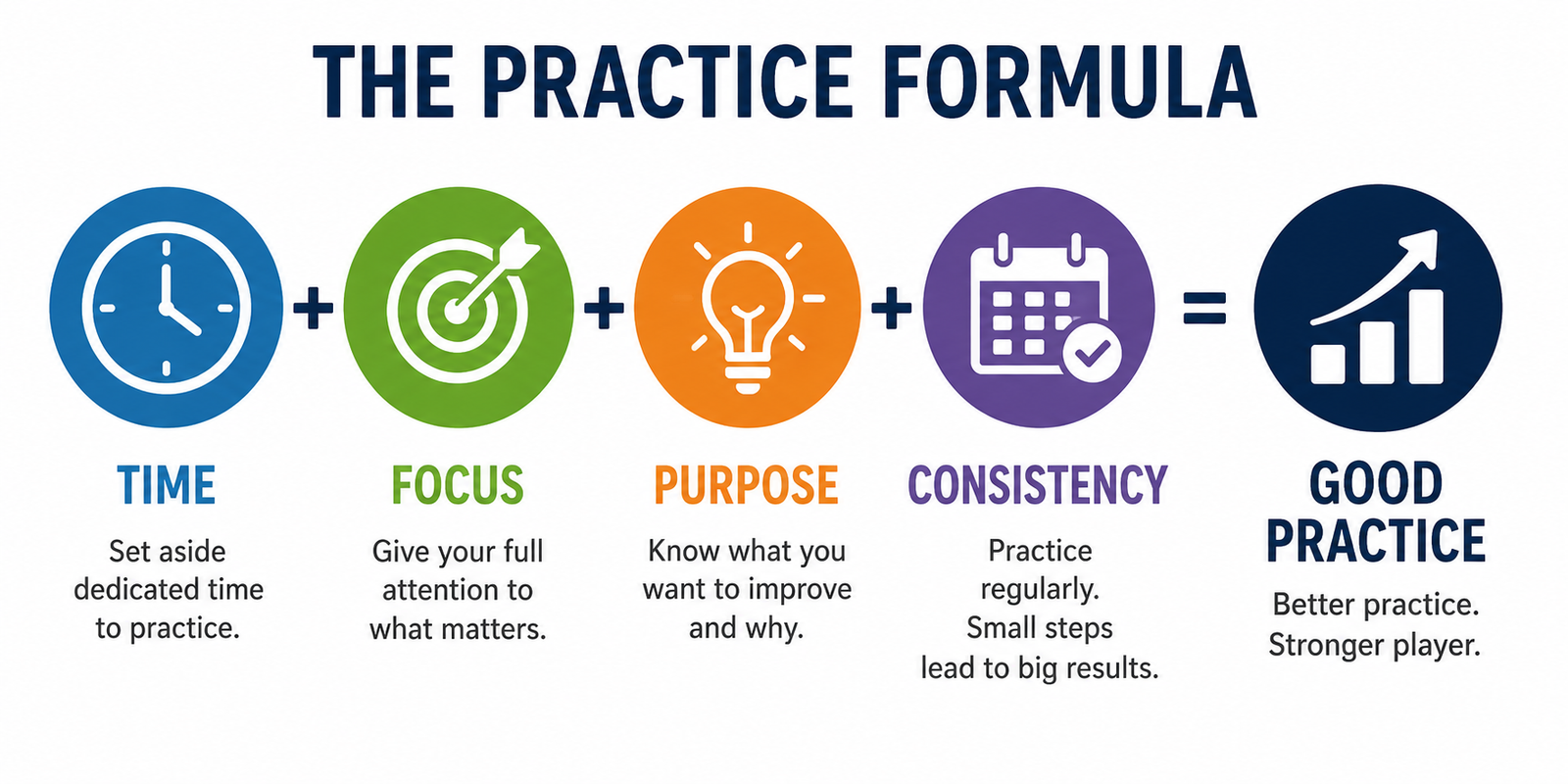
A student who practices for a shorter amount of time with concentration and a clear purpose can accomplish more than a student who spends twice as long playing without a plan.
The goal should be progress rather than a deadline.
A beginning student may first work toward producing a good sound and playing simple music. An advanced student may be working toward better range, flexibility, sight reading, audition preparation, or musical expression.
Learning the trombone is a process that continues as long as you continue to play.
How Much Do Trombone Lessons Cost?
The cost of trombone lessons varies depending on several factors.
These can include:
- Teacher experience
- Lesson length
- Lesson frequency
- Location
- Online or in-person instruction
- The type of instruction required
The cost of private trombone lessons is usually based on the length of the lesson. Common lesson lengths include:
- 30 minutes
- 45 minutes
- 60 minutes
Prices can vary considerably. As a general example, you may find private lessons ranging from about $30–$50 for a 30-minute lesson to $150 or more for a one-hour lesson. Rates depend on the teacher, location, experience, and type of instruction provided.
Online trombone lessons may sometimes be less expensive than in-person lessons. They also give students access to teachers who may not be available in their local area.
However, price should not be the only factor when choosing a teacher.
The more important question is: What does the student receive during that lesson?
A good private lesson should provide individual attention, specific feedback, instruction that addresses the student’s needs, and a clear plan for practice between lessons.
The goal is not simply to find the lowest price. The goal is to find instruction that helps the student make meaningful progress.
Online vs. In-Person Trombone Lessons
Traditional in-person lessons remain a good way to learn.
However, online trombone lessons have become an excellent and very practical option for students who want individual instruction.
The important question is not simply whether lessons are online or in person.
The better question is:
Does the student receive effective, individualized instruction from a qualified trombone teacher?
In-Person Trombone Lessons
In-person lessons allow the teacher and student to work together in the same room.
The teacher can demonstrate techniques, listen to the student, and provide immediate feedback.
For some beginners, having the teacher physically present can be especially helpful.
The main limitation for some families is finding the right teacher nearby.
Online Trombone Lessons
Online instruction allows a student to work one-on-one with a teacher from home.
This can be especially useful when a qualified trombone teacher is not available locally.
Online lessons may also be helpful for students who have busy schedules, families who want to avoid travel, or high school students looking for instruction focused on a particular goal.
One major advantage is access.
A student is no longer limited to teachers who happen to live nearby.
What Makes an Online Lesson Effective?
Simply connecting two people through a video call does not automatically create a good lesson.
An effective online trombone lesson should include individual attention, demonstration, listening, correction, questions, and a clear practice assignment.
The teacher needs to hear the student’s tone, articulation, rhythm, and musical expression. The teacher should also be able to observe important aspects of posture and technique.
The technology is the medium for the lesson.
The teacher’s knowledge, experience, listening skills, and ability to communicate are what make the instruction valuable.
For more information, see How Online Trombone Lessons Work
How to Choose a Trombone Teacher
Choosing a trombone teacher is an important decision.
A good teacher can have a significant effect on how a student develops tone, technique, practice habits, musical understanding, and confidence.
Look for Trombone Experience
The trombone has unique challenges involving slide positions, intonation, articulation, air support, flexibility, and tone production.
A teacher with significant trombone experience should understand those challenges.
Look for Teaching Experience
Being an excellent trombone player does not automatically make someone an excellent teacher.
Teaching requires the ability to listen, explain, demonstrate, and adjust instruction to the individual student.
A good teacher should be able to take a difficult problem and explain it in a way the student can understand.
Consider the Student’s Goals
A beginner may need help learning the fundamentals.
A middle school student may want to become more confident in band.
A high school student may need audition preparation, sight reading, solo preparation, or college preparation.
An adult may simply want to learn the instrument for enjoyment.
The student’s goals should help determine the type of instruction needed.
Look for Individualized Instruction
Every student has different strengths and weaknesses.
One student may have a beautiful tone but struggle with rhythm. Another may understand the music but have difficulty with slide accuracy.
A good teacher recognizes those differences and adjusts instruction accordingly.
A Teacher Should Help You Learn How to Practice
A teacher should not simply give you exercises and say, “Practice these.”
You should understand what you are practicing, why you are practicing it, and how you should practice it.
If a difficult passage is not working, the teacher may break it into smaller sections, slow the tempo, identify the problem, and develop a method for putting the passage back together.
The goal is not simply to practice more.
The goal is to practice more effectively.
The Teacher Should Listen
A teacher needs to listen for more than wrong notes.
The teacher should listen for:
- Tone quality
- Pitch and intonation
- Rhythm
- Articulation
- Air support
- Slide accuracy
- Musical phrasing
- Dynamics
- Tension or inefficient playing habits
Remember:
We hear with our ears, but we listen with our brain.
A good teacher helps students develop that ability to listen and make adjustments.
For more information, see How to Choose an Online Trombone Teacher.
What Equipment Do You Need for Trombone Lessons?
You do not need a room full of equipment to begin taking trombone lessons.
A beginning student needs a trombone, a suitable mouthpiece, music, and a place to practice.
A Good Trombone
The instrument should be appropriate for the student’s level and in good working condition.
For a beginning student, a reliable tenor trombone is usually an appropriate starting point.
Parents should be careful about choosing an instrument based only on the lowest price. A poorly made or poorly maintained trombone can make learning more difficult.
A Mouthpiece
The mouthpiece is a small but important part of the trombone.
Beginning students generally need a mouthpiece appropriate for their instrument and level of development.
As players progress, mouthpiece selection can become more important for tone, range, endurance, and different styles of playing.
Music and Method Books
Students need appropriate music to practice between lessons.
A method book provides a structured progression of notes, rhythms, techniques, and exercises.
One method book I use with my students is Arban’s Complete Method for Trombone. I often refer to it as the “Trombone Bible” because it provides an enormous amount of material for developing technique and musicianship.
Students do not need to work through the entire book at once. A teacher can select exercises appropriate for the student’s level and goals.
A Music Stand
A sturdy music stand helps the student maintain good posture while reading music.
The music should be positioned so the student can read comfortably without constantly looking down.
A Tuner and Metronome
A tuner can help students develop an awareness of pitch and intonation.
However, students should not become dependent on watching a tuner. The goal is to develop the ability to hear when a note is in tune.
A metronome helps develop a steady sense of tempo and is useful when practicing scales, technical exercises, and difficult passages.
A Practice Space
The practice space does not have to be large or elaborate.
It should allow the student to play comfortably, read music, and concentrate without unnecessary distractions.
For online lessons, the space also needs to allow the teacher to see and hear the student clearly.
How Much Should You Practice?
Taking trombone lessons is only part of learning to play.
What happens between lessons is just as important.
Instead of focusing only on the number of minutes practiced, think about the quality of the practice.
Time + Focus + Purpose + Consistency
Time gives you an opportunity to work.
Focus means you are paying attention.
Purpose means you know what you are trying to accomplish.
Consistency means you practice regularly.
Before you begin, ask:
What am I trying to improve today?
Your goal might be tone, scales, articulation, a difficult rhythm, a musical passage, range, flexibility, or audition material.
Practice Slowly When Necessary
One common mistake is trying to play difficult music at performance speed before it is ready.
If a passage is not working, slow it down.
Think about the notes, rhythm, slide positions, articulation, breathing, and musical direction.
Once you can play the passage correctly and consistently, gradually increase the tempo.
Practice the Problem
If you repeatedly make a mistake in the same place, simply playing the entire piece again may not solve the problem.
Stop and identify the difficulty.
Is it rhythm? Slide movement? Air? Articulation? Technique?
Once you identify the problem, practice that specific problem.
This is another area where a good teacher can be extremely helpful.
Practice Should Match Your Goals
A beginning student does not need the same practice routine as a high school student preparing for an all-state audition.
A student preparing a solo may need concentrated work on musical expression.
An audition student may need scales, sight reading, technical exercises, and audition repertoire.
An adult playing for enjoyment may have completely different goals.
Your practice should reflect where you are and where you want to go.
For more information, see Practicing Trombone.
Trombone Lessons for Specific Goals
Not every student takes trombone lessons for the same reason.
The best instruction begins with the question:
What do you want to accomplish with the trombone?
Beginning Students
The beginning student needs a strong foundation in sound production, breathing, slide positions, notes, rhythms, reading, articulation, and practice habits.
The goal is to develop good habits from the beginning.
High School Students
High school students may need help with concert band, wind ensemble, jazz, marching band, solos, sight reading, auditions, all-state ensembles, or college preparation.
Lessons can become more specialized as the student’s goals become more specific.
Audition and All-State Students
Audition preparation requires focused work.
The student may need to prepare scales, excerpts, solos, sight reading, rhythm, articulation, tone, and musical expression.
The goal is not simply to learn the audition material.
The student needs to be prepared enough to perform confidently under pressure.
Jazz Students
Jazz introduces additional skills involving articulation, swing feel, phrasing, improvisation, listening, and style.
Students also need to understand the role of the trombone within a jazz ensemble.
Listening is especially important. Students should listen to experienced players and learn to recognize differences in style, tone, phrasing, and musical interpretation.
College-Bound Students
Students considering music study in college may need to prepare audition repertoire, scales, technical studies, sight reading, and solo literature.
College preparation is not simply about preparing one audition.
It is about developing the fundamentals and musical independence necessary for continued study.
Adult and Returning Players
Adults can learn the trombone, and returning players can rebuild skills they developed earlier in life.
The important thing is to establish realistic goals and a practice routine that can be maintained.
Students Who Simply Want to Improve
Not every student has an audition or performance deadline.
Sometimes the goal is simply:
“I want to become a better trombone player.”
That is a perfectly good reason to take lessons.
A student may want a better tone, greater range, improved technique, stronger sight-reading skills, or a better understanding of music.
Lessons provide a structured way to identify those goals and work toward them.
Finding the Right Trombone Lessons
Learning the trombone is a process.
Whether you are a beginning student, middle school or high school player, adult beginner, or someone returning to the instrument, the goal is the same:
Become a better and more confident musician.
Good trombone lessons should address more than correct notes. They should help develop tone, slide technique, breathing, articulation, flexibility, sight reading, musical expression, and effective practice habits.
Most importantly, instruction should be appropriate for where you are now and where you want to go.
A good teacher listens.
The teacher identifies problems, explains solutions, and helps the student develop a plan.
The goal is not to make the student dependent on the teacher. The goal is to help the student become an increasingly independent musician.
For students who do not have access to an experienced trombone teacher nearby, online trombone lessons provide another option.
One-on-one online instruction allows students to learn from home while receiving individualized attention and feedback.
If you are interested in learning more, explore Online Trombone Lessons at The Trombone Mentor.
Whether your goal is to learn your first notes, improve in school band, prepare for an audition, develop as a high school musician, or simply become a better trombone player, the important step is to begin with good instruction and purposeful practice.
Learn. Practice. Listen. Improve.
That is how we become better trombone players—one lesson at a time.
About the Author
Rick Lawrence is a music educator, conductor, professional trombonist, and private instructor with more than 40 years of playing and teaching experience. He has performed with orchestras, jazz ensembles, brass bands, and pit orchestras, and studied with John Coffey of the Boston Symphony Orchestra, Donald Knaub of the University of Texas, and Edward J. Madden, composer, arranger, trombonist.
Through The Trombone Mentor website, Rick provides online trombone lessons and educational resources for beginner, intermediate, and advanced trombonists.