Online Trombone Lessons: Complete Guide
Learning to play the trombone is a rewarding musical journey, but every student follows a different path. Some students are just beginning, while others are working to improve their playing, prepare for an audition, return to the instrument after years away, or become more confident in their chosen medium for performance.
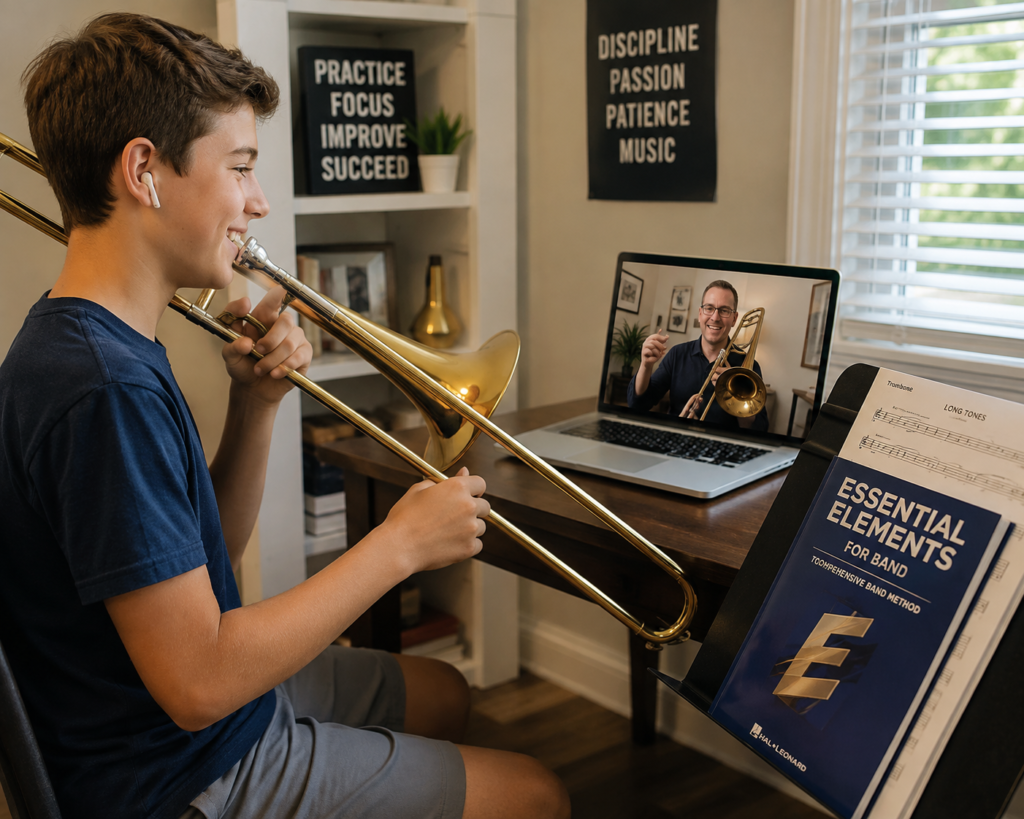
Online trombone lessons provide a way for students to receive individualized instruction from a trombone teacher without traveling to a studio. Through live online lessons, a teacher can listen to the student play, observe technique, provide feedback, demonstrate concepts, and develop instruction around the student’s individual needs and goals.
Online instruction can be appropriate for beginning students as well as experienced players. Students may perform in concert or symphonic bands, orchestras, jazz ensembles, marching bands, chamber groups, or as soloists. The fundamentals of good trombone playing remain important regardless of the musical setting.
This guide explains how online trombone lessons work, what students can learn, what equipment and setup are needed, how to choose an online trombone teacher, and how to make the most of instruction and practice. Whether you are a student, a parent looking for a teacher, or an adult returning to the trombone, this guide will help you understand what to expect from online trombone lessons.
Let’s get started!
What Are Online Trombone Lessons?
Online trombone lessons are live, individual lessons conducted over the internet between a student and a trombone teacher. Instead of traveling to a teacher’s studio, the student participates from home or another suitable location.
The word “lessons” is important. Online trombone lessons are not simply a collection of videos for a student to watch independently. They are a form of private instruction in which the teacher and student interact during the lesson.
The teacher can listen to the student’s playing, observe posture and technique, identify areas that need attention, demonstrate exercises or musical passages, answer questions, and provide assignments for practice between lessons.
Private Instruction Online
One of the greatest advantages of private online instruction is that the lesson can be adapted to the individual student.
Students do not all begin with the same experience, physical characteristics, musical interests, or goals. A beginning student may need help learning how to hold the instrument, produce a first sound, and learn the first slide positions. A more experienced student may be working on tone, articulation, flexibility, range, sight reading, audition preparation, or musical interpretation.
A good private trombone lesson therefore begins with the student—not with a predetermined lesson that every student is expected to follow.
The teacher evaluates where the student is in their development and provides instruction appropriate to the student’s current level and goals.
Online Trombone Lessons vs. Instructional Videos
There is a tremendous amount of useful trombone information available through videos and other online resources. These resources can supplement a student’s education, but they are not the same as private instruction.
A video provides the same information to everyone watching it. The instructor cannot hear the individual student play, observe the student’s technique, or respond to a specific problem.
During a private online lesson, the teacher can hear and observe the student and provide immediate, individualized feedback.
For example, a video can demonstrate an exercise intended to improve tone quality, but it cannot tell a student exactly what may be causing a particular problem with their sound. A private teacher can listen, observe, ask questions, and help the student determine what needs to change.
That interaction between teacher and student is one of the defining characteristics of private trombone instruction.
If you would like to learn more about the role of the teacher in online instruction, see Online Trombone Teacher for All Skill Levels.
How Do Online Trombone Lessons Work?
Online trombone lessons work much like private lessons in a traditional studio, except the teacher and student meet through a live video connection rather than in the same physical room.
The student and teacher meet at a scheduled time, and the lesson is conducted in real time. The teacher can listen to the student play, observe technique, demonstrate exercises, answer questions, and provide feedback throughout the lesson.
The exact structure of a lesson depends on the student’s experience, goals, and current needs.
Before the Lesson
Before the lesson begins, the student should have the trombone, music, and any assigned materials ready. The student should also be in a location where they can comfortably play the instrument without distractions.
For a new student, the first lesson may include an assessment of playing experience, musical interests, goals, and current skills. This gives the teacher a starting point for developing an appropriate plan of instruction.
During the Lesson
A typical lesson may include several different activities:
● Warm-up and fundamentals – Breathing, long tones, flexibility, articulation, or other exercises appropriate for the student’s level.
● Technique development – Work on slide technique, tone production, range, flexibility, articulation, and other playing skills.
● Music and sight reading – Reading and performing music appropriate for the student’s level.
● Problem solving – Identifying specific difficulties in the student’s playing and working on ways to correct them.
● Musical development – Developing phrasing, dynamics, style, expression, and confidence.
● Performance preparation – Preparing music for concerts, auditions, recitals, jazz ensembles, orchestras, bands, or other performance situations.
The teacher may demonstrate an exercise or musical passage and then have the student perform it. The teacher listens and observes, provides feedback, and may make adjustments before the student tries it again.
This creates an important cycle:
Play → Listen → Evaluate → Adjust → Play Again
That process is at the heart of effective private instruction.
After the Lesson
At the end of the lesson, the teacher should provide the student with clear directions for practice. These may include specific exercises, sections of music to work on, technical goals, or other assignments.
The student then applies what was learned during individual practice before the next lesson.
This creates an ongoing learning cycle:
Lesson → Practice → Improvement → Next Lesson
The teacher can then evaluate the student’s progress during the following lesson and adjust instruction as needed.
For a more detailed look at the lesson process, see How Online Trombone Lessons Work.
How Often Should Lessons Take Place?
Many students benefit from a regular weekly lesson because it provides consistency and gives the teacher an opportunity to monitor progress from one lesson to the next.
However, lesson frequency can depend on the student’s age, experience, goals, schedule, and available practice time. Some students may benefit from more frequent instruction, while others may use lessons less often as a supplement to their own practice.
The most important factor is consistency. Regular instruction combined with purposeful practice gives the student the opportunity to build skills over time.
For more information about preparing for an online lesson, see Online Trombone Lesson Setup Guide: What You Need for Success.
For more information, see the Online Trombone Lesson Setup Guide.
Who Are Online Trombone Lessons For?
Online trombone lessons can work for a wide range of students. Because private instruction can be adapted to the individual, lessons can be designed around the student’s age, experience, musical interests, and goals.
Beginners
Beginning students can learn the fundamentals of trombone playing through online instruction. Lessons may include how to hold the instrument, proper posture, breathing, producing a good first sound, learning slide positions, developing a comfortable embouchure, and reading music.
Starting with good fundamentals is important. Habits developed during the early stages of learning can have a lasting effect on a student’s progress.
For a closer look at getting started, see Online Trombone Lessons for Beginners.
Middle School Students
Middle school students are often developing rapidly as musicians. They may be learning new notes and rhythms, playing increasingly challenging music, and preparing for performances with their school ensembles.
Private online lessons can provide individual attention that may not be possible during a group rehearsal. Instruction can focus on improving fundamentals, tone quality, range, articulation, slide technique, sight reading, and overall musical confidence.
For more information about private instruction at this age, see Online Trombone Lessons for Middle School Students.
High School Students
High school trombone players often have more specific musical goals. They may be preparing for auditions, honor ensembles, All-State or regional ensembles, performances, or more advanced repertoire.
Lessons can be tailored to these goals while continuing to strengthen the fundamentals of good trombone playing.
For high school students, instruction may include audition preparation, sight reading, scales, technical development, musical interpretation, and performance preparation.
For a closer look at lessons designed for students at this level, see Online Trombone Lessons for High School Students.
Adult Beginners and Returning Players
Online trombone lessons aren’t just for young students.
Adults who are beginning the trombone for the first time can receive structured instruction without having to travel to a teacher’s studio. Adults who played previously and are returning to the instrument can also benefit from individualized instruction as they rebuild their skills and confidence.
Goals might include playing for personal enjoyment, joining a community band or other ensemble, improving technique, preparing specific music, or simply getting back into the habit of playing.
If you’re beginning the trombone as an adult or returning after time away, see Online Trombone Lessons for Adult Beginners: Learn at Any Age.
Students With Different Musical Goals
Students do not all learn the trombone for the same reason. Some want to play in a school band, while others may be interested in orchestral playing, jazz ensembles, marching bands, chamber music, solo performance, or community ensembles.
A good private teacher takes these differences into account.
The fundamentals of trombone playing remain important regardless of the student’s chosen medium for performance, but instruction can be shaped around the music the student wants to perform and the goals they want to achieve.
Is Online Instruction Right for Every Student?
Online lessons can be effective for many students, but they are not automatically the best choice for everyone.
A student’s age, ability to work independently, home environment, technology, and learning preferences can all affect the experience. Younger beginners may need additional support from a parent or caregiver, particularly when getting started.
The most important question is not simply whether lessons are online or in person. It is whether the student is receiving consistent, individualized instruction from a teacher who understands the trombone and can help the student make progress toward meaningful musical goals.
What Will You Learn in Online Trombone Lessons?
What a student learns in online trombone lessons depends on their current playing level, goals, and musical interests. A beginning student will have different needs from an experienced player preparing for an audition, but the goal is the same: to develop the skills needed to become a confident and capable trombone player.
Tone Production
A good trombone sound begins with proper fundamentals. Students learn how to produce a clear, centered tone and how to develop consistency throughout the instrument’s range.
Tone development may include long tones, listening exercises, breath support, embouchure development, and other exercises appropriate to the student’s level.
Breathing and Air Support
Breathing is an essential part of trombone playing. Students learn how to use the breath efficiently and how air supports tone, phrasing, dynamics, and endurance.
Rather than simply taking larger breaths, students learn to understand how breathing affects the way they play.
Slide Technique
The trombone’s slide is one of the instrument’s defining characteristics, and developing accurate slide technique is essential.
Students learn slide positions, coordination, smooth movement between positions, and techniques that help them play with greater accuracy and efficiency.
As students advance, instruction can address more demanding technical passages, alternate positions, and the coordination required for faster playing.
Articulation and Flexibility
Students develop the ability to begin and connect notes cleanly through proper articulation. Instruction may include tonguing, legato playing, slurs, and exercises designed to improve flexibility.
These skills help students move more easily between notes and produce a more musical and controlled performance.
Range and Endurance
Range and endurance develop gradually as a student’s fundamentals become stronger.
Instruction can help students develop their usable range without relying on excessive force or tension. Students also learn how practice habits, breathing, embouchure, and efficient technique contribute to endurance.
Music Reading and Sight Reading
Playing the trombone involves much more than producing the correct notes. Students also need to understand and respond to the music in front of them.
Lessons may include reading rhythms, recognizing notes and slide positions, understanding musical markings, and developing sight-reading skills.
Sight reading is particularly important for students who participate in school ensembles, auditions, honor ensembles, or other performance situations.
Music Theory
A strong trombone player benefits from understanding the musical language behind the notes.
Depending on the student’s level, lessons may incorporate music theory concepts such as scales, key signatures, intervals, rhythm, time signatures, dynamics, articulation markings, and musical form.
Understanding these concepts can make it easier for students to learn new music and become more independent musicians.
Musical Interpretation
Technical skills are only part of becoming a good musician. Students also learn how to make musical decisions.
Lessons may address phrasing, dynamics, articulation, style, expression, and the character of a musical passage.
The goal is not simply to play the correct notes, but to communicate the music.
Performance Confidence
As students develop their playing skills, they also become more prepared to perform.
Depending on their goals, students may prepare music for school bands, symphonic bands, orchestras, jazz ensembles, marching bands, chamber groups, solo performance, auditions, or other musical settings.
A teacher can help students prepare the music, identify areas that need additional work, develop an effective practice plan, and build confidence through preparation.
Developing the Whole Musician
Ultimately, online trombone lessons should do more than improve a student’s ability to play individual exercises or pieces of music.
The goal is to help students become more independent musicians—players who understand their instrument, know how to practice effectively, can listen critically to their own playing, and are able to approach new music with greater confidence.
These skills continue to benefit the student regardless of their age, playing level, or chosen medium for performance.
What Equipment Do You Need for Online Trombone Lessons?
One of the advantages of online trombone lessons is that you do not need a professional recording studio or expensive equipment to get started.
You need a trombone, a reliable internet connection, a device capable of video communication, and a space where you can comfortably play. A few additional items can improve the lesson experience, but the basic setup can be quite simple.
Your Trombone
Obviously, you will need your trombone and any accessories normally used during your practice sessions.
Your teacher may also ask you to have specific music, method books, exercises, or other materials available during the lesson.
A Computer, Tablet, or Phone
You need a device with a camera, microphone, and internet connection that can support your live lesson.
A computer or tablet is often convenient because the larger screen makes it easier to see the teacher and read music or other materials. However, a phone can also work when positioned appropriately.
A Camera Position That Shows You Playing
Camera placement is particularly important for a trombone lesson.
Your teacher needs to be able to see enough of your body and instrument to observe posture, slide technique, and other aspects of your playing. The camera should be positioned so that you can play naturally without having to adjust your posture to remain on screen.
A Microphone
The microphone built into your computer, tablet, or phone may be sufficient to begin with.
The most important consideration is that your teacher can hear your playing clearly. In some situations, an external microphone or other audio equipment may provide a better listening experience, but expensive recording equipment is not required for most students.
Headphones
Headphones can sometimes make communication easier by reducing room noise and helping the student hear the teacher clearly.
They are optional, however, and should not interfere with the student’s ability to hear their own trombone sound naturally.
Music Stand and Good Lighting
A music stand should be positioned at a comfortable height and angle so that you can read your music without compromising your playing posture.
Good lighting also helps the teacher see you clearly. You do not need professional lighting equipment; a well-lit room is usually sufficient.
A Suitable Playing Space
You need enough room to hold and move the trombone comfortably.
The space should be relatively quiet and free from distractions. Whenever possible, choose a location where you can play at a normal volume without worrying about disturbing other people.
A Reliable Internet Connection
Because online lessons take place in real time, a stable internet connection is important.
Connection problems can interrupt communication or affect the quality of the video and audio. If your internet connection is unreliable, positioning your device closer to your router or using a wired connection may help.
You Don’t Need Expensive Equipment
It is easy to assume that online music lessons require professional audio and video equipment. They don’t.
A student can begin with equipment they may already have at home. The goal is not to create a professional recording studio. The goal is to give the teacher a clear view of the student and a useful representation of the student’s sound.
As your needs change, you can consider improving your setup.
For a more detailed explanation of camera placement, lighting, audio, room setup, and other practical considerations, see Online Trombone Lesson Setup Guide: What You Need for Success.
How to Set Up Your Space for an Online Trombone Lesson
A good playing environment can make an online trombone lesson much more productive.
Choose a space where you have enough room to hold and move your trombone comfortably. Your music stand should be at a height that allows you to maintain good playing posture, and your camera should provide the teacher with a clear view of you and your instrument.
Try to eliminate unnecessary distractions and background noise. Good lighting is also helpful because your teacher needs to be able to see your posture, slide movement, and other aspects of your playing.
You do not need a perfect setup. The goal is simply to create an environment in which you can play naturally and your teacher can see and hear you clearly.
For detailed instructions on camera placement, lighting, audio, equipment, and room setup, see Online Trombone Lesson Setup Guide: What You Need for Success.
Are Online Trombone Lessons Effective?
A common question from students and parents is whether online trombone lessons can really be as effective as lessons taught in person.
The answer is that online trombone lessons can be highly effective when the right conditions are in place. The technology itself does not determine the quality of instruction. The teacher, student, lesson structure, communication, and practice between lessons all play important roles.
The Teacher Matters
Effective instruction begins with a teacher who understands both the trombone and how to teach it.
A good teacher can listen carefully to a student’s playing, observe technique, identify problems, demonstrate solutions, and adjust instruction to meet the student’s needs. These are fundamental parts of private instruction whether the lesson takes place online or in person.
The Student Matters
The student also has an important role.
Students need to participate actively in the lesson, ask questions, listen carefully to feedback, and apply what they learn during individual practice. Younger students may need additional support from a parent or caregiver to stay organized and focused.
Communication Is Important
Because the teacher and student are not in the same room, clear communication becomes especially important during an online lesson.
The teacher may ask the student to demonstrate something from a different camera angle, repeat a passage, or describe what they are experiencing. Good communication helps the teacher understand what the student is hearing and feeling as well as what the teacher can observe.
Technology Has a Role
A reliable internet connection, appropriate camera position, and clear audio make online instruction easier.
Technology does have limitations. Audio and video can sometimes introduce delays or make it more difficult for a teacher and student to play simultaneously. A good teacher understands these limitations and structures the lesson accordingly.
Practice Makes the Difference
No lesson format can replace individual practice.
A student may receive excellent instruction, but improvement comes from applying that instruction between lessons. Consistent, purposeful practice allows the student to develop the skills introduced during the lesson.
The teacher can then evaluate that progress during the next lesson and adjust the student’s instruction.
Consistency and Goals
Students are more likely to make progress when lessons and practice are consistent and connected to meaningful goals.
Those goals may be as simple as learning to play the first few notes of the trombone or as advanced as preparing for an audition, developing skills for a jazz ensemble, or preparing challenging orchestral or band repertoire.
Online vs. In-Person Instruction
Online instruction is not automatically better than in-person instruction, and in-person instruction is not automatically better than online instruction.
Each format has advantages and limitations. What matters most is whether the student receives appropriate instruction, practices consistently, and has a teacher who can help them move toward their musical goals.
For many students, online trombone lessons provide an effective way to receive individualized instruction while learning and practicing in their own environment.
How to Choose an Online Trombone Teacher
Choosing the right online trombone teacher is one of the most important decisions a student or parent will make. The goal is not simply to find someone who can play the trombone, but to find a teacher who can communicate effectively, understand the student’s needs, and provide appropriate instruction.
Look for Trombone-Specific Experience
A teacher who specializes in trombone can bring knowledge that is specific to the instrument.
The trombone has unique characteristics, including slide technique, position accuracy, embouchure development, articulation, range, and the coordination required to move the slide efficiently.
A teacher should understand these fundamentals and know how to explain them in a way the student can understand.
Consider Teaching Experience
Being an accomplished trombone player does not automatically make someone an effective teacher.
Look for a teacher who has experience working with students at the student’s age and playing level. Teaching a beginning student requires a different approach from teaching an advanced high school player preparing for an audition.
A teacher with substantial teaching experience should also be able to recognize common problems and provide practical ways for students to address them.
Consider the Student’s Age and Level
The best teacher for a beginner may not be the best teacher for an advanced player.
Before choosing a teacher, consider whether the teacher regularly works with:
- Beginning students
- Middle school students
- High school students
- Adult beginners
- Returning players
- More advanced trombone players
The teacher should be comfortable starting where the student is rather than expecting every student to follow the same instructional path.
Consider the Teacher’s Approach
Every teacher has an individual teaching style.
Some teachers emphasize fundamentals and technical development, while others may place greater emphasis on repertoire, performance, or musical interpretation. A good teacher should be able to balance these areas according to the student’s needs.
Most importantly, the teacher should be able to explain why a student is being asked to do something and how the exercise or assignment will help the student improve.
Consider the Student’s Goals
Think about what the student wants to accomplish.
A student may want to:
- Learn the trombone from the beginning
- Improve school ensemble playing
- Prepare for an audition
- Develop better tone and technique
- Improve sight reading
- Prepare advanced repertoire
- Play in a jazz ensemble, orchestra, band, or other ensemble
- Return to the trombone after an extended break
- Simply become a more confident player
A teacher who understands the student’s goals can help create a more meaningful plan of instruction.
Look for a Teacher Who Develops Independence
The ultimate goal of private instruction should not be to make the student dependent on the teacher.
A good teacher helps students learn how to listen to themselves, recognize problems, practice effectively, and make increasingly independent musical decisions.
As students develop these skills, they become better equipped to continue learning both inside and outside the lesson.
Consider Performance Experience
A teacher’s performance experience can also be valuable.
Experience performing in concert and symphonic bands, orchestras, jazz ensembles, chamber groups, or as a soloist can give a teacher practical knowledge that can be passed on to students.
However, performance experience should complement teaching ability rather than replace it.
Ask Questions Before Getting Started
Before committing to lessons, students and parents should feel comfortable asking questions.
Consider asking:
- What ages and playing levels do you teach?
- What is your teaching experience?
- How are online lessons conducted?
- What equipment will I need?
- How long are the lessons?
- How often do you recommend lessons?
- How do you assign and monitor practice?
- Can you help prepare students for auditions or performances?
- What happens during the first lesson?
The answers can help determine whether the teacher’s approach is a good match for the student.
The Right Teacher-Student Relationship Matters
Perhaps the most important consideration is the relationship between teacher and student.
Students learn best when they feel comfortable asking questions, making mistakes, receiving constructive feedback, and trying something again.
The right online trombone teacher should provide appropriate challenges while also encouraging the student and recognizing progress.
The goal is to find a teacher who can help the student become a better trombone player and a more independent musician.
Online Trombone Lessons vs. In-Person Lessons
Students and parents often wonder whether online trombone lessons are as good as traditional in-person lessons. Both formats can provide effective private instruction, but each has advantages and limitations.
The better choice depends on the student’s needs, circumstances, learning preferences, and access to a qualified teacher.
Online Trombone Lessons
Online lessons allow the student and teacher to work together through a live video connection.
Advantages may include:
- No travel to and from a teacher’s studio
- Access to teachers who may live outside the student’s local area
- Learning from the comfort of home
- Flexible scheduling for some students
- The ability to use the student’s own practice environment
- Individualized instruction rather than group instruction
Online instruction can also be especially convenient for students whose local area has few trombone specialists.
Potential limitations include:
- Dependence on a reliable internet connection
- Audio and video limitations
- Some difficulty playing simultaneously with the teacher because of online delay
- The need for the student to manage some aspects of the technology and lesson setup
- Younger students may need help from a parent or caregiver
In-Person Trombone Lessons
In-person lessons take place with the teacher and student in the same physical location.
Advantages may include:
- Direct face-to-face interaction
- No internet or technology concerns
- The teacher can hear the student in the same physical space
- Easier opportunities for teacher and student to demonstrate certain activities together
- A physical studio environment that may help some students stay focused
Potential limitations may include:
- Travel time
- Limited availability of qualified trombone teachers nearby
- Scheduling around travel and studio hours
- Fewer choices if the student’s local area has limited trombone instruction
Which Is Better?
There is no universal answer.
For some students, in-person instruction may be the best fit. Others may find that online lessons provide the convenience and access to specialized instruction they need.
The most important factors are the quality of instruction, the teacher’s ability to work with the student, the student’s willingness to participate and practice, and whether the lesson format supports the student’s musical goals.
Whether the lesson takes place online or in person, effective private instruction should help the student develop sound fundamentals, musical understanding, good practice habits, and greater independence as a musician.
For students considering online instruction, the next step is to determine whether it fits their particular needs and circumstances.
Can Online Trombone Lessons Help With Auditions?
Yes. Online trombone lessons can be an effective way for students to prepare for auditions.
Auditions often require more than simply learning the assigned music. Students may need to demonstrate tone, technique, scales, sight reading, musical interpretation, and the ability to perform confidently under pressure.
A private trombone teacher can help the student prepare for these different aspects of the audition.
Preparing the Audition Music
The teacher can help the student learn the required music and identify passages that need additional attention.
Instruction may focus on:
- Correct notes and rhythms
- Tone quality
- Articulation
- Intonation
- Slide technique
- Dynamics
- Phrasing
- Musical interpretation
- Tempo and consistency
Rather than simply playing the music repeatedly, the student can learn how to practice specific problems efficiently.
Developing Sight-Reading Skills
Some auditions include a sight-reading component. This requires students to respond to unfamiliar music without extensive preparation.
Sight reading can be developed through regular practice. A teacher can introduce music appropriate to the student’s level and help the student develop strategies for reading unfamiliar passages.
For more information, see Trombone Sight Reading: A High School Student’s Guide.
Scales and Technical Preparation
Depending on the audition requirements, students may need to perform scales or other technical exercises.
A teacher can help students develop accurate technique while also making sure they understand the specific requirements of the audition.
Students should always check the current audition requirements because requirements can change from one year to another.
Building a Practice Plan
Preparing for an audition can become overwhelming when a student tries to practice everything at once.
A teacher can help break the preparation into manageable goals. For example, one practice session might emphasize difficult technical passages while another focuses on scales, sight reading, or musical interpretation.
The goal is to make practice purposeful rather than simply spending more time playing.
Preparing to Perform
Audition preparation should also include performance preparation.
Students need to learn how to begin confidently, maintain concentration, recover from mistakes, and continue performing even when something does not go exactly as planned.
A teacher can create practice situations that help students become more comfortable performing for another person.
Online Lessons and Audition Preparation
Online instruction does have some limitations. For example, technology can make it difficult for a teacher and student to play together at the same time because of audio delay.
However, most audition preparation does not require the teacher and student to perform simultaneously. The teacher can listen to the student, provide feedback, demonstrate concepts, work through difficult passages, and help organize the student’s preparation.
For high school students, online trombone lessons can therefore be a useful part of preparing for school, district, regional, All-State, and other auditions.
For a more complete discussion of audition preparation, see Trombone Auditions: The Complete Guide for High School Students and All-State Auditions: A High School Student’s Guide.
How Much Should You Practice Between Online Trombone Lessons?
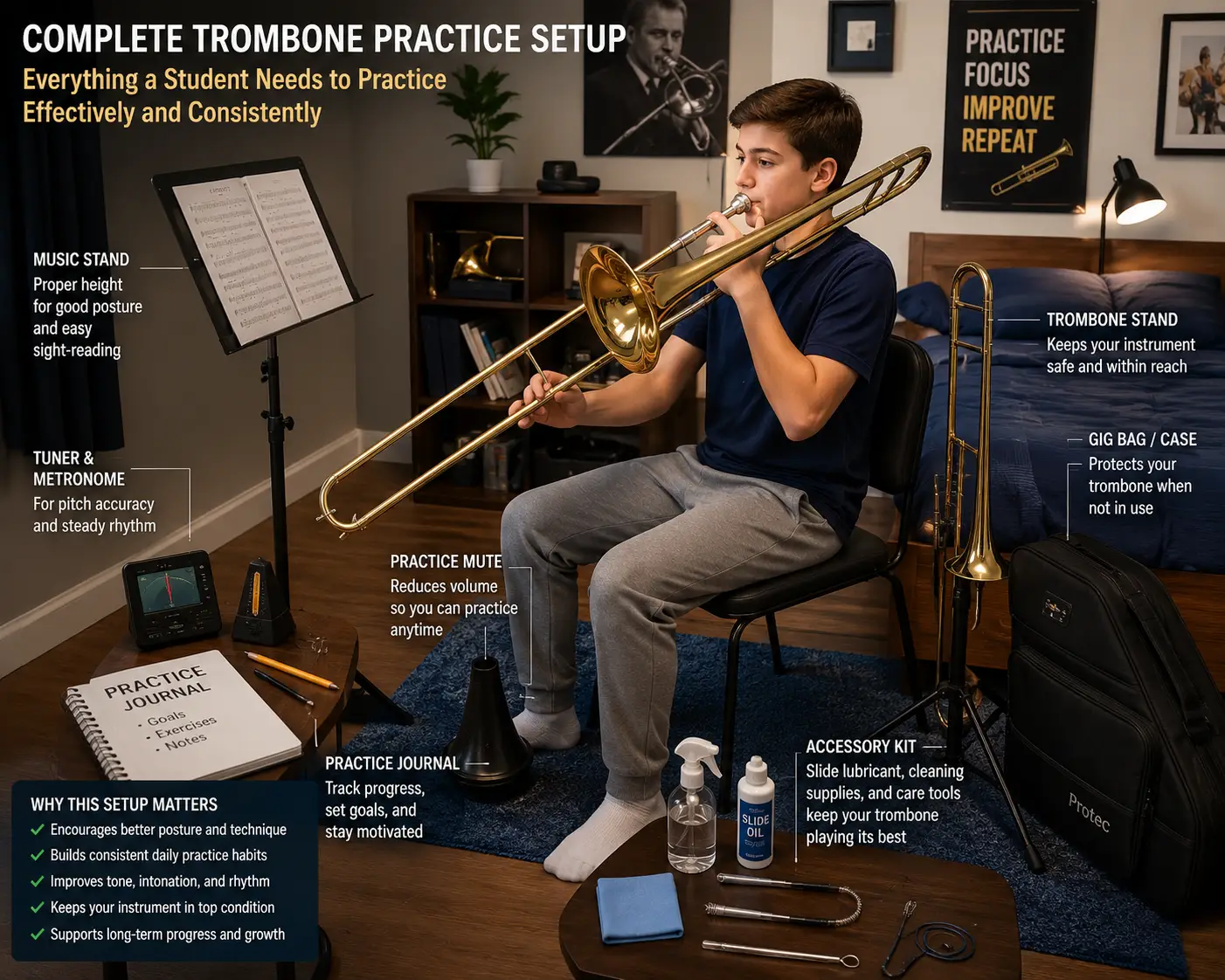
The lesson is only one part of learning to play the trombone. What students do between lessons is where new skills are developed and strengthened.
There is no single number of minutes that every student should practice. The appropriate amount depends on the student’s age, playing level, goals, schedule, and ability to practice effectively.
Consistency Is More Important Than Occasional Long Sessions
Regular practice is generally more productive than practicing for a long time only once or twice a week.
A student who practices consistently can reinforce new skills and address problems before they become habits. Even shorter practice sessions can be productive when they have a clear purpose.
Practice With a Purpose
Practice should not simply mean playing through music from beginning to end.
A teacher may assign specific exercises, difficult passages, scales, long tones, articulation studies, or other activities based on what the student needs to improve.
Students should understand what they are practicing and why.
For example, if a student is having difficulty with a particular passage, the solution may involve practicing a few measures slowly rather than repeatedly playing the entire piece.
Follow Your Teacher’s Assignments
One advantage of private instruction is that practice can be connected directly to the student’s current needs.
After a lesson, the student should know what to practice before the next lesson. Keeping track of assignments can help the student stay focused and make better use of practice time.
Quality Matters
More practice is not always better practice.
Students can reinforce inefficient habits if they repeatedly practice something incorrectly. Focused practice, careful listening, and attention to technique are more valuable than simply accumulating minutes.
As students develop, they should also learn to listen critically to their own playing and recognize when something needs to be changed.
Practice Time Changes as Students Progress
A beginning student may need relatively short practice sessions while learning how to coordinate breathing, embouchure, slide movement, and music reading.
More advanced students may need longer practice sessions because they are working on more demanding repertoire, auditions, performances, or technical development.
Practice should therefore be adjusted as the student’s needs change.
Practice Between Lessons Is Part of the Learning Process
A useful way to think about private instruction is:
Lesson → Practice → Progress → Next Lesson
The teacher introduces or refines skills during the lesson. The student then applies those skills through individual practice. At the next lesson, the teacher evaluates the results and adjusts instruction as necessary.
This cycle allows the student to make steady progress over time.
For a more detailed approach to developing an effective practice routine, see Practicing Trombone: A High School Student’s Guide and How to Practice Trombone: A Beginner Routine That Actually Works.
Ready to Start Your Trombone Journey?
Learning to play the trombone is a process. Whether you are picking up the instrument for the first time, working to improve your playing, preparing for an audition, or returning to the trombone after years away, the right instruction can help you make steady progress.
Online trombone lessons provide individualized instruction without requiring you to travel to a teacher’s studio. You can learn in your own environment while receiving guidance designed around your playing level, musical interests, and goals.
If you are ready to improve your trombone playing, learn more about Online Trombone Lessons – Learn Anywhere With a Private Trombone Teacher and see how private online instruction can work for you.
About the Author
Rick Lawrence is a music educator, conductor, professional trombonist, and private instructor with more than 40 years of playing and teaching experience. He has performed with orchestras, jazz ensembles, brass bands, and pit orchestras, and studied with John Coffey of the Boston Symphony Orchestra, Donald Knaub of the University of Texas, and Edward J. Madden, composer, arranger, trombonist.
Through The Trombone Mentor website, Rick provides online trombone lessons and educational resources for beginner, intermediate, and advanced trombonists.