How to Choose a Trombone Teacher
Finding the right trombone teacher can make a big difference in how you learn and develop as a musician. A good teacher does more than show you which notes to play. Your teacher should help you develop a good sound, understand the instrument, practice effectively, and become a more confident musician.
There are many trombone teachers available, and they may have very different backgrounds and teaching styles. Some specialize in beginners, while others work primarily with advanced students. Some teach in person, while others offer online trombone lessons.
The right teacher for you depends on your age, experience, goals, and learning style. In this guide, I’ll explain what to look for in a trombone teacher and some of the questions you should ask before choosing one.
Let’s get started!
Disclaimer
Some of the links below are affiliate links. The Trombone Mentor participates in the Amazon Services LLC Associates Program. What this means, is that at no cost to you, if you click on a link and follow through with a purchase, this site may earn a small commission.
What Does a Trombone Teacher Do?
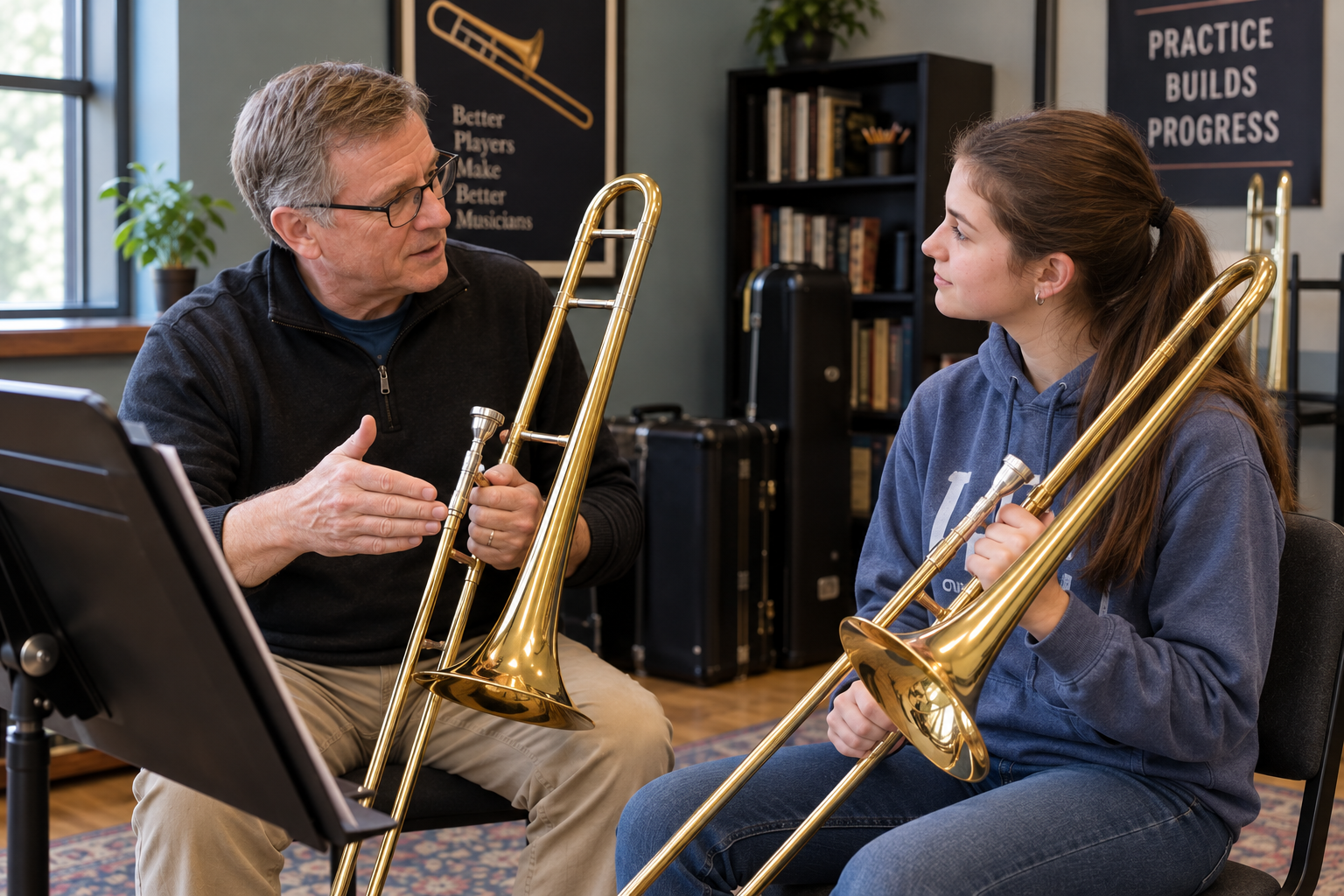
A trombone teacher helps you develop the skills you need to play the instrument correctly and musically. That includes much more than learning notes and slide positions.
When I teach a student, I want them to understand how the trombone works, why we practice certain exercises, and how those exercises help them become a better player.
Developing a Good Sound
One of the first things a trombone teacher should help you develop is a good sound.
This involves learning how to use:
- Proper breathing
- Steady air support
- A comfortable embouchure
- Good posture
- A relaxed approach to playing
A good trombone sound does not happen by accident. It develops through correct playing habits and consistent practice.
Teaching Trombone Technique
Your teacher should also help you develop the physical skills needed to play the trombone.
These can include:
- Learning slide positions
- Playing with accurate intonation
- Developing flexibility
- Improving articulation
- Developing range
- Playing scales and technical exercises
These skills provide the foundation for everything else you will eventually play.
Developing Musical Skills
Playing the right notes is only part of being a musician.
A trombone teacher should also help you develop:
- Rhythm
- Sight-reading
- Musical expression
- Listening skills
- Phrasing
- Dynamics
- Ensemble skills
The ultimate goal is not simply to play the trombone correctly. It is to make music with the instrument.
That’s why I believe trombone lessons should combine technical development with actual musical playing. Exercises are important, but students also need opportunities to apply those skills to music.
Why Should You Take Trombone Lessons From a Trombone Teacher?
You can certainly find books, videos, and other resources that can help you learn the trombone. However, learning on your own can make it difficult to know whether you are doing things correctly.
A teacher gives you something those resources cannot provide: personal feedback.
When I work with a student, I can listen to how they play and identify things they may not hear themselves. I can then demonstrate a different approach and give them specific things to work on.
For a broader look at what private instruction can provide, see my Trombone Lessons: A Complete Guide for Students and Parents.
Immediate Feedback
Small problems can become habits if they are not corrected.
A teacher can help you recognize problems with:
- Tone
- Breathing
- Embouchure
- Articulation
- Slide technique
- Rhythm
- Intonation
The sooner you recognize a problem, the easier it usually is to correct.
A Practice Plan Designed for You
Every student is different.
You may have plenty of time to practice, or you may have only a few minutes each day. You may be preparing for a school concert, an audition, or simply trying to become a better player.
A good teacher can help you develop a practice plan that fits your needs and goals.
Instead of wondering what you should practice, you leave your lesson with a clear idea of what to work on during the coming week.
For more help developing an effective routine, see How to Practice Trombone: A Beginner Routine That Actually Works.
Accountability and Consistency
One of the biggest challenges for any musician is practicing consistently.
Having a regular lesson gives you a reason to keep moving forward. You know that someone will be listening to your progress and helping you solve problems along the way.
Perfection between lessons is not the goal. You do need to keep working.
Building Confidence
Learning an instrument takes time. There will be days when something seems easy and other days when the same thing feels difficult.
A good trombone teacher can help you recognize your progress and keep problems in perspective.
Confidence doesn’t mean believing that you will never make mistakes. It means knowing that you can identify a problem, work on it, and improve.
What Should You Look for in a Trombone Teacher?
Choosing a teacher is an important decision. The teacher who is right for one student may not be the right teacher for another.
Here are several things to consider.
Playing Experience
A trombone teacher should have a solid understanding of the instrument.
Look for someone who has spent significant time actually playing trombone. Performance experience can help a teacher understand the physical and musical challenges that students encounter.
However, remember that being an excellent player and being an excellent teacher are not necessarily the same thing.
Teaching requires another set of skills.
Teaching Experience
A good teacher needs to know how to explain things.
Sometimes a student doesn’t understand a concept because the explanation doesn’t make sense to them. An experienced teacher should be able to explain the same idea in several different ways.
This is especially important with beginning students.
The teacher needs patience and the ability to break complicated skills into manageable steps.
Experience With Your Level
Think about where you are right now.
Are you:
- A complete beginner?
- A middle school student?
- A high school player?
- An advanced student?
- An adult beginner?
- Someone returning to the trombone after many years?
Look for a teacher who is comfortable working with students at your level.
Teaching Style
Pay attention to how a teacher communicates.
A good teacher should be willing to listen to you, answer questions, demonstrate concepts, and provide constructive feedback.
You should feel comfortable saying:
“I don’t understand.”
or
“Can you show me that again?”
Learning happens much more effectively when the student and teacher can communicate openly.
Understanding Your Goals
Finally, make sure the teacher understands why you want to play the trombone.
Your goals might include:
- Playing in your school band
- Improving your tone
- Learning jazz
- Preparing for an audition
- Making an All-State band
- Playing in a community ensemble
- Preparing for college
- Learning the instrument simply because you enjoy it
Your goals should influence what you work on during your lessons.
A good trombone teacher doesn’t simply give every student the same lesson. The instruction should be adapted to the student’s needs and musical goals.
Local or Online Trombone Lessons?
Once you know what you are looking for in a trombone teacher, you have another decision to make: Should you take lessons in person or online?
Both options can provide valuable instruction. The best choice depends on your circumstances, learning preferences, schedule, and access to teachers.
Local Trombone Lessons
In-person lessons allow you and your teacher to work together in the same room.
Some students enjoy the personal interaction of sitting across from their teacher. It can also be convenient if you have an experienced trombone teacher nearby.
Local lessons may be a good choice if you:
- Prefer face-to-face instruction
- Have a qualified teacher nearby
- Enjoy playing with other local musicians
- Have transportation to and from lessons
However, your choices may be limited by where you live. You may have only a few trombone teachers in your area, or none who specialize in the type of instruction you need.
Online Trombone Lessons
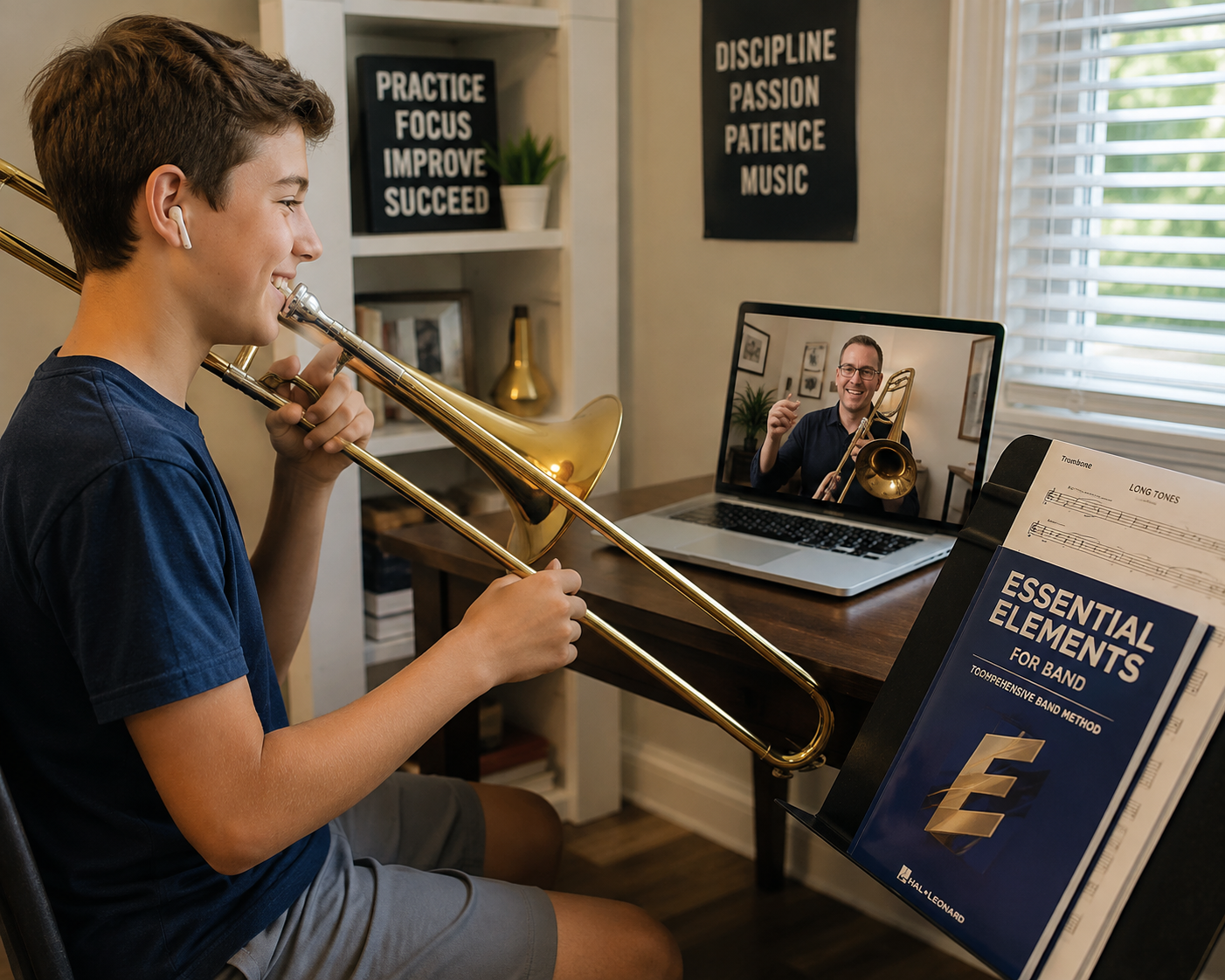
Online lessons give you another option. Instead of traveling to a teacher’s studio, you can take a live lesson from home using video communication.
This can be especially useful if there are few trombone teachers in your local area.
Online lessons can offer:
- One-on-one instruction
- Convenient scheduling
- No travel time
- Lessons from the comfort of your home
- Access to a teacher outside your immediate area
The most important thing is that online lessons should still be live and interactive. You should be able to play for your teacher, receive feedback, ask questions, and work through exercises together.
At The Trombone Mentor, I offer live, one-on-one online trombone lessons designed around the student’s experience, goals, and needs.
You can learn more about how online trombone lessons work, including what equipment you need and what happens during a lesson.
Whether you are a beginner picking up the trombone for the first time, a high school student preparing for an important performance or audition, or an adult returning to the instrument, the lesson should be built around helping you make progress.
If you’re interested in learning more about the complete approach, you can explore my Online Trombone Lessons: Complete Guide.
What Age Should a Student Be to Take Trombone Lessons?
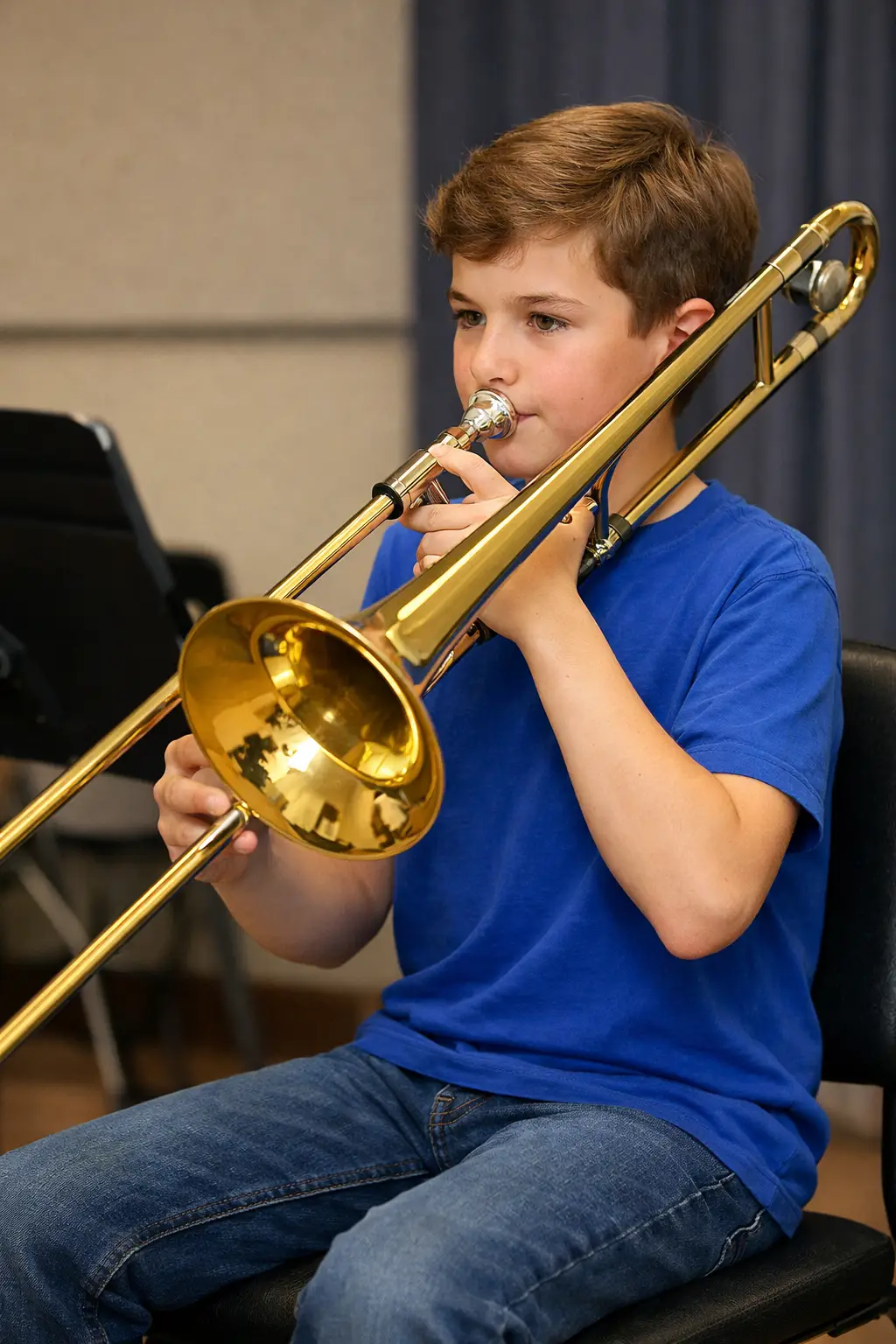
There is no single perfect age for learning the trombone. Students can begin at different ages, and the right time depends on the student’s physical development, interest, goals, and readiness to practice.
Young Beginners
For a young student, the most important thing is having enough physical development to handle the trombone comfortably.
A beginning student also needs to be able to follow basic instructions and stay focused during a lesson.
The teacher should keep early lessons positive and make learning the instrument enjoyable.
Parents may also find my How to Start Playing Trombone: A Beginner’s Guide helpful when preparing a young player to begin.
Middle School Students
Middle school is a common time for students to begin developing their trombone skills more seriously.
Students can begin working on:
- Tone production
- Scales
- Slide technique
- Articulation
- Sight-reading
- Music from their school band
A good trombone teacher can help establish strong playing and practice habits before poor habits become difficult to change.
High School Students
High school trombone players often have more specific goals.
They may be preparing for:
- Concert band
- Jazz ensemble
- Marching band
- Solo and ensemble performances
- Auditions
- All-State or other honor ensembles
- College music programs
At this stage, a teacher should be able to adapt lessons to the student’s musical goals.
Students preparing for auditions may also benefit from my Trombone Auditions: The Complete Guide for High School Students.
Adult Beginners and Returning Players
Adults can also learn the trombone or return to the instrument after many years away.
Adult students often bring different goals and experiences to their lessons. Some want to learn for personal enjoyment, while others want to return to an instrument they played when they were younger.
The important thing is to find a teacher who understands your goals and is willing to build the lessons around them.
If you are an adult beginner, you may also want to read Online Trombone Lessons for Adult Beginners.
The best time to begin trombone lessons is when you are ready to learn and willing to practice consistently.
What Makes a Good Trombone Student?
Finding the right trombone teacher is important, but the student has an important role to play, too.
A good trombone student doesn’t have to be the most talented student in the room. Instead, a good student is willing to learn, willing to practice, and willing to accept guidance.
Good students:
- Come to lessons prepared.
- Listen carefully and ask questions.
- Practice regularly between lessons.
- Work on the things their teacher assigns.
- Are willing to make mistakes and learn from them.
- Take responsibility for their own progress.
The best teacher-student relationship is a partnership. The teacher provides the knowledge, guidance, and encouragement; the student provides the effort, attention, and commitment.
How Often Should You Take Trombone Lessons?
For most students, weekly trombone lessons provide a good balance between instruction and practice.
A weekly lesson gives you enough time to work on your assignment, develop new skills, and return to your teacher with questions or problems.
Weekly Lessons
Weekly lessons work well for students who want steady progress.
During each lesson, your teacher can:
- Review what you practiced
- Correct problems
- Introduce new material
- Answer questions
- Adjust your practice plan
- Set goals for the following week
The key is what happens between lessons.
A lesson provides direction, but your practice is where the development takes place.
If you need help creating that practice routine, see How to Practice Trombone: A Beginner Routine That Actually Works.
More Frequent Lessons
Some students may benefit from lessons more frequently, especially when preparing for an important audition, performance, or competition.
Additional instruction can provide more opportunities for feedback during a period of concentrated preparation.
Less Frequent Lessons
Some students may prefer lessons every other week because of their schedule, budget, or other commitments.
This can work, but it places more responsibility on the student to practice independently and stay on track between lessons.
Whatever schedule you choose, consistency is important.
One well-prepared lesson every week is much more valuable than practicing only when you have a lesson coming up.
What Happens During a Lesson With a Trombone Teacher?
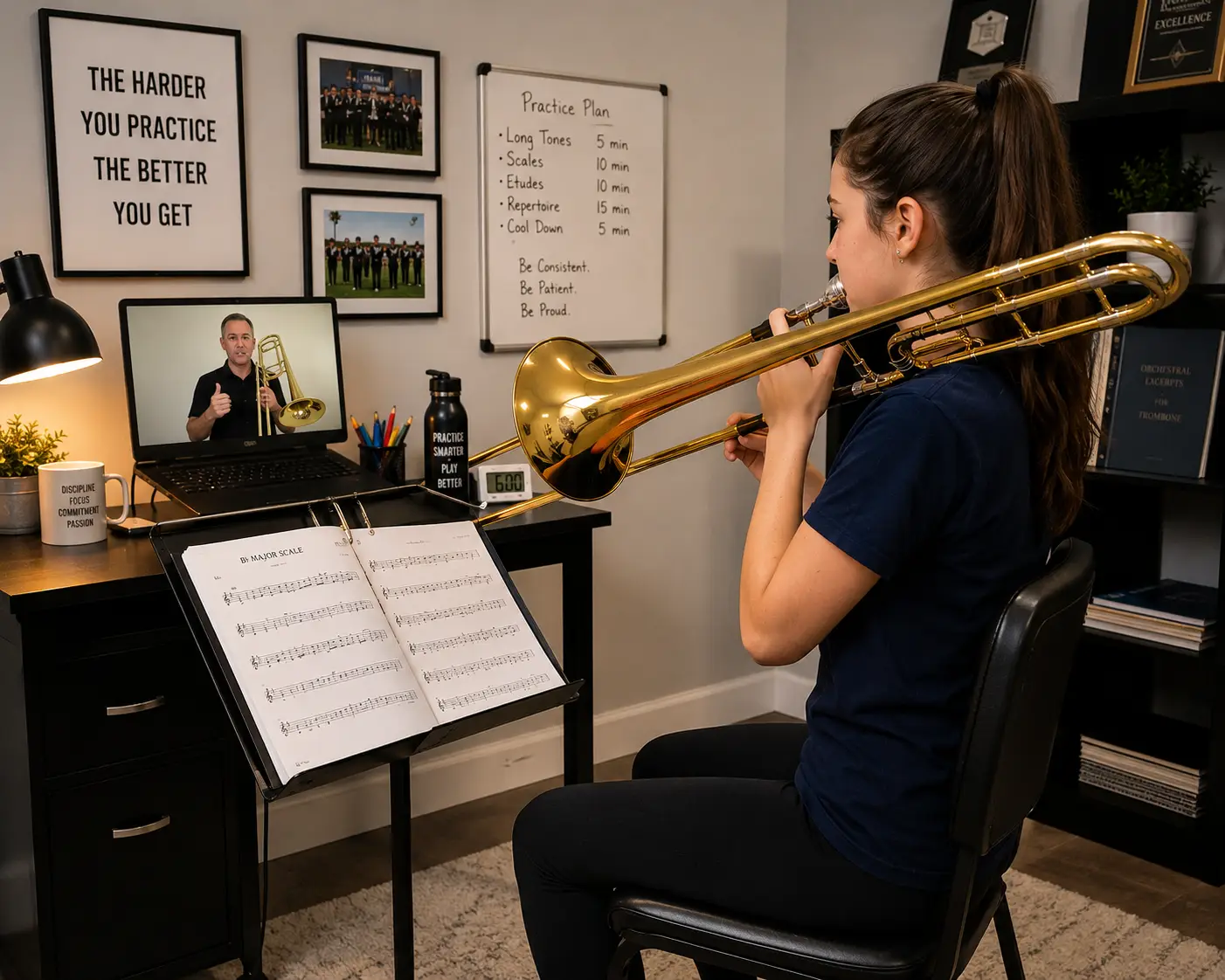
If you have never taken private lessons before, you may wonder what actually happens during a trombone lesson.
Every teacher has a different approach, but a good lesson should have a purpose. You should know what you are working on and why it matters.
A typical lesson might include several of the following activities.
1. Warm-Up
We may begin with simple exercises designed to get the air moving and the embouchure working.
Warm-ups can include:
- Breathing exercises
- Long tones
- Lip slurs
- Scales
- Articulation exercises
The purpose is not simply to “warm up.” These exercises also help develop the basic skills you need to play the trombone well.
For a more detailed look at this part of your playing, see Trombone Warm Ups: 10 Exercises Every Player Should Know.
2. Review of Previous Work
Your teacher should listen to what you practiced since the previous lesson.
This is an opportunity to identify progress and address anything that is still causing difficulty.
Don’t worry if you didn’t play everything perfectly. Your teacher needs to know what you found easy, what was difficult, and what questions came up while you were practicing.
3. Technical Development
You may spend part of the lesson working on specific playing skills.
Depending on your level, this could include:
- Tone
- Flexibility
- Articulation
- Scales
- Range
- Slide technique
- Intonation
These exercises are tools for developing your playing. The goal is to eventually use those skills when performing music.
4. Method Book and Exercises
Your teacher may use a method book or other instructional materials to provide a logical progression of skills.
I often use exercises to help students solve specific playing problems rather than simply assigning pages to complete.
The important question is not just “What page are we on?”
It is “What am I learning from this exercise?”
My favorite method book is the Arban Method for Trombone
5. Sight-Reading
Sight-reading helps you become more comfortable seeing and performing music you have not practiced before.
Even a short sight-reading exercise can help develop:
- Rhythm
- Note recognition
- Counting
- Musical awareness
- Confidence
6. Playing Music
A trombone lesson should include actual music.
Exercises are important, but the reason we develop those technical skills is to make music.
Depending on the student’s level and goals, this might include concert band music, solos, jazz, ensemble music, or other repertoire.
7. Practice Assignment
At the end of the lesson, you should know what to practice before your next lesson.
A good assignment should be specific.
Rather than simply saying “practice more,” your teacher should give you clear goals and explain what to listen for while you practice.
That way, you leave the lesson knowing exactly what you need to accomplish before the next one.
Two Essential Items Every Trombone Player Should Have
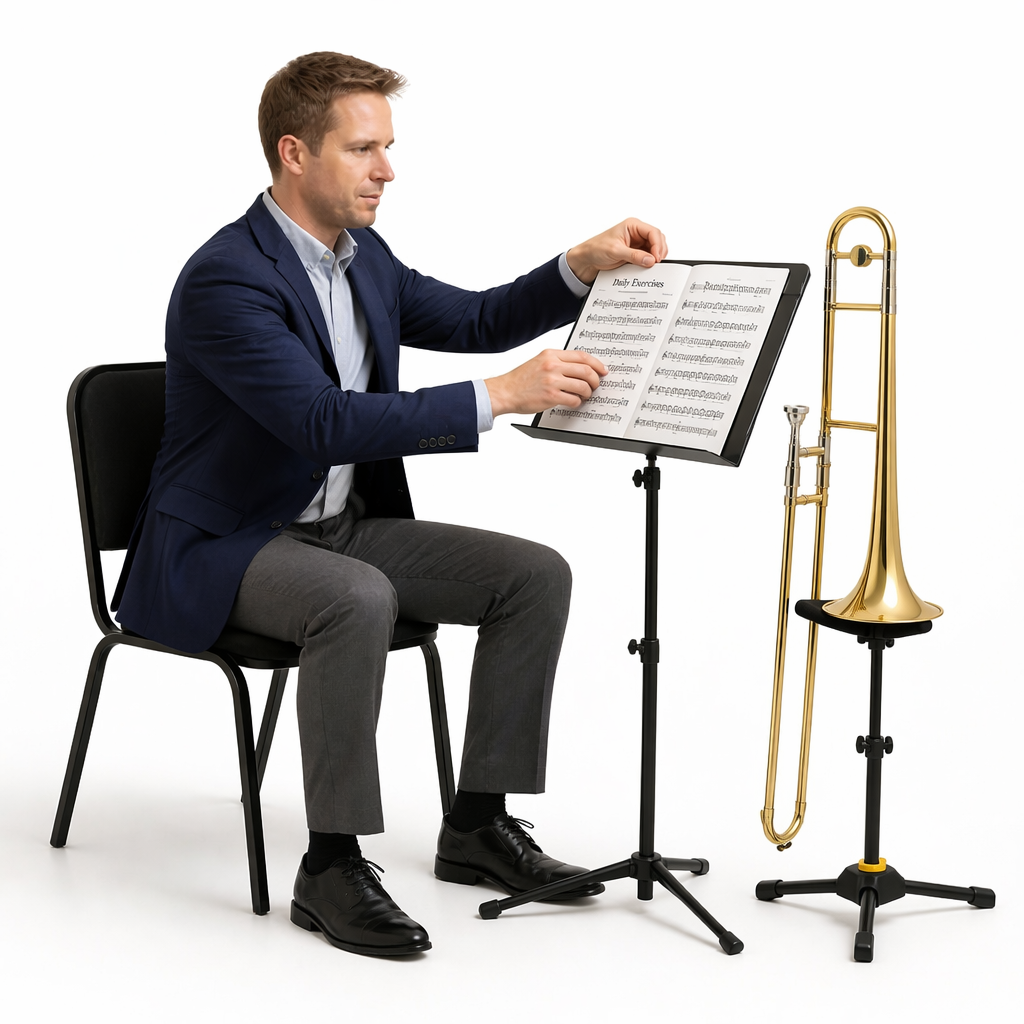
There are two simple pieces of equipment I recommend that every trombone student have: a trombone stand and a music stand.
A Trombone Stand
A trombone stand gives you a safe place to put your instrument when you are not playing.
Instead of laying the trombone on a chair, bed, or other surface, you can place it securely on its stand. This also makes it easy to pick up and play when you are practicing.
A stand is especially useful when you are practicing exercises that require you to stop frequently to look at your music, make an adjustment, or take a short break.
A Music Stand
A music stand is just as important.
Your music should be positioned so that you can see it comfortably while maintaining good playing posture. Holding music in your hand or placing it on a desk that is too low can encourage poor posture and make it more difficult to play comfortably.
A good music stand gives you a consistent place to put your method book, sheet music, or practice material.
These two items are simple, but they can make your practice area more organized and make it easier to develop good playing habits.
What Should I Ask a Trombone Teacher Before Taking Lessons?
Before choosing a trombone teacher, it is a good idea to ask a few questions. You want to know what to expect and whether the teacher’s approach fits your needs.
Here are some questions worth asking.
How Much Teaching Experience Do You Have?
Playing experience is valuable, but teaching experience matters too.
Ask how long the teacher has been teaching and what types of students they typically work with.
What Levels Do You Teach?
Make sure the teacher is comfortable teaching your level.
A teacher may work primarily with beginners, advanced players, or a combination of both.
Do You Teach Students My Age?
Teaching a beginning elementary or middle school student can require a different approach than teaching a high school student or adult.
Ask whether the teacher has experience working with students in your age group.
What Is Your Teaching Approach?
Every trombone instructor has a somewhat different approach.
Ask how the teacher structures lessons and how they decide what a student should work on.
You might also ask how the teacher handles areas that are difficult for a student.
What Materials Do You Use?
Find out whether the teacher uses method books, exercises, solos, band music, or other materials.
The materials should support the student’s level and goals.
Do You Offer Online Lessons?
If you are considering online instruction, ask how the lessons are conducted.
Find out what technology is required and whether the lessons are live and interactive.
You can also read How Online Trombone Lessons Work to learn more about the process before contacting a teacher.
How Long Is Each Lesson?
Lesson lengths can vary.
Ask whether lessons are 30, 45, 60 minutes, or another length.
You should also understand how frequently the teacher recommends meeting.
What Do You Expect From Students Between Lessons?
This is an important question.
A teacher should be able to explain how much practice is generally expected and what students should accomplish between lessons.
What Are the Costs?
Make sure you understand the lesson fee, payment schedule, cancellation policy, and any other costs before beginning.
Knowing these details ahead of time prevents confusion later.
For a more detailed discussion of pricing, see Trombone Lessons: A Complete Guide for Students and Parents.
Can I Talk With You Before Scheduling?
If possible, having a brief conversation with a potential teacher can be helpful.
You should feel comfortable communicating with the person who will be guiding your musical development.
The right trombone tutor or teacher should be someone who can explain things clearly, listen to your concerns, and help you work toward your individual goals.
How Much Do Trombone Lessons Cost?
The cost of trombone lessons can vary depending on several factors. These can include the teacher’s experience, lesson length, lesson frequency, and whether the lessons are online or in person.
When comparing teachers, don’t look only at the price. Consider what is included in the lesson and whether the teacher’s experience and teaching approach fit your goals.
If you want a more detailed look at the factors that affect lesson prices, see Trombone Lessons: A Complete Guide for Students and Parents.
Finding the Right Trombone Teacher for You
Choosing a trombone teacher is an important decision. The teacher you choose will have an influence on how you learn, practice, and develop as a musician.
Look for someone who has a strong understanding of the trombone and knows how to teach. Your teacher should be able to explain concepts clearly, listen carefully, identify problems, and give you specific things to work on.
Just as important, your teacher should understand your goals.
A beginner needs different instruction than an experienced high school player preparing for an audition. An adult returning to the trombone may have different goals than a student who is just beginning.
The right teacher should be willing to meet you where you are and help you move forward from there.
What Matters Most?
When choosing a teacher, consider these questions:
- Does the teacher have experience playing and teaching trombone?
- Are they comfortable teaching your level?
- Can they explain things in a way you understand?
- Do they listen to your questions and concerns?
- Do they understand your musical goals?
- Will they give you a clear practice plan?
- Do you feel comfortable learning from them?
You don’t need to find the “perfect” teacher. You need to find a teacher who can help you become a better trombone player.
Learn With The Trombone Mentor
At The Trombone Mentor, my goal is to help students develop their trombone skills while building confidence and enjoyment in playing.
I offer live, one-on-one online trombone lessons for students at different levels and stages of development. Lessons are designed around the student’s experience, goals, and individual needs.
If you’re looking for a trombone teacher and would like to learn more about my approach, visit the Online Trombone Teacher page.
If you’re ready to talk about lessons, you can also Book a Lesson.
Frequently Asked Questions
How do I find a trombone teacher near me?
Start by looking for teachers who have experience with your age and playing level. Ask about their teaching experience, lesson format, availability, and cost. You may also want to consider online trombone lessons if there are limited options in your area.
Can I learn trombone with an online teacher?
Yes. Live online lessons can provide individual instruction, demonstrations, feedback, and opportunities to ask questions. A reliable internet connection, a suitable device, and an appropriate space for playing are important for online lessons.
Are online trombone lessons a good option for adult beginners?
Absolutely. Adults can learn the trombone for the first time or return to the instrument after many years. A good teacher can adapt instruction to the adult student’s experience, goals, and available practice time. If you’re an adult beginner, see Online Trombone Lessons for Adult Beginners.
Ready to Take Your Trombone Playing to the Next Level?
Whether you are just starting trombone or looking to strengthen your tone, technique, and musical confidence, private lessons can help you progress faster with clear guidance and personal support.
With The Trombone Mentor, you receive:
• Step-by-step instruction
• Customized practice plans
• Expert feedback and encouragement
• Online lessons you can take from anywhere
Stop guessing and start making steady progress with lessons designed around your goals.
Schedule a free consultation lesson with Rick Lawrence
About the Author
Rick Lawrence is a music educator, conductor, professional trombonist, and private instructor with more than 40 years of playing and teaching experience. He has performed with orchestras, jazz ensembles, brass bands, and pit orchestras, and studied with John Coffey of the Boston Symphony Orchestra, Donald Knaub of the University of Texas, and Edward J. Madden, composer, arranger, trombonist.
Through The Trombone Mentor website, Rick provides online trombone lessons and educational resources for beginner, intermediate, and advanced trombonists.