Private Trombone Lessons: What Students and Parents Should Know
Private trombone lessons can give a student something that is difficult to get in a school band setting: individual attention from a teacher who can focus specifically on the student’s playing, needs, and goals.
If you or your child is learning the trombone, you may eventually ask an important question:
Are private lessons really necessary?
The answer depends on the student, the student’s goals, and the quality of instruction available.
School band provides an important foundation. Students learn how to read music, play in an ensemble, follow a conductor, and make music with other musicians.
Private instruction provides something different. The teacher can listen carefully to one student, identify problems, demonstrate solutions, and develop a practice plan specifically for that player.
For parents, private lessons can also provide guidance about how to support a young musician without becoming the music teacher at home.
In this article, I’ll explain what students and parents should know before beginning private trombone lessons.
Let’s get started!
Disclaimer
Some of the links below are affiliate links. The Trombone Mentor participates in the Amazon Services LLC Associates Program. What this means, is that at no cost to you, if you click on a link and follow through with a purchase, this site may earn a small commission.
What Are Private Trombone Lessons?
Private trombone lessons are individual lessons between a student and a trombone teacher.
Unlike a school band rehearsal or group class, the teacher works directly with one student.
A private lesson may include:
- Tone development
- Breathing and air support
- Embouchure
- Slide positions
- Articulation
- Scales
- Flexibility
- Range development
- Sight-reading
- Rhythm
- Music theory
- Musical expression
- Practice strategies
- School band music
- Solo or audition preparation
The exact content should depend on the student’s current ability and goals.
A beginner should not receive the same lesson as an advanced high school trombonist preparing for an important audition.
That is one of the greatest advantages of private instruction.
The lesson can be built around the student.
For a broader explanation of what students learn and how private instruction fits into a student’s musical education, see Trombone Lessons: Complete Guide for Students and Parents.
Why Take Private Trombone Lessons?
Students can learn a great deal from school band, method books, videos, and independent practice.
But there is one thing those resources cannot completely replace:
Personal feedback from an experienced teacher.
A student may not realize that their slide is consistently too far out of position.
They may not hear that their tone is becoming strained.
It maybe that he or she does not recognize that their articulation is uneven.
They may practice a difficult passage repeatedly without understanding why they keep making the same mistake.
A private teacher can listen, identify the problem, explain what is happening, and give the student a specific way to work on it.
That individual feedback can save a student from practicing the wrong thing over and over.
Private lessons can complement a student’s school music education. The National Association for Music Education provides additional information about music education and its role in students’ development.
Private Lessons and School Band Are Different
One of the most important things parents should understand is that private trombone lessons do not replace school band.
They serve different purposes.
School Band
School band gives students the opportunity to:
- Play with other musicians
- Follow a conductor
- Develop ensemble skills
- Learn balance and blend
- Perform concerts
- Read music in an ensemble
- Experience the social side of making music
These are skills that are difficult to develop through private instruction alone.
Private Trombone Lessons
Private lessons allow the teacher to concentrate on the individual player.
For example, suppose a middle school trombone section is struggling with a passage.
During a group rehearsal, the band director has to work with the entire section.
During a private lesson, I can work with the student on exactly what that student needs.
The problem might be slide accuracy.
Perhaps it is rhythm.
Maybe the student does not understand the articulation.
Perhaps the student is playing with too much tension.
The private lesson provides time to identify the individual problem and work toward a solution.
I view private lessons as a supplement to school music education, not a replacement for it.
The two experiences can work very well together.
What Does a Student Learn in Private Trombone Lessons?
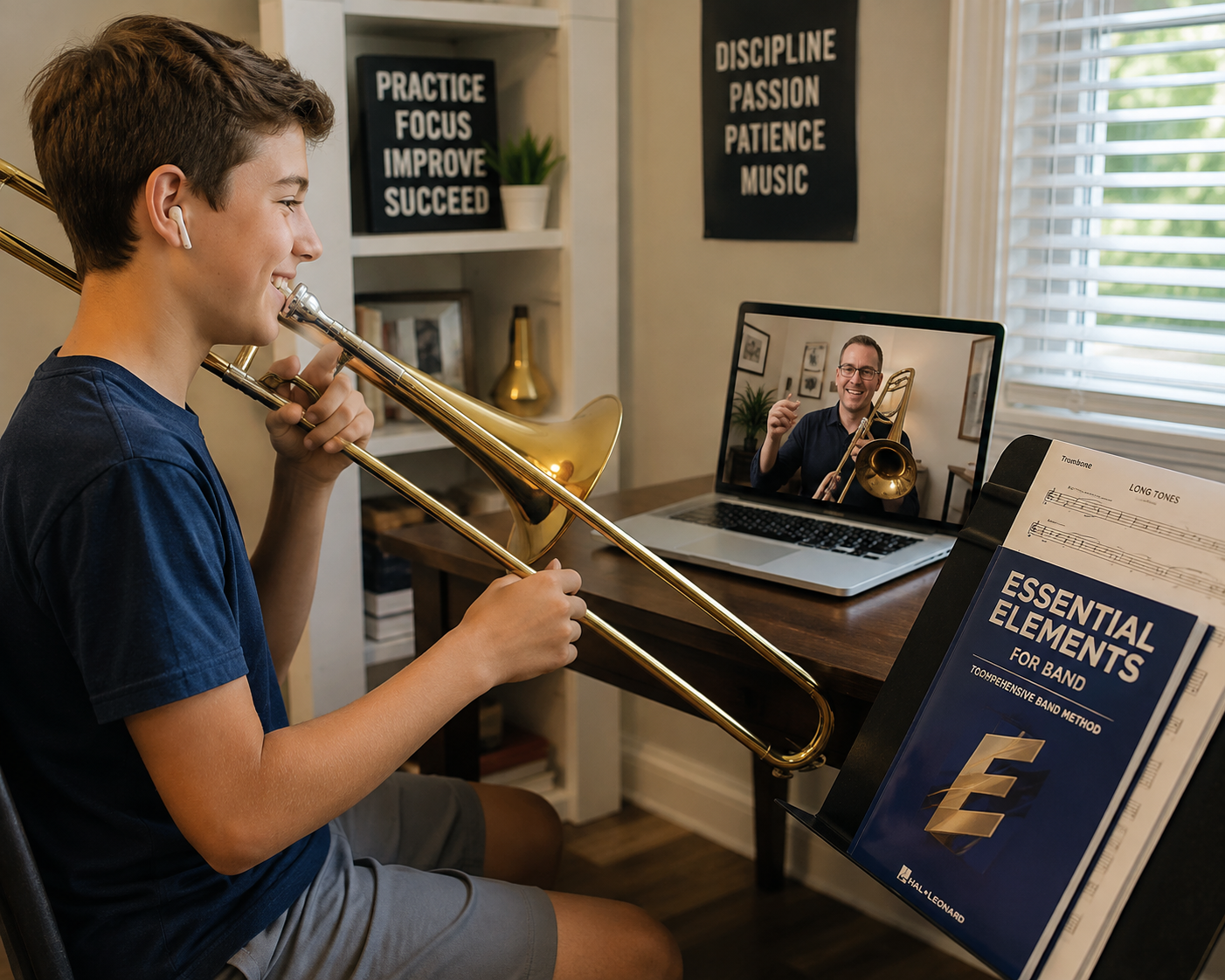
The answer changes as the student develops.
Beginning Students
A beginning trombone student needs to establish good habits from the beginning.
Early lessons may include:
- How to hold the trombone
- Proper posture
- Breathing
- Producing the first sound
- Embouchure
- Slide positions
- First notes
- Rhythm
- Basic articulation
- Reading music
- Simple exercises
- Practice habits
The goal is not to rush the student into difficult music.
The goal is to establish a strong foundation.
If your child is just starting the instrument, my How to Start Playing Trombone: A Beginner’s Guide can provide additional information.
Middle School Students
As students gain experience, lessons can become more focused on developing musicianship.
Students may work on:
- Major scales
- Tone
- Articulation
- Flexibility
- Range
- Slide accuracy
- Intonation
- Sight-reading
- School band music
- Solos
- Practice strategies
This is often an important period in a student’s development.
Good habits become increasingly important because students are beginning to play more difficult music.
High School Students
High school trombone players may have more specific goals.
They may be preparing for:
- School performances
- Jazz ensemble
- Concert or symphonic band
- Marching band
- Solo and Ensemble
- District or regional auditions
- All-State auditions
- Honor ensembles
- College auditions
Private lessons can be adjusted to address those goals while continuing to develop fundamental playing skills.
For high school students, see Online Trombone Lessons for High School Students and All-State Auditions: A High School Student’s Guide.
What Happens During a Private Trombone Lesson?
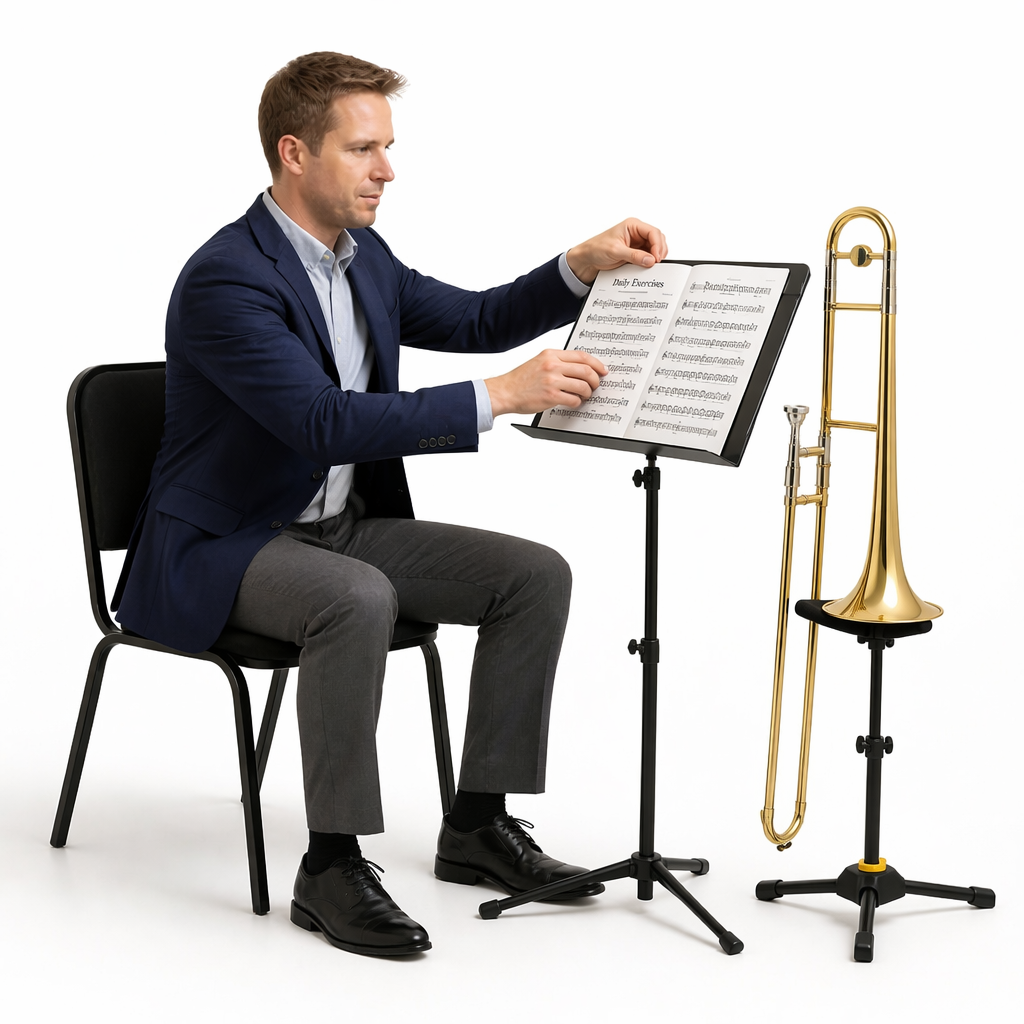
Every teacher has a somewhat different approach, but a productive lesson should have a purpose.
A typical lesson might include several of the following activities.
1. Warm-Up
The student may begin with simple exercises to prepare the embouchure, air, and instrument.
These might include:
- Long tones
- Lip slurs
- Scales
- Articulation
- Breathing exercises
Warm-ups are not simply something to get through before the “real” playing begins.
They can be an important part of developing good fundamentals.
See Trombone Warm Ups: 10 Exercises Every Player Should Know for more information.
2. Review of Previous Work
The teacher should listen to what the student has been practicing.
This gives the teacher an opportunity to determine:
- What improved
- What remains difficult
- What needs additional explanation
- Whether the student practiced correctly
- Whether the practice assignment needs to change
Students should not be afraid to tell their teacher when something was difficult.
That information is valuable.
3. Technical Development
The teacher may work on a particular technical problem.
This could involve tone, articulation, flexibility, range, slide technique, intonation, or rhythm.
The important point is that exercises should have a purpose.
Students should understand why they are doing an exercise and how it connects to their playing.
4. Music
Private lessons should not consist entirely of exercises.
Students need opportunities to make music.
Depending on their level, they may work on:
- School band music
- Solos
- Jazz music
- Ensemble parts
- Method books
- Audition material
Technical exercises provide tools.
Music gives students a reason to develop those tools.
5. Practice Assignment
A student should leave the lesson knowing what to work on.
“Practice more” is not a very useful assignment.
A better assignment might be:
Practice measures 25–32 slowly with a metronome. Concentrate on accurate slide positions and clean articulation.
Now the student knows what to do.
For additional help, see How to Practice Trombone: A Beginner Routine That Actually Works or, for high school players, Practicing Trombone: A High School Student’s Guide.
How Often Should a Student Take Private Trombone Lessons?
How Often Should a Student Take Private Trombone Lessons?
For many students, weekly lessons provide a good balance.
A weekly lesson gives the student time to:
- Learn something new.
- Practice it during the week.
- Identify problems.
- Return for feedback.
- Continue developing the skill.
Consistency is important.
A student does not have to practice for hours every day to make progress.
What matters is purposeful practice.
Some students may need additional lessons during periods of intensive preparation, such as an important audition or performance.
Other students may take lessons every other week because of scheduling or financial considerations.
The right schedule depends on the student’s needs and circumstances.
How Much Should a Student Practice?
How Much Should a Student Practice?
This is one of the questions parents ask most often.
While there is no single number of minutes that applies to every trombone student, please remember that student practice is the key to the success of private lessons.
A beginning student may need a relatively short practice session.
A more advanced student may need considerably more time.
The important thing is that practice should have a purpose.
A student who spends 30 focused minutes working on specific goals may accomplish more than a student who spends an hour playing without a plan.
I encourage students to ask:
What am I trying to improve today?
That question can change the way they practice.
What is the Parent’s Role in Private Trombone Lessons?
Parents play an important role, especially when the student is young.
But parents do not need to become the trombone teacher.
In fact, that can sometimes create unnecessary frustration for both parent and student.
Instead, parents can provide support by helping create the conditions for successful practice.
Parents Can Help By:
- Providing a suitable place to practice
- Helping establish a regular practice time
- Making sure the student has the necessary equipment
- Helping the student remember lesson times
- Encouraging consistent practice
- Asking the student what they are working on
- Recognizing progress
- Communicating with the teacher when necessary
Parents Do Not Need to:
- Correct every mistake
- Tell the student how to hold the slide
- Decide whether a note sounds correct
- Compare their child with another student
- Turn every practice session into an argument
Let the teacher teach.
Your job as a parent is to support the student and help create an environment where learning can take place.
What Should Parents Look for in a Trombone Teacher?
Choosing a teacher is an important decision.
Not every trombone teacher will be the right fit for every student.
Consider the teacher’s:
- Trombone playing experience
- Teaching experience
- Experience with the student’s age
- Experience with the student’s playing level
- Communication skills
- Teaching philosophy
- Understanding of the student’s goals
Most importantly, the teacher should be able to communicate with the student.
A teacher may be an excellent trombone player but still not be the right teacher for a particular child.
Teaching requires more than playing ability.
A teacher needs to be able to listen, explain, demonstrate, correct, encourage, and adapt.
For a more detailed discussion, see How to Choose a Trombone Teacher.
What Questions Should Parents Ask Before Hiring a Teacher?
Before beginning lessons, it is reasonable to ask questions.
For example:
How much teaching experience do you have?
Playing experience is valuable, but teaching experience is important too.
What ages and levels do you teach?
A teacher who primarily works with advanced college students may have a different approach from someone who specializes in beginning middle school students.
Do you teach online or in person?
The answer may affect scheduling, travel, and equipment requirements.
How often do you recommend lessons?
Weekly lessons are common, but the appropriate schedule depends on the student.
What materials do you use?
Ask about method books, exercises, repertoire, and other materials.
How do you communicate practice assignments?
A student should leave a lesson knowing what to work on.
How do you involve parents?
This is particularly important for younger students.
You want to understand how the teacher expects parents to support the student’s progress.
Private Trombone Lessons: Online or In Person?
Private instruction can take place in person or online.
Both formats have advantages.
In-Person Private Lessons
In-person lessons allow the teacher and student to work together in the same physical space.
Some students prefer this environment.
There are also no concerns about internet connections or video/audio technology.
The major limitation may be finding an experienced trombone teacher nearby.
Online Private Trombone Lessons
Online lessons provide another option.
The student can receive individual instruction from home without traveling to a teacher’s studio.
This can be particularly useful when a student does not have access to an experienced trombone teacher locally.
Online lessons can include:
- Live instruction
- Individual feedback
- Demonstration
- Questions and answers
- Practice assignments
- Goal setting
- Audition preparation
The technology is simply the method of connecting teacher and student.
The quality of the lesson still depends on the teacher, the student, communication, preparation, and practice.
For a complete explanation, see Online Trombone Lessons: Complete Guide.
You can also read How Online Trombone Lessons Work and Online Trombone Lesson Setup Guide.
What Equipment Does a Student Need?
A beginning student does not need a room full of equipment.
The essentials are relatively simple.
A Trombone
The student needs an instrument that is appropriate for their level and in good working condition.
Parents should be cautious about choosing an instrument based solely on price.
A poorly made or poorly maintained trombone can create unnecessary problems for a beginning player.
A Suitable Mouthpiece
The mouthpiece should be appropriate for the student’s instrument and level.
Choosing a mouthpiece can become more complicated as the student develops.
For more information, see Trombone Mouthpieces Explained.
A Music Stand
A music stand provides a consistent place for the student’s music.
It also helps the student maintain better playing posture than placing music on a low desk or holding it in their hands.
A Trombone Stand
A trombone stand provides a safe place to put the instrument when the student is not playing.
These two simple pieces of equipment can make a practice area more organized and functional.
What Method Book Should a Trombone Student Use?
There are many trombone method books available.
One of the most important resources in my teaching is the Arban Method for Trombone.
I use the Arban method because it provides a comprehensive collection of exercises that can be adapted to the needs of individual students.
However, a method book is a tool.
Simply owning the book does not make a student a better trombone player.
The teacher needs to select appropriate exercises and explain how the student should use them.
For a deeper look at this important resource, see Arban Method for Trombone: The Complete Student Guide.
How Much Do Private Trombone Lessons Cost?
The cost of private trombone lessons can vary considerably depending on the teacher, lesson length, location, and type of instruction.
As a general guideline, parents and students can expect private trombone lessons to range from approximately $30–$50 for a 30-minute lesson, with longer lessons costing more. A 60-minute private lesson may range from about $60–$150 or more, depending on the teacher and the level of instruction.
Several factors can affect the price, including:
- Teacher experience and professional background
- Lesson length
- Lesson frequency
- Geographic location
- Online versus in-person instruction
- Student’s playing level
- Teacher specialization
- Studio policies
A 30-minute lesson will generally cost less than a 60-minute lesson, but the price should always be considered in relation to what the student is receiving.
For example, an experienced teacher who provides individualized instruction, specific practice assignments, and detailed feedback may offer considerably more value than a less expensive lesson that provides little structure or direction.
Parents should also remember that the lowest price does not necessarily provide the best value, and the highest price does not automatically mean the best instruction.
The better question is:
What is the student receiving for the investment?
Are they receiving knowledgeable instruction, individual attention, useful feedback, and a clear plan for improvement?
Those are the things that can make private trombone lessons valuable.
For a more detailed discussion of lesson pricing and the factors that affect the cost of trombone lessons, see Trombone Lessons: Complete Guide for Students and Parents.
What Makes a Good private Trombone Lesson?
A good private lesson should accomplish more than getting through a page in a method book.
A productive lesson should help the student understand:
What am I doing?
Why am I doing it?
How should I practice it?
What should I listen for?
How will this help me become a better trombone player?
The teacher should listen carefully and provide useful feedback.,
The student should participate actively.
And the practice between lessons should reinforce what was learned.
That combination is important.
Teacher + Student + Practice = Progress
What Should Students Expect From Their Teacher?
Students should expect their teacher to:
- Listen carefully
- Explain concepts clearly
- Demonstrate when appropriate
- Correct problems
- Answer questions
- Provide appropriate exercises
- Choose music appropriate for the student’s level
- Give specific practice assignments
- Adjust instruction as the student develops
- Encourage continued growth
Students should also understand that the teacher cannot do the practicing for them.
A teacher can provide direction.
The student has to do the work.
What Should a Teacher Expect From the Student?
A teacher should expect the student to:
- Attend lessons consistently
- Bring the necessary materials
- Listen carefully
- Ask questions
- Practice between lessons
- Attempt assigned exercises
- Be honest about difficulties
- Accept constructive feedback
- Take increasing responsibility for their own progress
This last point is particularly important.
The ultimate goal of private instruction is not to make a student dependent on the teacher.
The goal is to help the student become an independent musician.
When Should a Student Start Private Trombone Lessons?
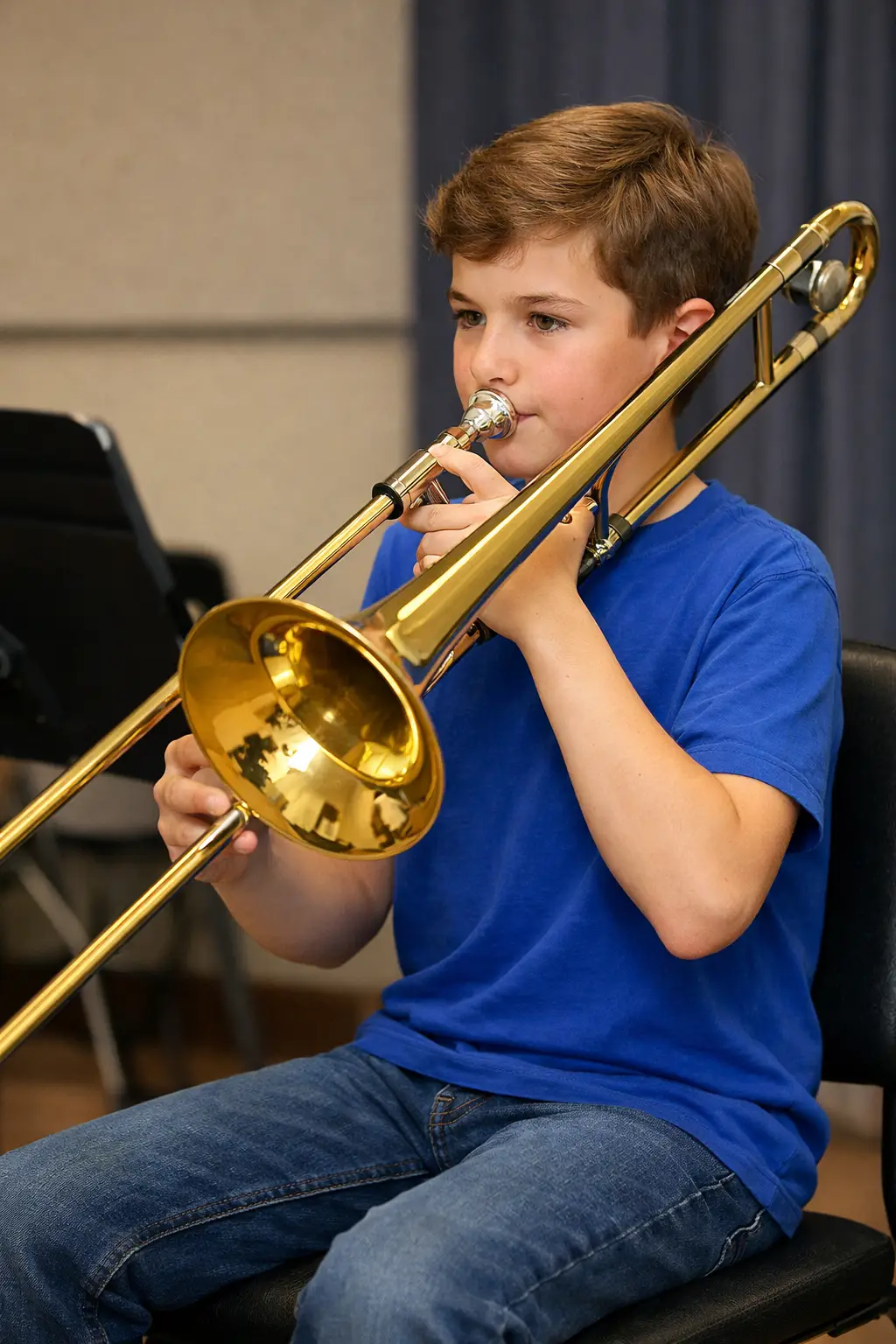
There is no single perfect age.
A student should be physically able to handle the instrument, understand basic instructions, and have enough interest to participate in learning.
For some students, private instruction begins at the same time they begin school band.
For others, it begins after they have played for a while.
Some students start lessons because they are having difficulty.
Others start because they want to advance more quickly.
Still others begin private lessons when they become interested in auditions, jazz, solo playing, or more advanced musical opportunities.
The important thing is that the instruction should match the student’s needs.
Signs That a Student May Benefit From Private Lessons
Private instruction may be particularly useful if a student:
- Is struggling with basic trombone skills
- Is having difficulty reading music
- Has problems with tone or articulation
- Is unsure how to practice
- Wants to improve more quickly
- Is preparing for an audition
- Wants to participate in honor ensembles
- Is interested in jazz
- Wants to prepare for college music
- Has lost confidence
- Needs more individualized attention
Private lessons can also benefit students who are already doing well.
A strong student may simply need more challenging material and more specific guidance.
The Student’s Attitude Matters
Parents sometimes assume that paying for lessons will automatically produce improvement.
It won’t.
Private lessons provide instruction and direction.
The student still has to participate.
A student who listens carefully, asks questions, practices consistently, and takes responsibility for improvement is likely to get more from lessons than a student who simply attends each week without engaging in the process.
This is one reason I believe that becoming a good trombone student is an important part of learning the instrument.
The student needs to gradually take ownership of the learning process.
Private Trombone Lessons Are an Investment
Private lessons are more than another activity on a student’s weekly schedule.
They are an investment in the student’s musical development.
A good teacher can help a student avoid bad habits, develop stronger fundamentals, practice more effectively, and gain a better understanding of the instrument.
But the greatest benefit may be helping the student learn how to learn.
Eventually, the student should be able to hear a problem and begin figuring out how to solve it.
That is an important step toward becoming an independent musician.
Final Thoughts for Parents and Students
Private trombone lessons can provide something that school band and independent study cannot always provide: individualized instruction focused on one student.
For beginners, private lessons can help establish good habits from the beginning.
For middle school and high school students, they can strengthen fundamentals and support large and small ensemble playing.
Adult students can benefit from taking private lessons as they are a great way of returning to the instrument.
The most important factor is finding the right teacher for the student’s needs.
Look for a teacher who understands the trombone, understands teaching, listens to the student, communicates clearly, and is willing to adapt instruction to the student’s goals.
And remember:
The teacher provides the direction.
The student provides the effort.
About the Author
Rick Lawrence is a music educator, conductor, professional trombonist, and private instructor with more than 40 years of playing and teaching experience. He has performed with orchestras, jazz ensembles, brass bands, and pit orchestras, and studied with John Coffey of the Boston Symphony Orchestra, Donald Knaub of the University of Texas, and Edward J. Madden, composer, arranger, trombonist.
Through The Trombone Mentor website, Rick provides online trombone lessons and educational resources for beginner, intermediate, and advanced trombonists.
Related Trombone Articles
Trombone Sight Reading: A High School Student’s Guide
F Attachment Trombone: Complete Guide (2026)
15 Free Apps Every Trombone Student Should Use to Practice Smarter