Trombone Warm Ups: 10 Exercises Every Player Should Know
Trombone warm ups do more than simply get your lips moving. A good warm up prepares your breathing, embouchure, air support, tone, flexibility, articulation, slide technique, and ears for the playing you are about to do.
Whether you are a beginning trombone player, a high school student preparing for an audition, an adult returning to the instrument, or an experienced musician preparing for a rehearsal or performance, a few minutes of thoughtful preparation can make a significant difference.
The important word is thoughtful.
A warm up should prepare you to play music. It should not leave you tired before your practice session even begins.
In this article, we’ll look at 10 useful trombone warm ups and explain what each one can help you develop.
Disclaimer
Some of the links below are affiliate links. The Trombone Mentor participates in the Amazon Services LLC Associates Program. What this means, is that at no cost to you, if you click on a link and follow through with a purchase, this site may earn a small commission.
What is a Trombone Warm Up?
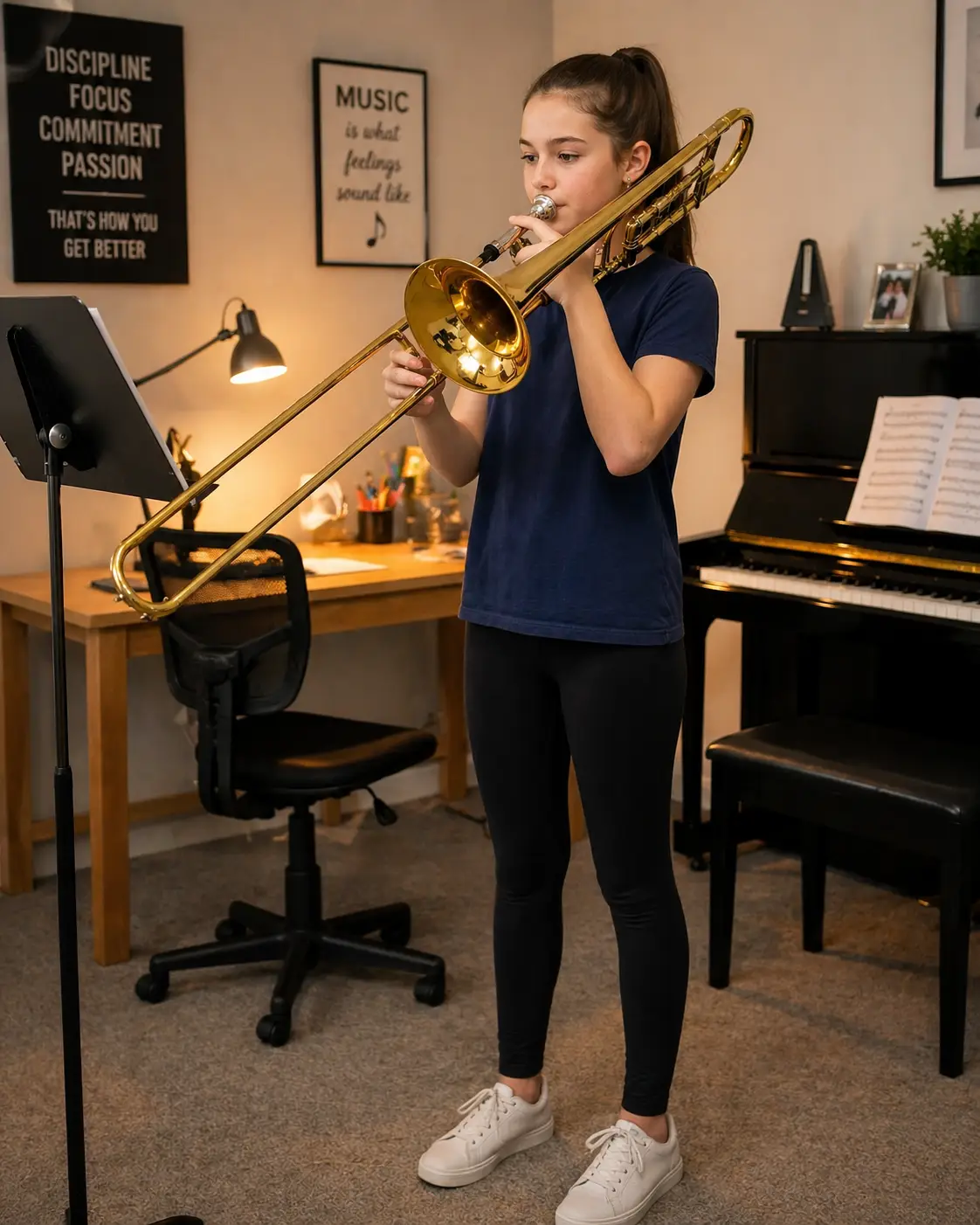
A trombone warm up is a series of controlled exercises that prepares you physically and musically for playing.
A good warm-up can help you prepare:
- Your breathing
- Your air support
- Your embouchure
- Your tone
- Your flexibility
- Your articulation
- Your slide coordination
- Your range
- Your intonation
- Your musical concentration
Not every player needs to perform every exercise every time.
Your warm-up should reflect your current playing level and what you are preparing to play.
For example, a beginner does not need the same warm-up as an advanced player preparing for a demanding performance.
Why Are Trombone Warm Ups Important?
A trombone warm up gives you an opportunity to establish good playing habits before you begin more demanding work.
A warm-up prepares your embouchure
Your embouchure needs time to become active and coordinated. Beginning gently allows you to establish your playing position without immediately placing unnecessary demands on your lips.
A warm-up develops your sound
The first sounds you produce each day can become an opportunity to listen carefully.
- Is your tone centered?
- Listen to the sound. Is it resonant?
- Is the air moving freely?
- Are you using unnecessary tension?
These are questions worth asking before you move into more difficult playing.
A warm-up gets your air moving
Good trombone playing begins with efficient use of air. Simple breathing and long-tone exercises can help you establish a steady, controlled airflow.
A warm-up develops your ears
This is an important part of warming up that is sometimes overlooked.
We hear with our ears, but we listen with our brain.
A good warm-up gives you time to listen for tone quality, pitch, resonance, response, and balance.
A warm-up prepares you for the day’s playing
Your warm-up should eventually lead toward whatever you are going to play.
If you are preparing for an orchestra rehearsal, your warm-up may emphasize a different set of skills than if you are preparing for a jazz ensemble rehearsal, solo performance, or audition.
The warm-up is preparation for the medium for performance that follows.
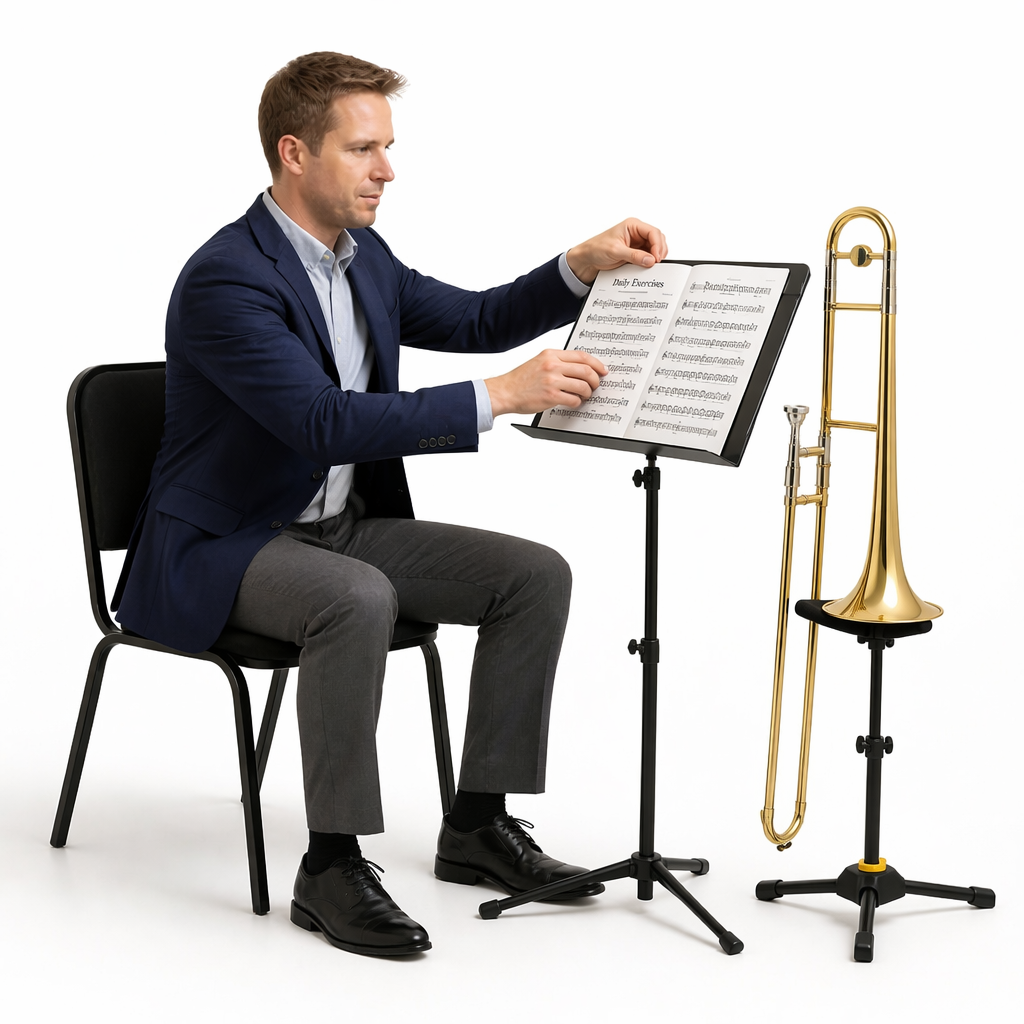
Take Your Playing to the Next Level
How Does Muscle Memory Fit Into a Trombone Warm Up?
When you repeat a movement correctly over and over, your brain and body become more familiar with that movement. This is often referred to as muscle memory.
For a trombone player, this can be important because playing involves coordinating many things at the same time:
- Breathing
- Embouchure
- Air support
- Tongue
- Slide movement
- Hearing the correct pitch
- Finger movement when using an F attachment
A good warm-up gives you an opportunity to reinforce these movements in a controlled way.
For example, when you practice a simple lip slur or a familiar slide-position pattern repeatedly, you aren’t just playing notes. You are practicing the coordination required to produce those notes.
Over time, these movements can become more natural and require less conscious thought.
But there is an important warning:
Muscle memory can reinforce bad habits as easily as good habits.
If you repeatedly practice with excessive tension, poor slide technique, an incorrect embouchure, or poor posture, you can become very good at repeating those mistakes.
That’s why quality matters more than quantity during a warm-up.
Play the exercise correctly, listen carefully, and repeat it enough times for the correct movement to become familiar.
I always remind my students of the following:
“Don’t let your muscles memorize something your ears know is wrong.”
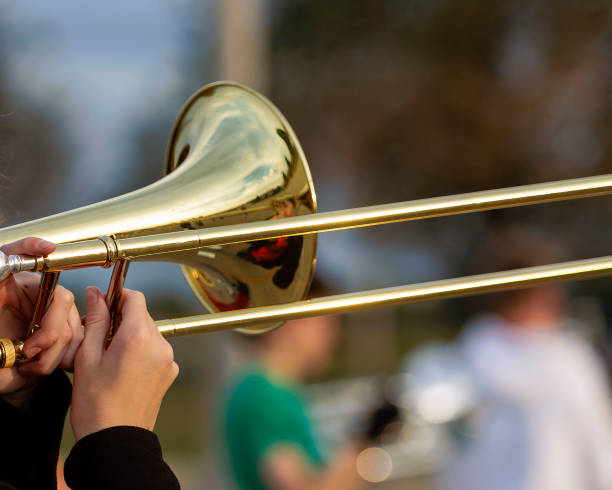
10 Trombone Warm Ups: Exercises Every Player Should Know
You don’t have to treat these 10 exercises as a checklist that must be completed every day.
Instead, think of them as a toolbox.
Select the exercises that address what you need on a particular day.
1. Breathing Exercises
Begin by paying attention to your breathing.
Take a relaxed breath and allow the air to move freely. Avoid lifting your shoulders or creating unnecessary tension in your upper body.
One simple exercise is to inhale comfortably and then release the air slowly and steadily.
The goal isn’t to see how long you can hold the air.
The goal is to become aware of:
- Relaxed inhalation
- Steady exhalation
- Air support
- Body position
- Unnecessary tension
Once your breathing is comfortable, you are ready to put that air into the instrument.
If you want to explore this subject in greater detail, see Trombone Breathing Exercises.
2. Mouthpiece Buzzing
Gentle mouthpiece buzzing is an exercise that will help “wake up” the lip muscles. I recommend this for trombone players at any level.
The purpose is not to see how loudly or how long you can buzz.
Instead, concentrate on producing a relaxed, centered buzz with a steady stream of air.
Start in a comfortable range and avoid forcing the sound.
Mouthpiece buzzing can help you become aware of the relationship between:
- Air
- Lips
- Embouchure
- Pitch
- Vibration
Remember that buzzing is a tool, not a test.
If buzzing leaves your lips tired before you even begin playing the trombone, you are probably doing too much.
3. Long Tones
Long tones are one of the most important trombone warm ups because they give you time to concentrate on the quality of each note.
Begin with notes in a comfortable middle register.
Play each note softly and steadily.
Listen carefully for:
- A centered tone
- Consistent air
- Stable pitch
- Resonance
- Smooth beginnings and endings
Don’t think of a long tone as simply holding a note for as long as possible.
Think of it as a listening exercise.
- Make the note sound the same from beginning to end
- Can you keep the pitch centered?
- Maintain a relaxed embouchure
These make long tones much more valuable.
4. Lip Slurs
Lip slurs are excellent exercises for developing flexibility and coordination.
They require you to move between notes without relying on the tongue to articulate each note.
Begin with simple, comfortable patterns.
Concentrate on:
- Smooth movement between partials
- Consistent airflow
- Relaxed facial muscles
- A steady sound
- Accurate pitch
Don’t rush.
A slow, smooth lip slur is generally more useful than a fast, sloppy one.
For more information, see Trombone Lip Slurs.
5. Glissandos
The trombone has a unique advantage when it comes to glissando exercises.
A slow glissando can help you become more aware of the relationship between the slide, air, embouchure, and pitch.
Start in a comfortable register.
Move the slide slowly and allow the pitch to change smoothly.
Listen to what happens as you move through the harmonic series.
Glissando exercises can help develop:
- Slide awareness
- Flexibility
- Air control
- Ear training
- Coordination
As with other warm ups, avoid forcing the extremes of your range.
The goal is controlled movement, not simply producing the longest possible glissando.
6. Easy Scale Patterns
Once you have established your basic sound and flexibility, simple scale patterns can help bring your tongue, air, and slide into better coordination.
You might use:
- Major scales
- Five-note patterns
- Arpeggios
- Simple chromatic patterns
- Scale fragments
Begin slowly.
For trombone players, the exercise is not simply about knowing which notes belong to a scale. You also need to coordinate the correct slide positions while maintaining good tone and intonation.
This is an excellent place to work on your Trombone Scales with Slide Positions.
7. Articulation Exercises
Your warm-up should eventually include some gentle articulation work.
Start with simple repeated notes.
For example, you might play a comfortable note using a series of evenly spaced quarter notes or eighth notes.
Listen for consistency.
Each note should have:
- A clear beginning
- Consistent tone
- Consistent volume
- Appropriate separation
- Good pitch
Don’t immediately turn articulation exercises into a speed test.
Good articulation at a slow tempo is more valuable than fast articulation that lacks control.
A metronome can help you keep your exercises consistent as you gradually increase the tempo. A digital tuner can also be useful when checking the accuracy of your pitch and slide positions.
8. Slide Coordination Exercises
The trombone slide must work in coordination with your air, tongue, embouchure, and ears.
Simple slide exercises can help you develop that coordination.
Practice slow patterns that move between familiar slide positions.
As you play, don’t rely entirely on the slide-position chart in your head.
Listen to the pitch.
The correct position is the place where the note is in tune—not merely the place where you have memorized that the slide should go.
This is especially important as you develop your ear.
Learn More: Trombone Slide Positions Chart
9. Range Exercises
Range exercises can be included in a warm-up, but they should come later rather than earlier.
Your embouchure and air should already be moving comfortably before you begin asking for higher or lower notes.
Start with a comfortable range and gradually expand it.
Never force a note simply because it is written on the page.
Good range development comes from consistent work over time.
Watch for signs that you are working too hard:
- Excessive lip pressure
- Tight facial muscles
- Forced air
- Poor tone
- Difficulty recovering between notes
Your goal is to expand your comfortable range—not simply to produce the highest or lowest note possible.
10. Easy Musical Patterns
One of my favorite ways to finish a warm-up is with something musical.
Play a simple melody, lyrical phrase, familiar scale pattern, or easy etude.
Why?
Because the purpose of your warm-up is ultimately to prepare you for music.
Technical exercises are important, but music requires more than correct notes.
It requires:
- Tone
- Pitch
- Phrasing
- Breathing
- Articulation
- Expression
- Listening
This final step can help you make the transition from warming up to your practice session or concert performance.
For more advanced students, a method such as Arban’s Method for Trombone provides a wide variety of exercises that can be incorporated into practice and warm-up work.
How Long Should a Trombone Warm Up Be?
There is no single correct amount of time for every trombone player.
Your warm-up should depend on your age, playing experience, physical condition, practice time, and what you plan to play.
As a general guideline:
Beginning player: 5–10 minutes
Intermediate player: 10–15 minutes
Advanced player: 15–20 minutes or more
These are guidelines—not requirements.
If you have only 30 minutes available to practice, spending 20 minutes warming up may not be the best use of your practice time.
Likewise, if you are preparing for a demanding performance, you may need a longer and more specific preparation period.
The key is to finish your warm-up feeling ready to play, not exhausted.
Should You Warm Up Before Every Trombone Practice Session?
In most situations, yes—but that doesn’t mean every warm-up needs to be long.
If you have only a short practice session, a few minutes of long tones, flexibility exercises, and simple playing may be enough.
If you are preparing for a rehearsal, audition, or performance, you may want a more extensive warm-up.
Your warm-up can also change depending on how you feel.
If your lips are tired or your playing feels unusually difficult, that may be a reason to shorten your warm-up rather than increase it.
Learn to pay attention to what your body and your instrument are telling you.
Trombone Warm Ups for Beginners
Beginning trombone players should keep their warm-ups simple.
You don’t need 20 different exercises.
A beginner might begin with:
- A few relaxed breaths
- Spend a few minutes on buzzing the mouthpiece
- Easy long tones
The emphasis should be on good sound and good habits rather than difficulty.
As your playing develops, your warm-up can develop with you.
A beginner who spends five focused minutes warming up can accomplish more than a student who spends fifteen minutes playing exercises without listening.
Trombone Warm Ups for Intermediate and Advanced Players
As your skills develop, your warm-up can become more specialized.
An intermediate or advanced player may include:
- Longer flexibility exercises
- More extensive scales
- Arpeggios
- Articulation patterns
- Range development
- Chromatic exercises
- Slide coordination
- More demanding musical passages
Your warm-up can also reflect what you will be playing.
For example, a player preparing for a jazz ensemble may emphasize articulation and flexibility, while a player preparing for an orchestral performance may spend more time developing tone, control, and lyrical playing.
A student preparing for a trombone audition may want to include passages that address the specific demands of the audition.
Common Mistakes With Trombone Warm Ups
Even a good warm-up can become counterproductive if it is approached incorrectly.
Warming up too hard
A warm-up is not supposed to be a workout.
If your lips are already tired before your practice session begins, your warm-up is probably too demanding.
Playing too loudly
You don’t have to play loudly to warm up.
In fact, starting at a comfortable dynamic can make it easier to concentrate on tone and control.
Starting with high notes
Beginning with your highest notes can place unnecessary demands on your embouchure.
Start comfortably and gradually expand your playing range.
Treating the warm-up like a test
Your warm-up isn’t a test of how high you can play, how fast you can tongue, or how loudly you can play.
It is preparation.
Not listening
Perhaps the biggest mistake is going through the exercises without actually listening to what you are producing.
Your warm-up is one of the best opportunities of the day to listen critically.
Ask yourself:
- How does my trombone sound today?
- How does each note respond?
- Is my pitch centered?
- Am I using unnecessary tension?
Don’t practice the exercise because your teacher told you to.
Understand what the exercise is designed to develop.
Once you understand the purpose, you can practice it more intelligently.
A Simple 10-minute Trombone Warm Up
If you need a quick warm-up before practicing, try something like this:
| Time | Activity |
|---|---|
| 1 minute | Relaxed breathing |
| 1 minute | Gentle mouthpiece buzzing |
| 3 minutes | Long tones |
| 2 minutes | Lip slurs |
| 1 minute | Scale patterns |
| 1 minute | Articulation |
| 1 minute | Easy musical passage |
This is only one example.
You can adjust the amount of time spent on each activity according to your needs.
For a more complete step-by-step routine, see The Best Warm-Up Routine for Trombone Players.
Final Thoughts
The purpose of a trombone warm up isn’t to see how many exercises you can complete.
It is to prepare your embouchure for your practice session or any performances.
A good warm-up helps bring together your breathing, embouchure, air, tone, flexibility, articulation, slide technique, and ears.
Most importantly, it should help you become a better listener.
Whether your next performance is with a band, orchestra, jazz ensemble, chamber group, as a soloist, or in an audition, your warm-up should prepare you for the musical demands ahead.
So the next time you pick up your trombone, don’t simply ask:
“What exercises should I play?”
Ask:
“What do I need to prepare today?”
That simple change in thinking can make your warm-up—and your practice—much more effective.
Ready to Take Your Trombone Playing to the Next Level?
Whether you are just starting trombone or looking to strengthen your tone, technique, and musical confidence, private lessons can help you progress faster with clear guidance and personal support.
With The Trombone Mentor, you receive:
• Step-by-step instruction
• Customized practice plans
• Expert feedback and encouragement
• Online lessons you can take from anywhere
Stop guessing and start making steady progress with lessons designed around your goals.
About the Author
Rick Lawrence is a music educator, conductor, professional trombonist, and private instructor with more than 40 years of playing and teaching experience. He has performed with orchestras, jazz ensembles, brass bands, and pit orchestras, and studied with John Coffey of the Boston Symphony Orchestra, Donald Knaub of the University of Texas, and Edward J. Madden, composer, arranger, trombonist.
Through The Trombone Mentor website, Rick provides online trombone lessons and educational resources for beginner, intermediate, and advanced trombonists.
Related Trombone Articles
Trombone Practice Mute: A Complete Guide for Quiet, Effective Practice
How to Practice Trombone: A Beginner Routine That Actually Works
Trombone Auditions: The Complete Guide for High School Students