How to Prepare for Your First Online Trombone Lesson
If you’re wondering how to prepare for your first online trombone lesson, you’ve come to the right place. Taking your first online trombone lesson is an exciting step toward becoming a better musician. Whether you’re a complete beginner, a middle or high school student, an adult returning to the instrument, or an advancing player looking for personalized instruction, a little preparation will help you get the most from your lesson.
Many new students wonder if online lessons are difficult or if they’ll need expensive equipment. Fortunately, the answer is no. With a reliable internet connection, a few basic supplies, and a quiet place to play, you’ll be ready to enjoy a productive lesson from the comfort of your home.In my article about Online Trombone Lessons: Beginner-to-Advanced Guide, I go into all aspects of taking private lessons online. Not just the first lesson.
In this guide, you’ll learn exactly how to prepare for your first online trombone lesson so you can feel confident, relaxed, and ready to learn.
Let’s get started!
Disclaimer
Some of the links below are affiliate links. The Trombone Mentor participates in the Amazon Services LLC Associates Program. What this means, is that at no cost to you, if you click on a link and follow through with a purchase, this site may earn a small commission.
Are You Ready to Take Online Trombone Lessons?
Consider taking them with The Trombone Mentor
ONLINE TROMBONE LESSONS – Learn Anywhere with a Private Trombone Teacher
Why Preparation Matters
Online lessons allow students to receive personalized instruction from experienced teachers regardless of where they live. While the format is different from an in-person lesson, the goals remain the same:
- Learn proper playing techniques
- Develop better tone quality
- Improve reading skills
- Build confidence
- Receive immediate feedback
- Create an effective practice routine
Preparing before your lesson helps eliminate distractions so you can focus on making music instead of troubleshooting technology.
What Happens During Your First Online Trombone Lesson?
Learning how to play a trombone is about you and your teacher. Every instructor teaches a little differently, but most first lessons are designed to help the teacher understand your current abilities and your musical goals.
During your first lesson, you can expect to:
- Meet your instructor
- Discuss your musical experience
- Talk about your goals
- Play a few exercises or pieces
- Review your posture and playing position
- Check your equipment setup
- Receive practice assignments
- Ask questions
If you’re a complete beginner, don’t worry—you won’t be expected to perform perfectly. Your instructor simply wants to understand where you’re starting so lessons can be tailored specifically to you.
One of the greatest advantages of private online lessons is that every lesson is customized to fit your individual needs.
For a closer look at the complete lesson process, see How Online Trombone Lessons Work.
Set Up a Comfortable Practice Space
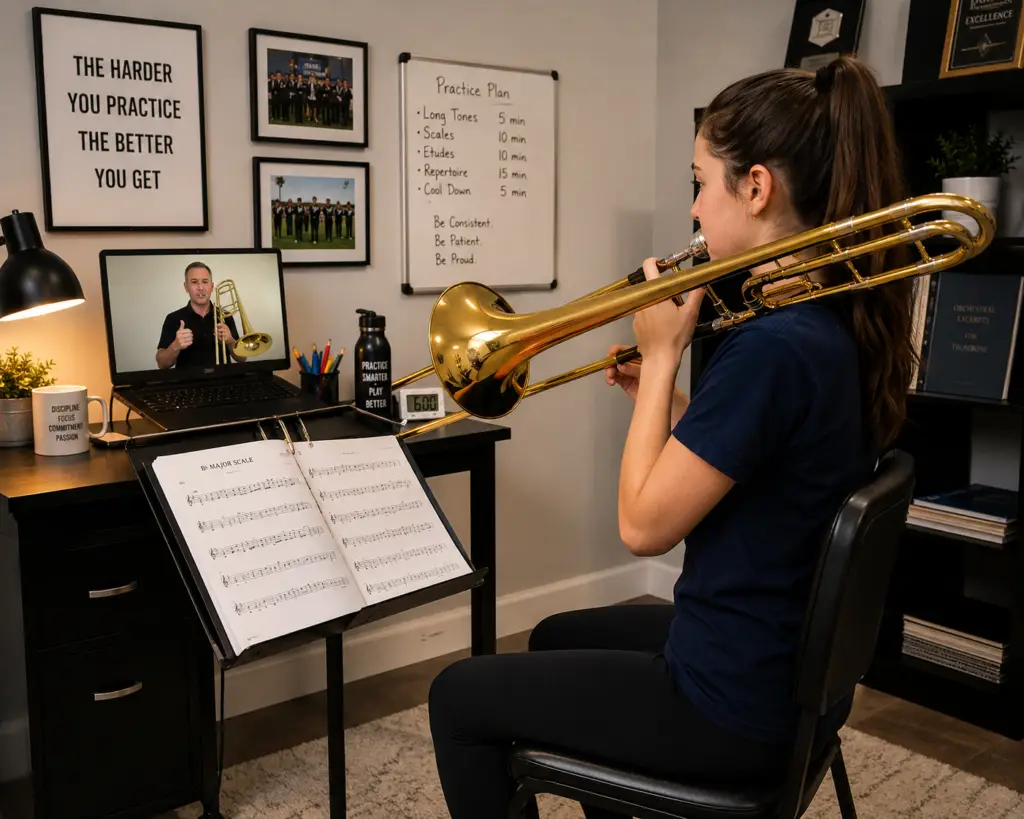
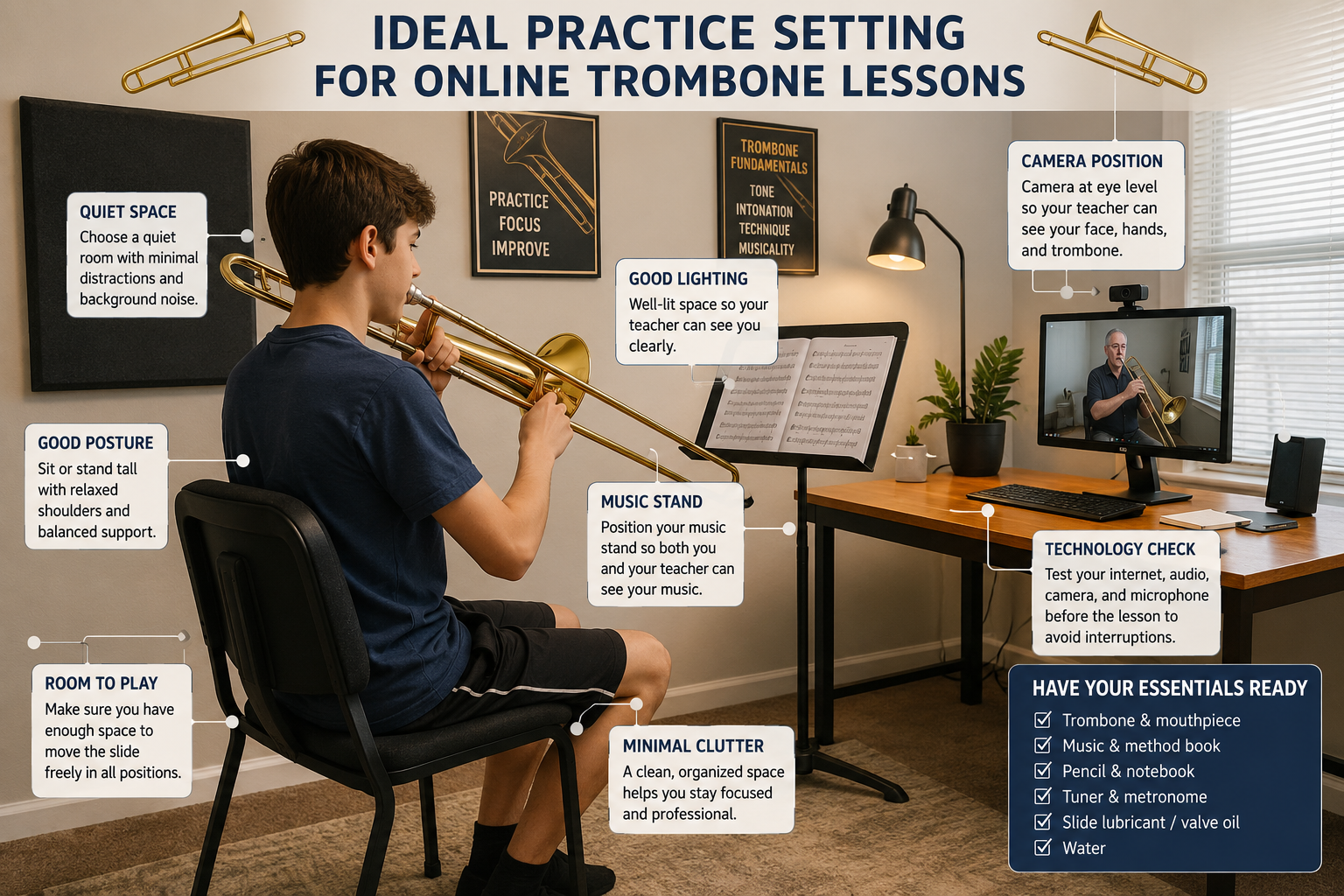
Your practice environment has a surprisingly large impact on your lesson.
Choose a room that is:
- Quiet
- Well lit
- Free from distractions
- Large enough to move the trombone slide comfortably
Avoid rooms where televisions, conversations, or pets may interrupt the lesson.
If possible, let family members know you’ll be in a lesson so they can help minimize background noise.
A dedicated practice space also helps establish a consistent routine that makes practicing easier throughout the week.
Position Your Camera Correctly
Unlike some online activities, your teacher needs to see how you play.
The camera should clearly show:
- Your face
- Your upper body
- Both hands
- Your trombone
- Your music stand
Avoid placing the camera too close or too low.
A side angle often works best because your instructor can easily observe:
- Embouchure
- Slide technique
- Hand position
- Posture
- Breathing
Good camera placement allows your teacher to give feedback almost as effectively as if you were sitting in the same room.
Test Your Internet Connection
A stable internet connection keeps lessons running smoothly.
Before your lesson:
- Test your internet speed.
- Move closer to your Wi-Fi router if necessary.
- Close unnecessary programs or browser tabs.
- Pause large downloads or video streaming on other devices.
- Restart your computer if it has been running for a long time.
If you have access to a wired Ethernet connection, it can provide even greater stability than Wi-Fi.
Don’t worry if technical issues occur occasionally. Most teachers are experienced with online lessons and can quickly help resolve common problems.
For detailed help with your camera, audio, lighting, internet connection, and practice space, see my Online Trombone Lesson Setup Guide: What You Need for Success.
Gather Everything You’ll Need
One of the easiest ways to reduce stress is to have everything ready before the lesson begins.
Here’s a helpful checklist.
Essential Equipment
- Trombone
- Mouthpiece
- Music Stand
- Trombone Method Book
- Pencil (No Pens)
- Notebook
- Microfiber Towel
Important Accessories
Don’t Forget the Water Key: Good Practice Habits Matter
Every trombonist quickly becomes familiar with the water key (sometimes called the “spit valve”). As you play, warm, moist air travels through the instrument, causing condensation to collect inside the tubing. Emptying this moisture regularly helps your trombone play its best and prevents unwanted gurgling sounds.
During your online lesson, it’s perfectly normal to stop occasionally and empty the water key. In fact, your teacher will probably do the same!
Where Should You Empty the Water?
Many beginning trombonists simply empty the water key onto the floor. While this may happen in a rehearsal room or on a stage, it’s not the best habit to develop at home—especially if you’re practicing on hardwood floors, carpet, or in a shared living space.
Instead, keep one of these nearby:
- A small hand towel
- A folded paper towel
- A microfiber cloth
- An old bath towel placed beside your chair
Simply hold the towel under the water key before releasing the moisture. It’s quick, tidy, and helps keep your practice area clean.
A Small Habit That Shows Professionalism
Using a towel may seem like a small detail, but developing good habits from the very beginning makes a difference. Professional musicians are mindful of their instruments, their surroundings, and the spaces where they perform and teach.
By taking a few extra seconds to empty your water key neatly, you’ll protect your floors, keep your practice space clean, and earn the appreciation of anyone who shares your home.
Your family—and especially Mom—will thank you!
Check Your Audio and Video
Spend a few minutes testing your computer before your lesson begins.
Verify that:
- Your webcam works.
- Your microphone is selected correctly.
- Your speakers or headphones are functioning.
- Your lesson software opens properly.
- You know how to adjust your camera.
Most modern laptops work perfectly well for online trombone lessons.
If possible, log in about five minutes early. This gives you time to solve any small technical issues before the lesson officially starts.
Warm Up Before Your Lesson
Just like athletes stretch before competition, trombonists benefit from warming up before playing. Learn about this technique by reading: The Best Warm-Up Routine for Trombone Players
You don’t need a long warm-up.
Five to ten minutes is usually enough.
A simple warm-up might include:
- Breathing exercises
- Buzzing the mouthpiece
- Long tones
- Easy lip slurs
- Simple scales
Arriving warmed up allows you to make better use of lesson time.
Listen Carefully to Your Teacher
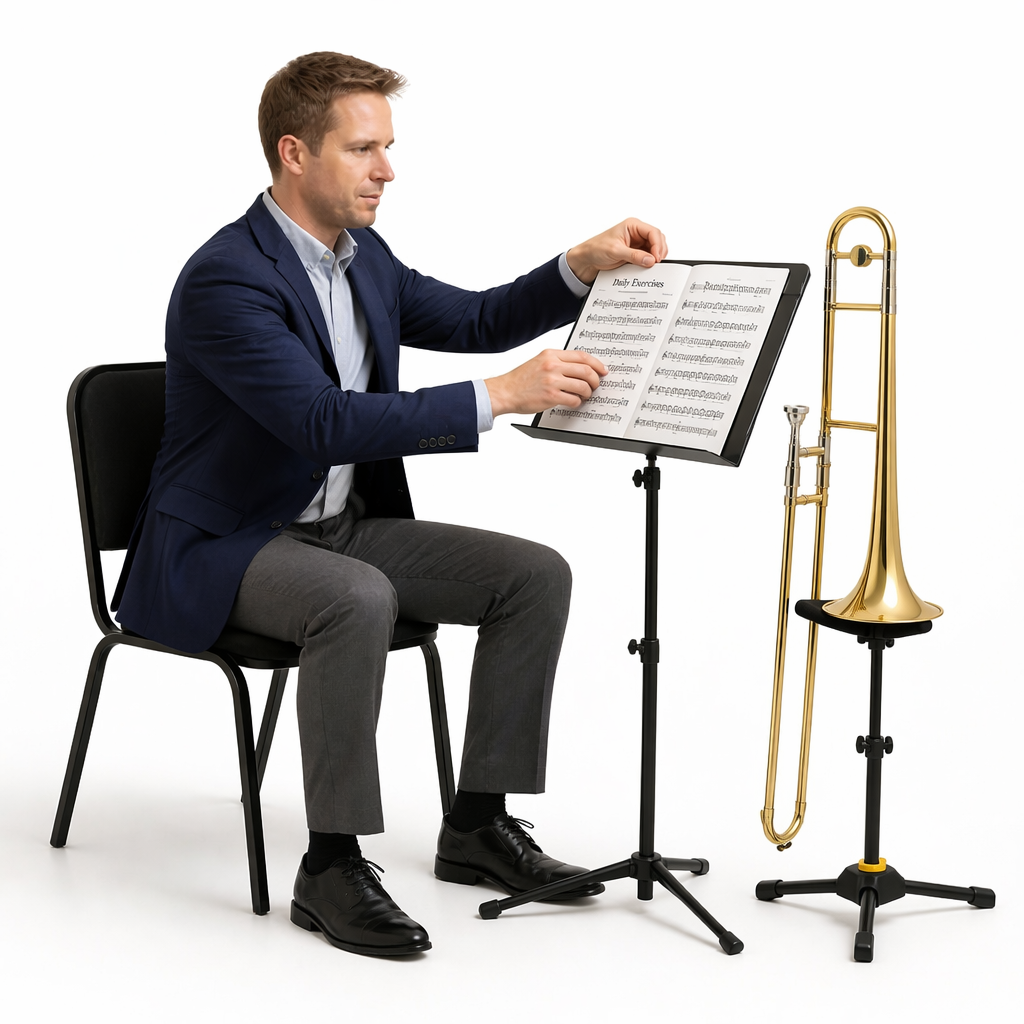
One of the greatest advantages of private online trombone lessons is receiving personalized instruction that’s tailored specifically to you. To get the most from each lesson, make a habit of listening carefully while your teacher is explaining a concept or demonstrating a technique.
It can be tempting to start playing right away or think about the next exercise before your instructor has finished speaking. Instead, take a moment to listen completely before picking up your trombone. Often, the explanation your teacher provides will answer questions you didn’t even realize you had.
When your instructor is demonstrating something, pay close attention to details such as:
- Breathing technique
- Embouchure formation
- Hand and slide position
- Articulation
- Tone quality
- Rhythm and timing
- Musical phrasing
Many online lesson platforms allow your teacher to demonstrate techniques from multiple camera angles, giving you a close-up view that can actually be better than what you’d see in a group classroom.
Take Notes During Your Lesson
Keep a notebook or lesson journal nearby and write down important reminders as your teacher explains them.
Some things to record include:
- New exercises
- Practice assignments
- Slide positions that need extra attention
- Breathing reminders
- Musical goals for the week
- Questions to ask next lesson
Writing notes helps reinforce what you’ve learned and gives you something to refer to during your practice sessions.
Ask Questions If You’re Unsure
Listening carefully doesn’t mean staying silent if you don’t understand something.
If your teacher explains a new concept and it isn’t completely clear, ask for clarification. A good instructor wants you to understand why you’re making a change—not just what to change.
Questions like these can be very helpful:
- “Could you demonstrate that one more time?”
- “Can you explain why that works?”
- “What should I listen for while I’m practicing?”
- “Am I holding the trombone correctly?”
- “How can I tell if I’m doing this correctly at home?”
Remember, asking thoughtful questions shows that you’re engaged and eager to learn.
Turn Instructions Into Better Practice
The real improvement happens between lessons. After your lesson, review your notes and focus on applying the specific feedback your teacher gave you. Rather than simply playing through your music, practice with purpose by concentrating on one or two skills at a time.
Careful listening during your lesson leads to more productive practice, faster progress, and greater confidence each week.
At The Trombone Mentor, I encourage students to understand why a technique works—not just how to do it. Learning to listen, ask questions, and think critically helps students become confident, independent musicians.
Can I Record the Lesson for Study and Review?
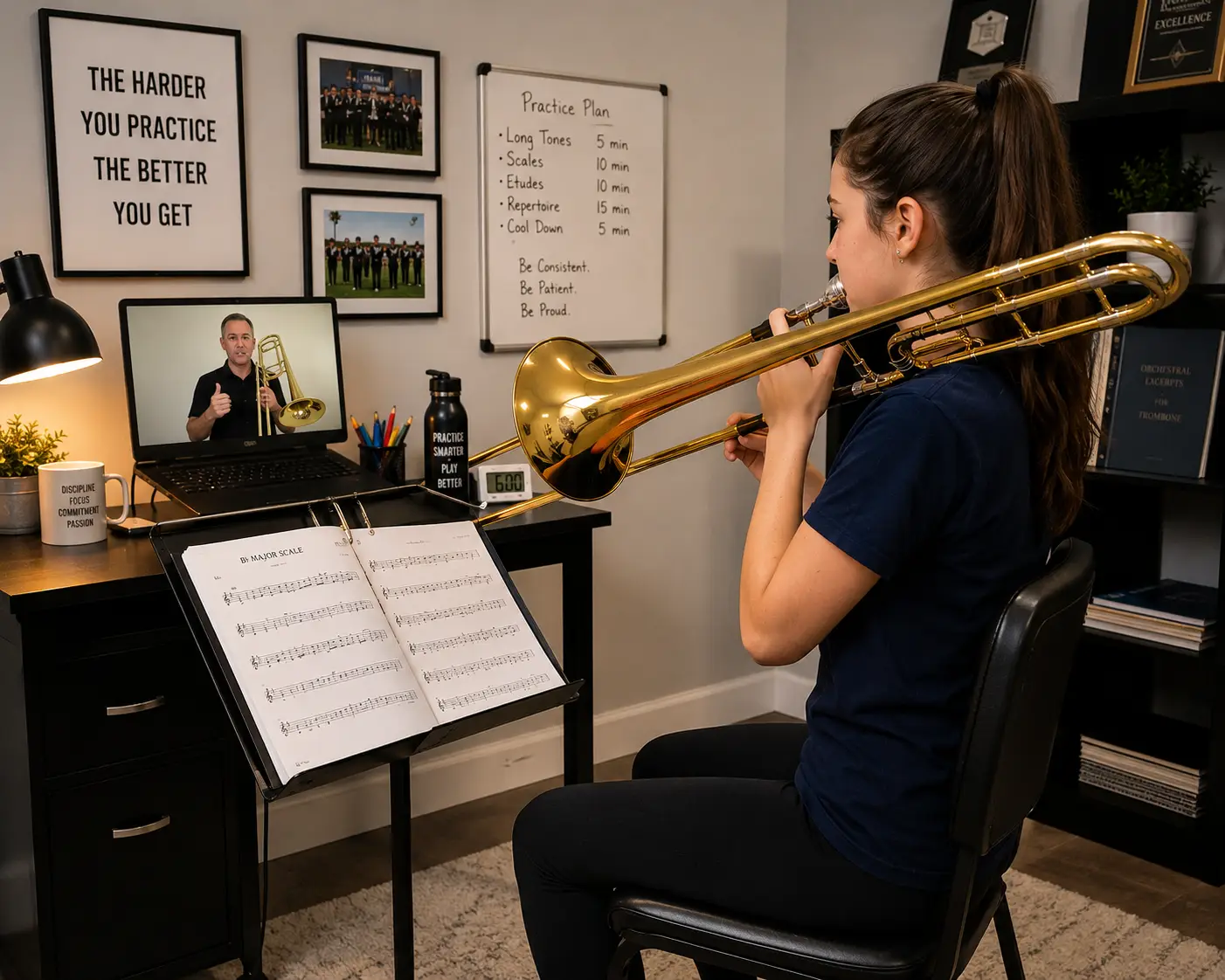
One of the biggest advantages of online trombone lessons is the opportunity to review what you learned after the lesson ends. It’s easy to forget an important tip or demonstration, especially when you’re focused on playing. Being able to revisit the lesson can make your practice sessions much more productive.
Before recording any lesson, always ask your instructor for permission. Every teacher has their own policy regarding lesson recordings, so it’s important to respect their preferences.
Why Recording Can Be Helpful
With your teacher’s permission, recording your lesson allows you to:
- Review difficult concepts at your own pace.
- Watch demonstrations more than once.
- Remember specific practice assignments.
- Reinforce proper technique and posture.
- Listen again to comments about tone, rhythm, or articulation.
- Track your improvement over time.
Many students discover details during a second viewing that they missed during the live lesson.
Recordings Are a Supplement—Not a Substitute
While lesson recordings can be a valuable learning tool, they shouldn’t replace active participation during your lesson. Continue to listen carefully, ask questions, and take notes while your teacher is explaining new concepts.
Think of a recording as a study guide rather than a replacement for paying attention in real time.
Use Recordings to Improve Your Practice
Instead of watching an entire lesson from beginning to end each time, try reviewing only the sections related to your current practice goals. For example, if you’re working on improving your articulation or learning a new scale, go back to that specific portion of the lesson and compare your playing with your teacher’s demonstration.
You might even keep a notebook nearby and write down new observations each time you review a recording. As your understanding grows, you’ll often notice details that weren’t obvious during the lesson itself.
Respect Your Teacher’s Recording Policy
Some instructors encourage lesson recordings, while others may have limitations based on privacy, copyright, or personal teaching policies. If recording is permitted, ask how the recording should be used and whether there are any restrictions on sharing or storing it.
In general, lesson recordings should be used only for your personal study and review. They should not be shared online or distributed to others without your instructor’s explicit permission.
Be Ready to Learn-Not to Be Perfect
Many students worry about making mistakes during their first lesson.
The truth is that mistakes are expected.
Your instructor isn’t looking for perfection.
Instead, they’re asking questions like:
- What are this student’s strengths?
- What habits need improvement?
- How can I help this student progress?
Every accomplished trombonist started as a beginner.
Making mistakes is simply part of learning.
Prepare a Few Questions
Online lessons are personal, which means you can ask questions throughout the lesson.
Some common questions include:
- How should I practice?
- Why does my tone sound airy?
- How can I improve my high range?
- Why do I miss certain notes?
- Which method book should I use?
- What warm-ups should I practice?
- How much should I practice each day?
Your instructor wants you to ask questions.
Often, the best lessons become conversations rather than lectures.
Parents: How You Can Help Younger Students
Parents play an important role, especially during the first lesson.
You can help by:
- Setting up the technology
- Making sure the lesson area is quiet
- Having music and supplies ready
- Helping younger students log in
After everything is set up, it’s usually best to let your child interact directly with the teacher. This helps build confidence and independence.
What Happens After the Lesson?
The learning doesn’t stop when the lesson ends.
After your lesson:
- Review your assignment.
- Organize your music.
- Write down practice reminders.
- Schedule daily practice time.
- Make note of questions for next week.
Consistent practice between lessons leads to the greatest improvement.
Read my article on: How to Practice Trombone: A Beginner Routine That Actually Works
Common Mistakes to Avoid
Many first-time students make the same simple mistakes.
Avoid these common problems:
- Waiting until lesson time to assemble your trombone
- Forgetting your music
- Having poor lighting
- Pointing the camera at the ceiling
- Practicing in a noisy room
- Skipping your warm-up
- Logging in late
- Forgetting a pencil
Most of these issues can be prevented with just a few minutes of preparation.
First Online Trombone Checklist
When learning how to prepare for your first online trombone lesson make sure you’ve completed this checklist:
Trombone assembled ☐
Mouthpiece cleaned ☐
Music stand ready ☐
Lesson music available ☐
Pencil nearby ☐
Notebook ready ☐
Water bottle filled ☐
Tuner available ☐
Metronome available ☐
Camera positioned correctly ☐
Microphone tested ☐
Internet connection checked ☐
Warm-up completed ☐
Logged in five minutes early ☐
Frequently Asked Questions
Do I need expensive equipment?
No. Most students can begin with a computer, tablet, or laptop that has a webcam and microphone, along with a reliable internet connection.
What if I make mistakes?
Mistakes are a normal part of learning. Your instructor expects them and will use them as teaching opportunities.
How early should I log in?
Aim to log in about five minutes before your scheduled lesson to test your audio and video.
Can complete beginners take online trombone lessons?
Absolutely. Online private lessons are an excellent way for beginners to develop proper fundamentals from the very beginning.
What if my internet disconnects?
Occasional technical issues happen. Most instructors simply reconnect and continue the lesson where it left off.
Final Thoughts
Learning how to prepare for your first online trombone lesson doesn’t require expensive equipment or advanced musical skills. With a little planning, you’ll create an environment where you can focus on learning, ask questions, and enjoy making music.
Remember, your first lesson is about getting to know your instructor, establishing goals, and beginning a personalized learning journey. Whether your goal is to make your school band, prepare for auditions, return to playing after many years, or simply learn a new instrument, online lessons provide expert guidance tailored to your needs.
The better prepared you are before the lesson begins, the more confident you’ll feel—and the more enjoyable your first experience will be.
Ready to Begin Your Trombone Journey?
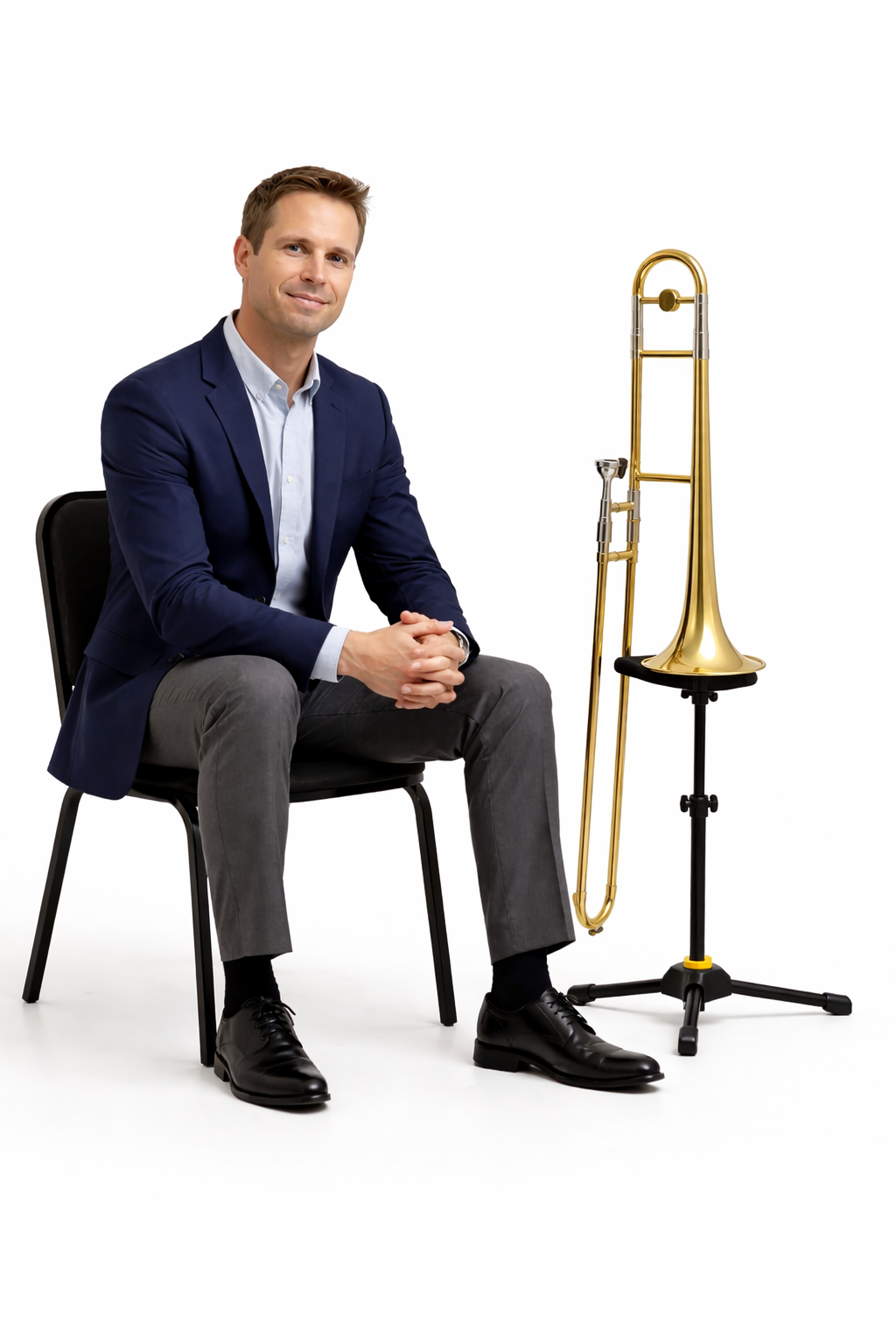
Whether you’re a beginner picking up the trombone for the first time, a student preparing for auditions, or an adult returning to the instrument, personalized instruction can help you reach your goals faster.
At The Trombone Mentor, every online lesson is tailored to your experience level, learning style, and musical interests. With over 40 years of teaching experience, you’ll receive patient, encouraging instruction designed to help you build confidence and enjoy making music.
Schedule your first online trombone lesson today and discover how convenient, engaging, and effective learning from home can be.
ONLINE TROMBONE LESSONS – Learn Anywhere with a Private Trombone Teacher
About the Author
Rick Lawrence is a music educator, conductor, professional trombonist, and private instructor with more than 40 years of playing and teaching experience. He has performed with orchestras, jazz ensembles, brass bands, and pit orchestras, and studied with John Coffey of the Boston Symphony Orchestra, Donald Knaub of the University of Texas, and Edward J. Madden, composer, arranger, trombonist.
Through The Trombone Mentor website, Rick provides online trombone lessons and educational resources for beginner, intermediate, and advanced trombonists.