
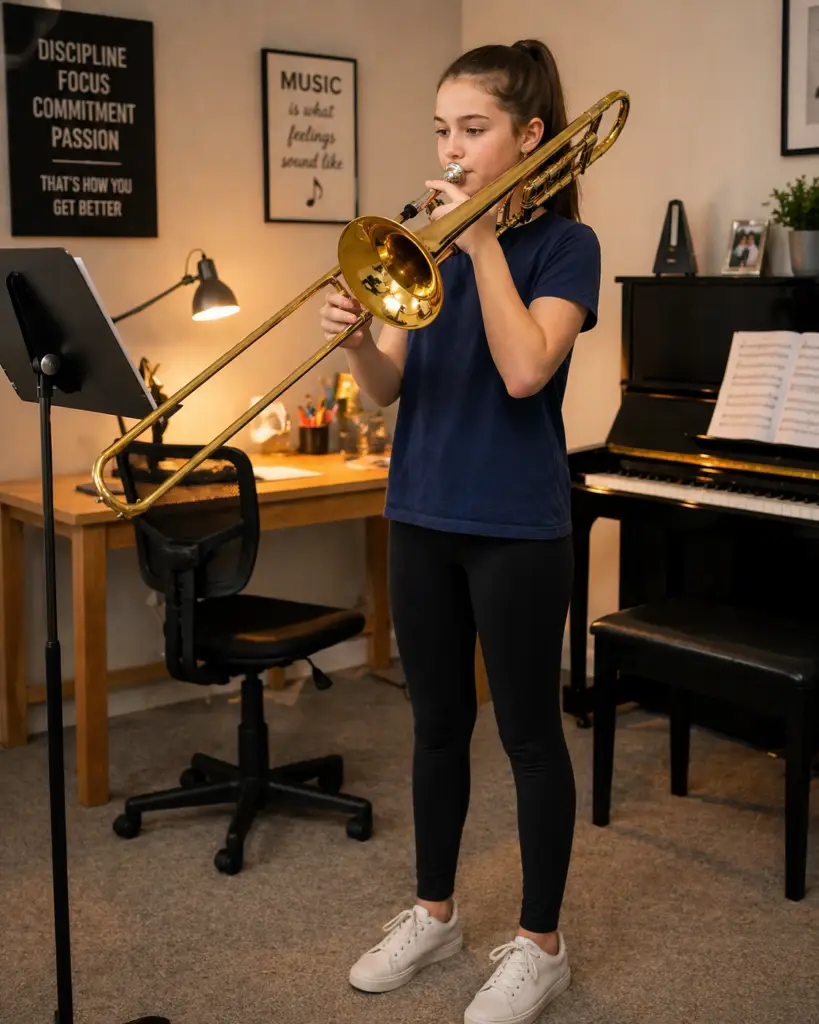
Practicing trombone in high school is about more than simply finding time to play your instrument. As your music becomes more challenging, you also need to become more intentional about how you use your practice time.
You may be balancing schoolwork, rehearsals, sports, activities, friends, and family responsibilities. Finding time to practice isn’t always easy. When you do sit down with your trombone, you want that time to count.
The good news is that you don’t need to practice for hours every day to make progress. A focused, well-planned practice session can accomplish a great deal—even when you only have 30 minutes.
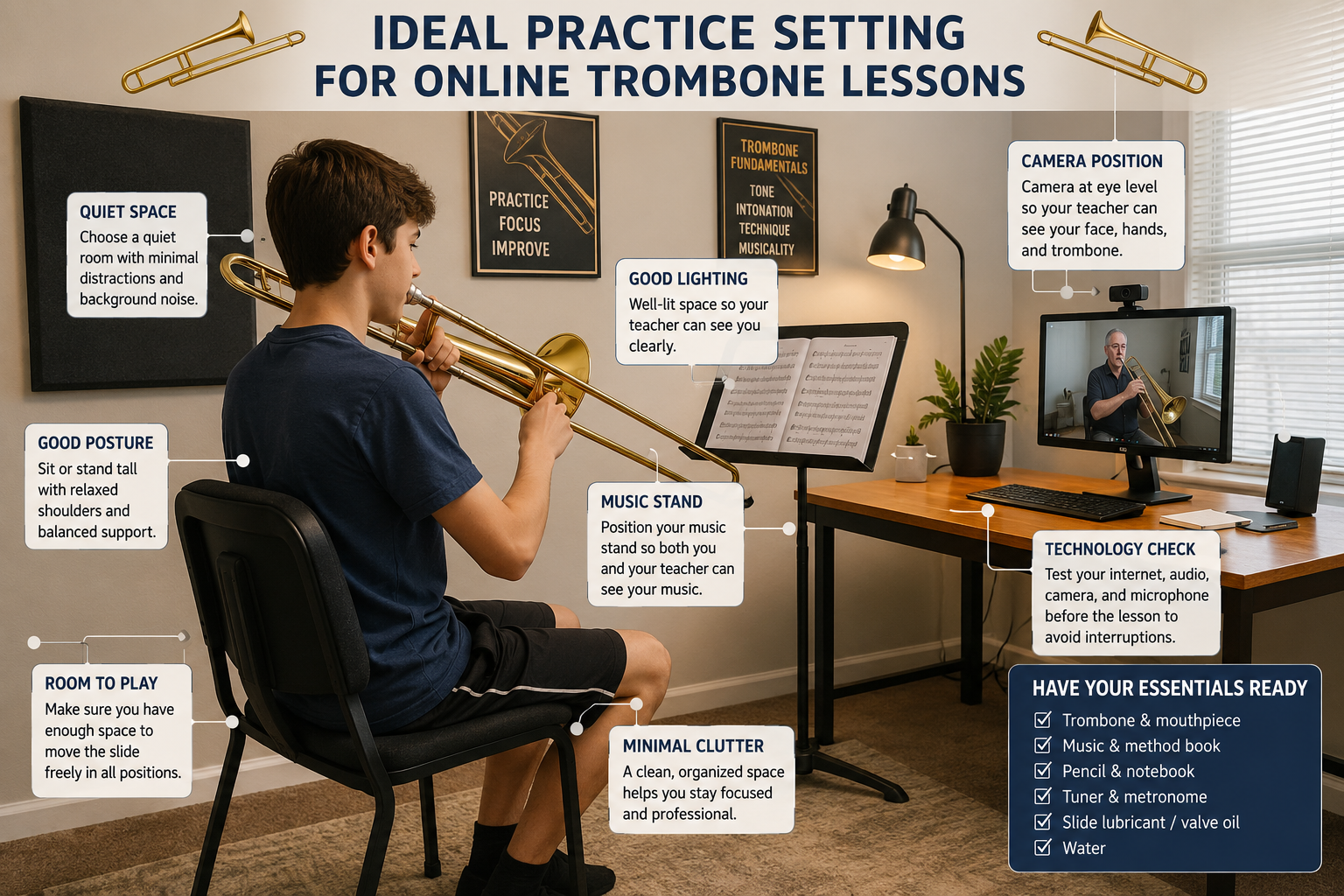
Along with this guide, is a companion article – Trombone Practice: How to Set Up the Perfect Practice Space I highly recommend you read this one.
In this guide, you will learn how to practice your trombone using a few of my favorite formulas. By the end of this aticle you will be able to practice with a purpose and create a plan to become a better trombonist.
Let’s get started!
Disclaimer
Some of the links below are affiliate links. The Trombone Mentor participates in the Amazon Services LLC Associates Program. What this means, is that at no cost to you, if you click on a link and follow through with a purchase, this site may earn a small commission.
The Mindset of a Dedicated Trombone Student
As a high school trombone player, your goals may include improving your tone, range, flexibility, articulation, and technique. You may also want to perform better in your school ensemble, prepare a solo, audition for an honor band, or simply become more confident on your instrument.
Whatever your goals, effective practice begins with an important question:
What do I want to accomplish with the time I have?
That question shifts your thinking from simply spending time practicing to using your practice time to improve. And that’s where mindset comes into the picture.
There is a difference between playing the trombone and practicing the trombone.
Playing can be fun. You play through your music, play along with your favorite songs, or enjoy making music with your friends.
Practicing is different.
Practicing means identifying something that needs improvement and deliberately working on it.
If you really want to become a better trombone player, you have to take some responsibility for your own improvement.
That doesn’t mean you have to practice for hours every day.
It means that when you practice, you have a reason for being there.
A dedicated trombone student asks questions such as:
- What do I need to improve?
- What am I having trouble with?
- Why am I making this mistake?
- What can I do differently?
- Am I listening carefully to my sound?
- Am I practicing slowly enough to play this correctly?
- What do I want to accomplish today?
This is the mindset that turns practice time into improvement.
Learn More: How to Play a Trombone: Beginner Step-by-Step Guide
You Don’t Have to Love Every Practice Session
Being dedicated doesn’t mean that you’re going to feel motivated every single day.
There will be days when you are tired from school. There will be days when you would rather do something else. That’s normal.
The important thing is developing the habit of practicing even when you aren’t particularly excited about it.
Motivation can get you started. Consistency is what helps you improve.
The High School Trombone Practice Formula
So, how much should you practice?
There isn’t one magic number that applies to every high school trombone player.
Instead of thinking:
“How long do I have to practice?”
Try thinking:
“What can I accomplish with the time I have?”
Here’s a simple formula to remember:
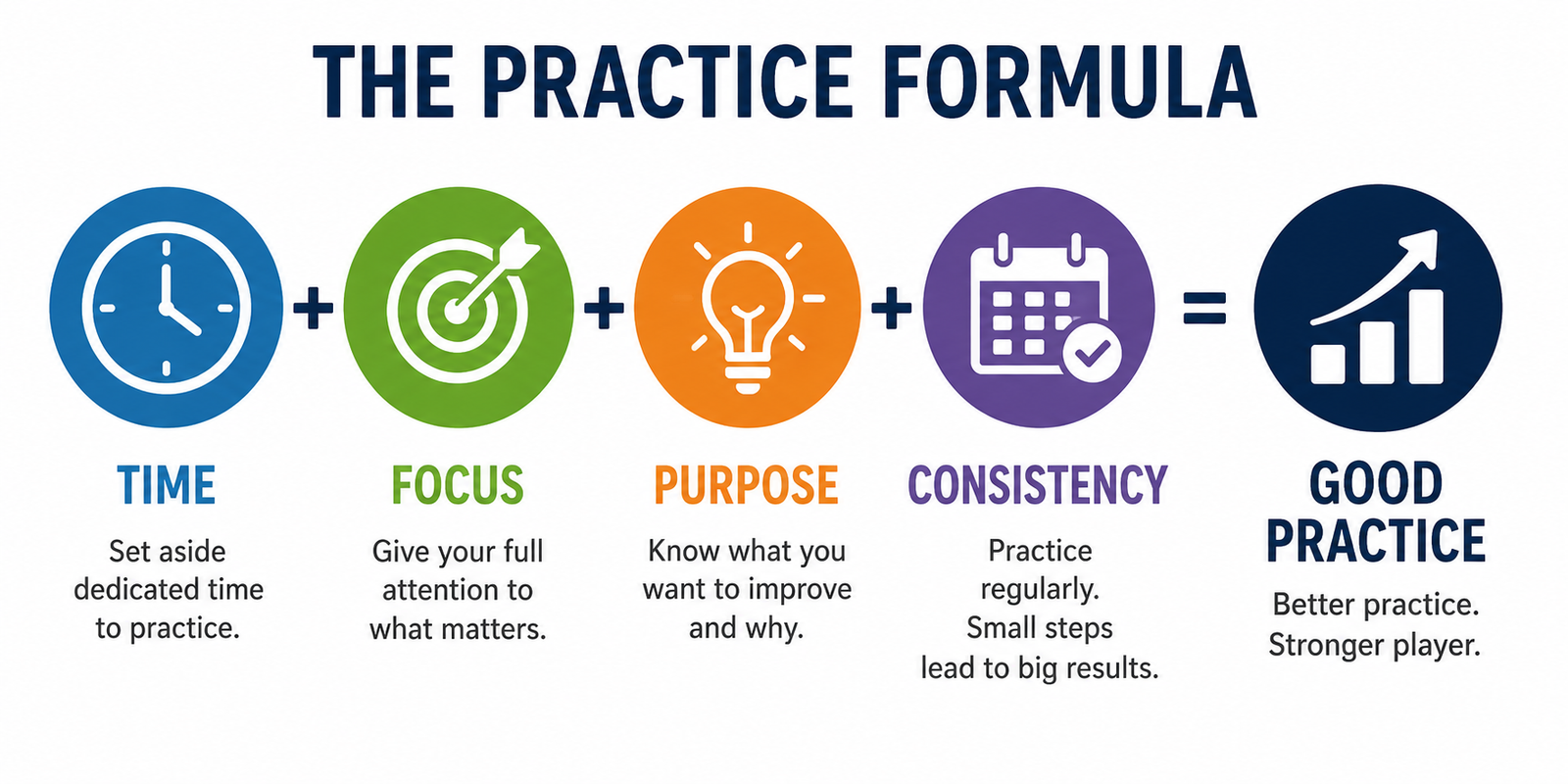
The amount of time matters, but the other three factors matter just as much.
You can practice for 60 minutes while distracted and accomplish very little.
You can practice for 30 focused minutes and make meaningful progress.
Your 30-Minute Trombone Practice Session
Thirty minutes may not sound like a lot of time, but you can accomplish quite a bit if you stay focused.
30-Minute Formula:
- 5 minutes — Warm-up
- 5 minutes — Tone and flexibility
- 5 minutes — Scales and technique
- 10 minutes — Band, orchestra, solo, or audition music
- 5 minutes — Work on one specific problem
Your goal isn’t to cover everything.
The goal is to identify what matters most and work on it.
Learn More: How to Practice Trombone: A Beginner Routine That Actually Works
Your 45-Minute Practice Session
Forty-five minutes gives you enough time to work on fundamentals while also spending meaningful time on your music.
45-Minute Formula:
- 5 minutes — Warm-up
- 10 minutes — Tone and flexibility
- 10 minutes — Scales, technique, and articulation
- 15 minutes — Band, orchestra, solo, or audition music
- 5 minutes — Sight-reading or a specific problem area
This is an excellent practice length for a student who wants a balanced daily routine.
Your 60-Minute Practice Session
If you have an hour available, you can go deeper into your playing.
60-Minute Formula:
- 10 minutes — Warm-up and long tones
- 10 minutes — Flexibility and lip slurs
- 10 minutes — Scales, technique, and articulation
- 15 minutes — Band or orchestra music
- 10 minutes — Solo or audition preparation
- 5 minutes — Sight-reading or targeted improvement
You don’t have to follow these numbers exactly.
Think of them as a framework.
If you have an important audition coming up, for example, you may want to spend more time on audition music and less time on sight-reading.
Set a Goal Before You Start Practicing
One of the easiest ways to improve your practice is to decide what you’re going to accomplish before you start playing.
Instead of:
“I’m going to practice trombone for 45 minutes.”
Try:
“I’m going to practice for 45 minutes and improve the difficult 8-measure passage in my audition music.”
That’s a much more useful goal.
Your practice session now has a purpose.
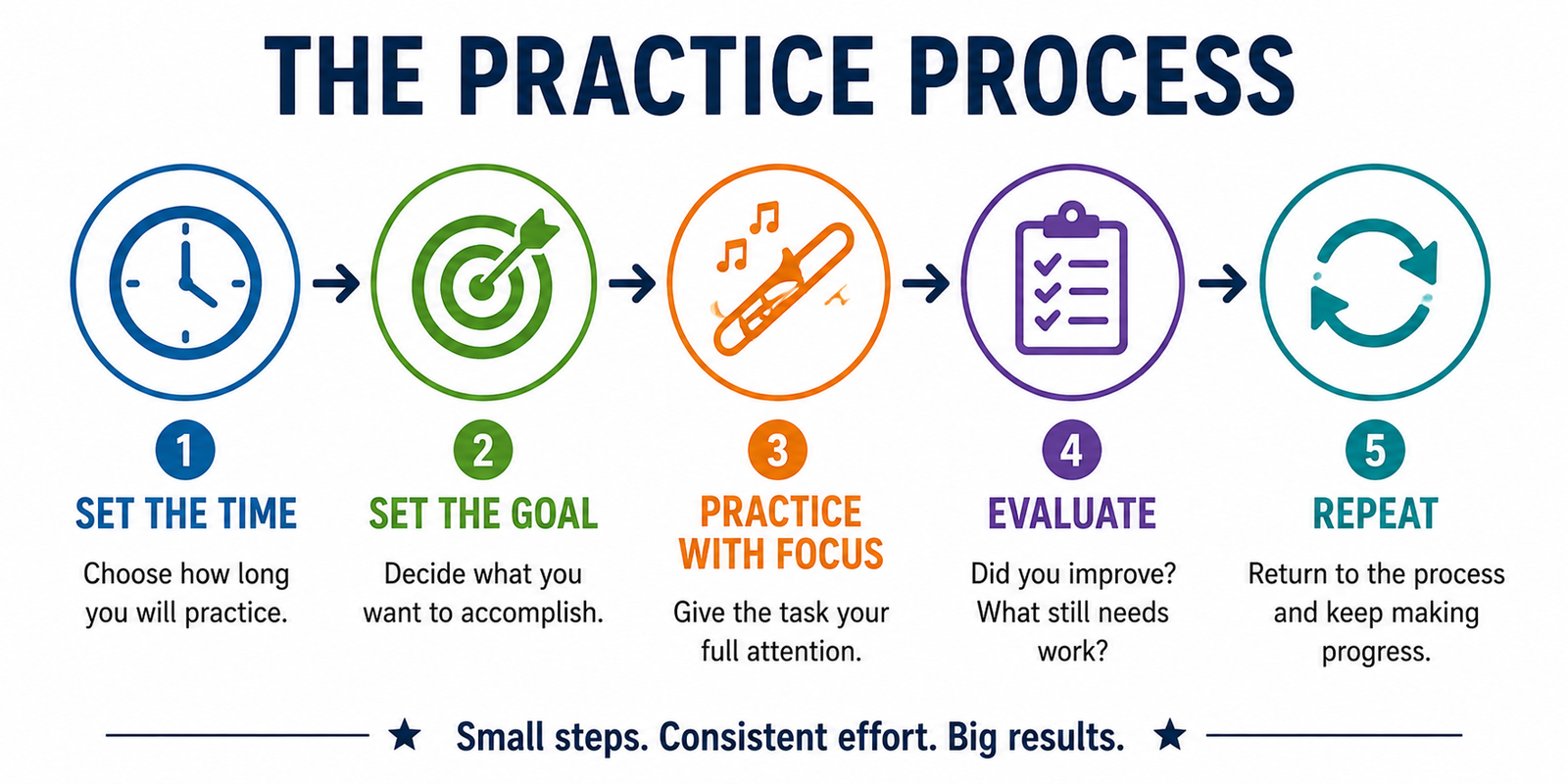
Try This Five-Step Practice Process
1. Set the time.
Decide whether you’re practicing for 30, 45, or 60 minutes.
2. Set the goal.
Identify what you want to accomplish.
3. Practice with focus.
Give the task your full attention.
4. Evaluate.
Did you improve? What still needs work?
5. Repeat.
Return to the problem during your next practice session.
This is how a practice routine becomes a practice plan.
Start With a Proper Warm-Up
Don’t pick up your trombone and immediately attack the hardest piece in your folder.
Your body and your instrument need time to get ready.
A warm-up might include:
- Breathing exercises
- Buzzing on the mouthpiece
- Easy sustained long tones
- Gentle lip slurs
- Simple scales
- Easy articulation
The purpose of your warm-up is not to see how high, low, loud, or fast you can play.
The purpose is to prepare your playing.
Listen to your sound from the very beginning.
LEARN MORE: The Best Warm-Up Routine for Trombone Players
Develop a Good Trombone Tone
Your tone on the trombone is your musical signature. It is the one thing that identifies you as a trombonist. Therefore, you must give it a great deal of attention. A good trombone tone is developed by playing long tones.
Long tones can help you develop greater awareness of:
- Air support
- Pitch
- Attacks
- Releases
- Consistency
Choose comfortable notes and concentrate on producing a beautiful, steady tone.
Don’t simply hold a note until you run out of air.
Listen while you play.
Ask yourself:
“Is this the sound I want?”
That question is part of becoming a mature musician.
Work on Flexibility
Flexibility exercises and lip slurs help develop smooth movement between notes and partials.
Start in a comfortable register and use exercises appropriate for your current ability.
Keep the air moving and avoid forcing the notes.
If you have to strain to complete an exercise, you’re probably trying to do too much.
The goal is:
Smooth + Relaxed + Controlled + Good Sound
Not:
Higher + Faster + Harder
Practicing Trombone Scales
Scales are fundamental to becoming a good trombone player.
They help develop:
- Slide accuracy
- Pitch awareness
- Air control
- Articulation
- Technique
- Knowledge of key signatures
Don’t simply race through your scales every day.
Change how you practice them.
Try:
- Slurring
- Tonguing
- Different rhythmic patterns
- Different tempos
- A metronome
- Different dynamics
- Arpeggios
And don’t forget to listen.
A scale played accurately but with poor tone, uneven rhythm, or inconsistent articulation still needs work.
Learn More: Major Scales for Trombone: A Complete Practice Guide
Practice Articulations
There are many different types of articulation in music. Think of articulation as the pronunciation of music. Just as we use pronunciation to speak words clearly, trombonists use articulation to play notes clearly and with the correct musical character.
Learning to articulate notes cleanly and consistently is an important part of becoming a good trombone player.
For example, you may see a dot (.) above or below a series of notes. These are staccato markings, which tell you to play the notes short, light, and separated.
At the other end of the spectrum, you may see a short line (—) above or below a note. This is a tenuto marking, which generally indicates that the note should be played fully and sustained for its intended value, with a smooth, supported sound.
As you practice articulation, don’t concentrate only on moving your tongue quickly. Think about how each note begins, how long it lasts, and how it connects—or doesn’t connect—to the next note.
Clean articulation helps your music speak clearly. Just like good pronunciation makes spoken language easier to understand, good articulation makes your trombone playing easier to understand and more musical.
Develop Your Range Carefully
High school students often become very interested in range.
That’s understandable.
However, constantly forcing high notes is not a good way to develop your upper register.
Good range is built on good fundamentals:
- Air support
- Efficient breathing
- A healthy embouchure
- Relaxation
- Flexibility
- Good tone
Work gradually.
Don’t turn every practice session into a test of how high you can play.
Your goal should be to develop a usable, musical range.
Practice Your Ensemble Music
Your band, orchestra, or jazz music should be an important part of your practice.
Don’t simply play the piece from beginning to end.
Find the sections that give you trouble.
Mark (with a pencil):
- Difficult rhythms
- High notes
- Low notes
- Slide movement
- Articulation
- Dynamics
- Long phrases
- Key changes
Then isolate those sections.
Sometimes four measures of focused practice can accomplish more than playing an entire piece five times.
Slow Down Difficult Music
One of the most important practice skills you can learn is how to slow down.
If you repeatedly play a difficult passage incorrectly, you’re practicing the mistake.
Instead:
- Identify the problem.
- Slow the tempo down.
- Break the passage into smaller sections.
- Play it correctly.
- Repeat it.
- Gradually increase the tempo.
- Stop and correct mistakes when they return.
A metronome/tuner can be extremely useful here.
Don’t practice mistakes at full speed.
Practice the correct version slowly, then build speed.
Practice for Auditions and Solo Pieces
High school students often have periods when their practice needs to become more specialized.
An upcoming audition might require additional work on:
- Scales
- Sight-reading
- Range
- Articulation
- Solo repertoire
- Excerpts
- Musical expression
Don’t wait until the week before an audition to begin serious preparation.
Give yourself time to make mistakes, solve problems, and build confidence.
For more information, see our guide to Trombone Auditions.
Include Sight-Reading
Sight-reading is an important skill for serious high school musicians.
You may encounter it during:
- Band auditions
- Honor band auditions
- College auditions
- Ensemble placement
- Festivals
- Private lessons
Spend a few minutes sight-reading several times each week.
Before you begin, quickly identify:
- Key signature
- Time signature
- Tempo
- Dynamics
- Articulations
- Repeated patterns
- Difficult rhythms
Then play.
Don’t stop every time you make a mistake.
Sight-reading is about keeping the music moving while making good musical decisions.
Don’t Practice Everything Every Day
Your practice priorities should change.
If you have a concert next week, your ensemble music may deserve more time.
An audition might be coming up, audition material should become a priority.
If your teacher identifies a problem with your articulation, you may need to spend additional time addressing it.
Think of your practice session as a daily plan for improvement.
You don’t need to check every box every day.
You need to work on what matters most right now.
The Most Important Practice Skill: Listening
You can’t improve what you don’t recognize. Remember the following saying and you will be a better trombone player for it. “We Hear With Our Ears, But We Listen With Our Brain”.
Learn to listen critically to yourself.
While you’re practicing, ask:
- Is my tone consistent?
- Is my pitch accurate?
- Are my attacks clean?
- Is my rhythm steady?
- Are my slide movements accurate?
- Am I using enough air?
- Are my dynamics clear?
- Am I playing musically?
Sometimes the most important thing you can do is stop playing and listen to what just happened.
Recording yourself can also be extremely valuable.
What sounds fine while you’re playing may sound very different when you listen back.
Common Practice Mistakes
Practicing Without a Plan
If you pick up your trombone without knowing what you’re trying to accomplish, it’s easy to waste your practice time.
Playing Through Everything
Playing an entire piece repeatedly isn’t necessarily productive.
Identify the difficult sections and work on them.
Always Playing Too Fast
If you can’t play it correctly slowly, you probably won’t magically play it correctly fast.
Practicing Only What You Like
It’s easy to practice the things you’re already good at.
Improvement usually comes from working on your weaknesses.
Repeating Mistakes
If you make the same mistake ten times, don’t simply play it an eleventh time.
Stop.
Figure out why it’s happening.
Then fix it.
Practicing While Distracted
Your phone, television, social media, and other distractions can quickly turn a focused practice session into an unfocused one.
Put the distractions away.
Your practice time is your time to improve.
What If You Don’t Feel Like Practicing?
This is where mindset becomes important.
You aren’t going to feel motivated every day.
That’s true for beginners, high school students, college musicians, and professional musicians.
The goal isn’t to wait until you feel inspired.
The goal is to develop the habit of showing up.
You can tell yourself:
“I don’t have to practice for three hours. I just need to give the next 30 minutes my full attention.”
Once you begin, you may find that your motivation returns.
And even if it doesn’t, you’ve still strengthened the habit of being a dedicated musician.
How Do You Know If You Are Improving?
Improvement can be difficult to notice from one day to the next.
Instead, look for small victories.
Can you:
- Play a difficult passage more accurately?
- Play it at a faster tempo?
- Produce a better sound?
- Play a scale more smoothly?
- Articulate more clearly?
- Play a difficult note more comfortably?
- Maintain better pitch?
- Play longer phrases?
- Perform with greater confidence?
These small improvements add up.
Consider keeping a simple practice journal.
Write down:
What did I practice?
Do you improved?
The areas that still need work?
What will I work on tomorrow?
This turns practice into an ongoing process rather than an isolated activity.
Your Practice Time Is an Investment
Think about your practice time differently.
Thirty minutes isn’t simply 30 minutes spent playing trombone.
It’s an investment in the player you want to become.
If you consistently use those 30 minutes with focus and purpose, you will eventually hear the difference.
The same is true of 45 or 60 minutes.
The important question isn’t:
“Did I practice long enough?”
The better question is:
“Did I use my practice time well?”
Final Thoughts
Becoming a good trombone player doesn’t happen simply because you own a good instrument, play difficult music, or spend a certain number of minutes practicing. It happens when you decide that becoming a better player matters to you—and commit to practicing trombone with a plan, purpose, focus, and consistency.
Some days you’ll have 30 minutes.
Other days you’ll have 45 minutes.
Some days you’ll have an hour.
Use the time you have.
Set a goal. Focus. Listen. Correct your mistakes. Keep improving.
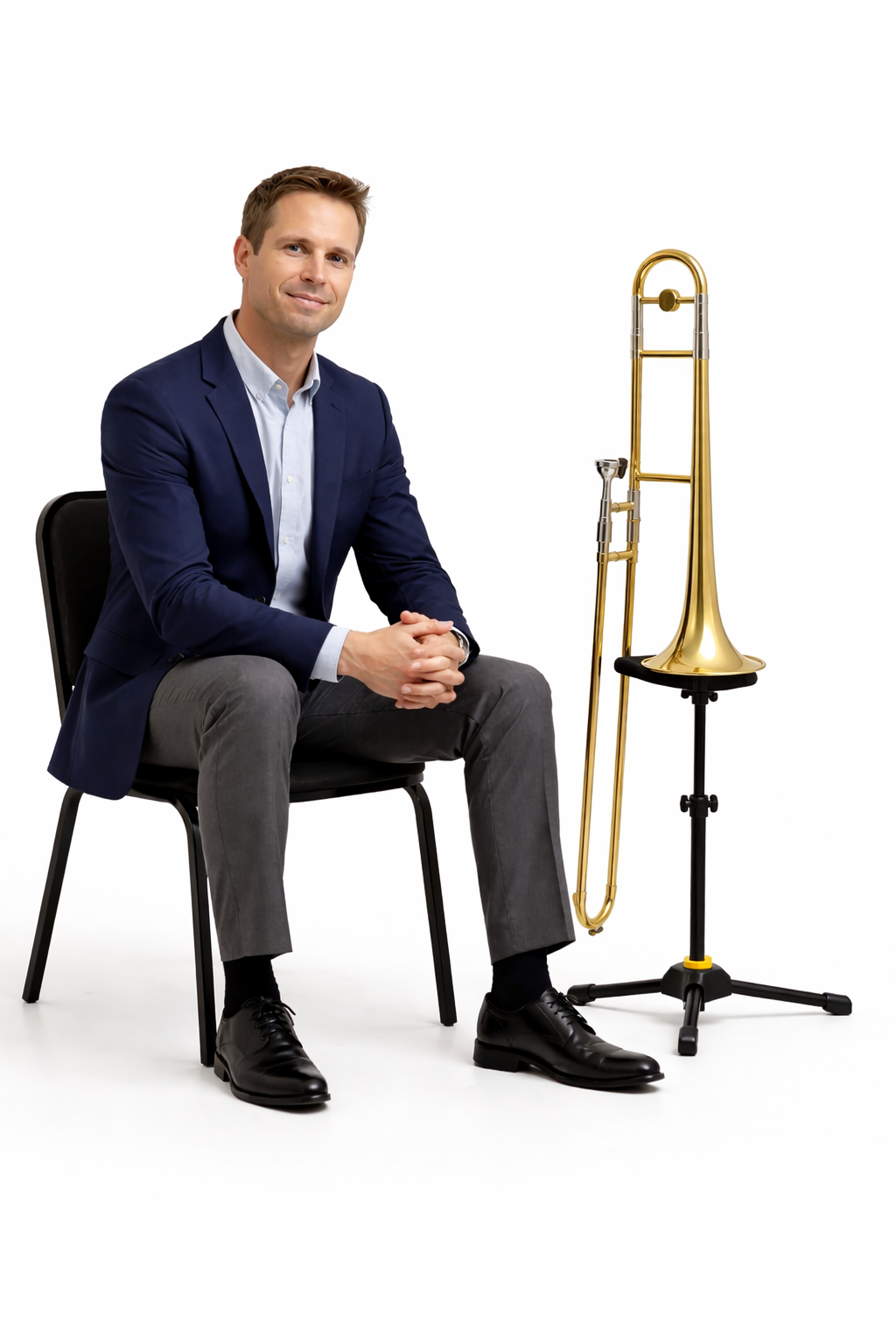
Ready to Take Your Trombone Playing to the Next Level?
Whether you are just starting trombone or looking to strengthen your tone, technique, and musical confidence, private lessons can help you progress faster with clear guidance and personal support.
With The Trombone Mentor, you receive:
• Step-by-step instruction
• Customized practice plans
• Expert feedback and encouragement
• Online lessons you can take from anywhere
Stop guessing and start making steady progress with lessons designed around your goals.
ONLINE TROMBONE LESSONS – Learn Anywhere with a Private Trombone Teacher
About the Author
Rick Lawrence is a music educator, conductor, professional trombonist, and private instructor with more than 40 years of playing and teaching experience. He has performed with orchestras, jazz ensembles, brass bands, and pit orchestras, and studied with John Coffey of the Boston Symphony Orchestra, Donald Knaub of the University of Texas, and Edward J. Madden, composer, arranger, trombonist.
Through The Trombone Mentor website, Rick provides online trombone lessons and educational resources for beginner, intermediate, and advanced trombonists.